English
 Español
 Français
 Deutsch
 Italiano
 Português
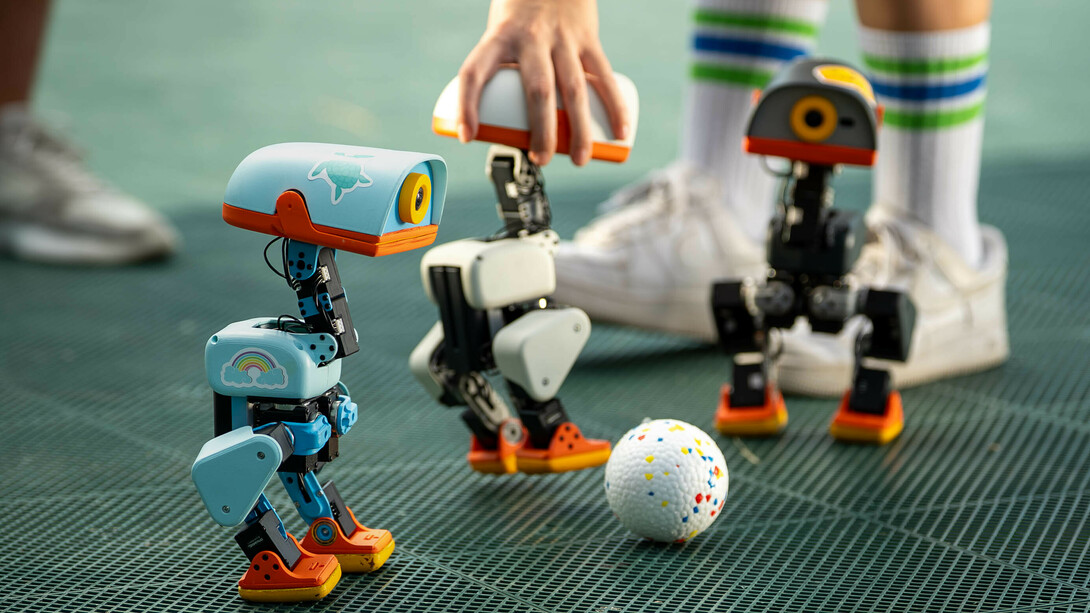
What makes Microduck special is how much it simplifies without sacrificing what matters. It is a tiny, 25-centimeter-tall bipedal duck robot that can walk, pick up objects, recover from falls, and learn new movements through reinforcement learning. Beyond the innovation, the best part is that its creators have opened up the software repository, allowing it to be completely open source, giving developers, researchers, students, and curious builders the opportunity to experiment with how robots learn to move.
Developed by French robotics company Pollen Robotics, acquired by Hugging Face in April 2025, Microduck is an unusually approachable entry point into advanced robotics. It combines playful industrial design with a serious technical foundation—and makes that foundation accessible for the community to build on: training reinforcement learning (RL) for the next generation of robotics.
Small robot, serious engineering
At first glance, Microduck looks more like a robot pet toy than a sophisticated robotics platform. Beneath its playful exterior, however, sits a compact system designed for physical AI research and experimentation.
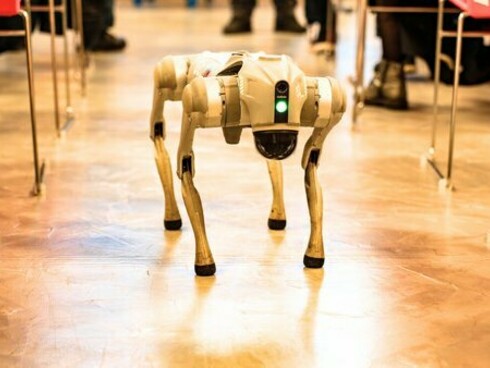
The robot stands approximately 25 centimeters tall, weighs around 780 grams, and has 15 motors controlling its articulated body. It features a front-facing camera, an 8 × 8 time-of-flight depth sensor, two inertial measurement units (IMUs), and an articulated beak that can grasp small objects. Its onboard control system runs learned movement policies at 50 Hz, or 50 control cycles per second. (Pollen Robotics — Microduck specifications1)
Much like a young animal learning to interact with the world around it, Microduck can walk, sit, stand up, kick a ball, grasp objects, and recover from many common falls. Optional roller-skate attachments introduce another form of movement. Seven trained behaviors are available out of the box, so owners can start playing with the robot before writing a single line of code.
These are not simply pre-programmed animations. Microduck uses neural-network-based control policies that translate information about the robot's state and task into physical movements. The project is designed not just to demonstrate what a robot can do, but to let people explore how those capabilities can be developed, modified, and improved. (Official Microduck GitHub repository2)
Microduck's core workflow connects three stages:
1. Train in simulation
Developers begin with a virtual version of Microduck inside a physics simulator. Using reinforcement learning, they can train the robot to walk, balance, or attempt other movements without repeatedly testing every failed attempt on physical hardware.
The original training stack uses MuJoCo, a physics simulator, alongside Proximal Policy Optimization (PPO), a reinforcement-learning algorithm. The result is a learned policy: a neural network that maps observations of the robot's state to actions.
2. Deploy on the real robot
Once the policy performs well in simulation, developers can export it in ONNX format and deploy it on the physical Microduck.
The robot then uses the trained policy to control its motors and attempt the learned behavior in the real world. This is known as sim-to-real transfer—taking something learned in a virtual environment and making it work on an actual machine.
This is a deceptively difficult problem. Real-world friction, motor delays, mechanical tolerances, and uneven surfaces can all cause a policy to behave differently from how it performed in simulation.
3. Refine and retrain
This is where the process becomes particularly interesting. If the robot struggles with a movement, developers can adjust the simulation, training rewards, or model, then run another training cycle and deploy the improved policy.
In October 2026, a tutorial developed with NVIDIA contributors demonstrated another route using NVIDIA Isaac Lab and the Newton physics engine. It walks through training a Microduck walking policy, evaluating it in simulation, exporting it, and deploying it on the physical robot. The tutorial also explores rough-terrain locomotion and the potential for more advanced perception-based tasks.
Instead of studying locomotion only through research papers or expensive laboratory equipment, the Microduck project has made these techniques tangible.
Where hugging face fits in
Pollen Robotics was acquired by Hugging Face in April 2025. The French company had spent years developing open robotics platforms, including its Reachy robots. The acquisition brought its robotics expertise into a company already building a major ecosystem for open machine-learning models, datasets, and developer tools. (Hugging Face — acquisition announcement3)
Microduck is a natural fit for that direction.
Hugging Face has helped make AI models easier to discover, share, and adapt. Microduck applies a similar philosophy to robot behavior: make the software accessible, publish the training tools, and give people a way to exchange the models that make a machine move.
Pollen Robotics publishes Microduck's software under the Apache-2.0 license. Its public repositories include the robot's software, the reinforcement-learning training stack, and supporting documentation. Developers can inspect the code, modify existing behaviors, train new policies, and contribute improvements. (Official Microduck GitHub repository2)
One distinction is important: the software is open source, but the complete hardware design is not. At the end of the day, this is an open-source software platform built around a commercially produced robot.
Even with that limitation, the opportunities are substantial:
For developers: Experiment with control systems, robotics software, and neural-network policies on real hardware.
For students and educators: Connect programming, physics, machine learning, and engineering through a physical project.
For researchers: Explore locomotion, recovery, sim-to-real transfer, and other embodied-AI problems.
For hobbyists and makers: Build new behaviors, customize existing ones, and share results with other owners.
Imagine one developer experimenting with uneven terrain, and someone else creating a new game or coordinating several ducks to perform new tricks. Each contribution could become a starting point for the next. That is the beauty of open development: progress does not have to begin from zero every time.
Large humanoid robots can be expensive and difficult to experiment with outside dedicated laboratories. Microduck offers a different proposition: a small machine that can sit on your desk, be controlled with an included gamepad, and be retrained using software you can inspect and modify.
Its scale also makes it easy to imagine several robots being used together for races, ball games, or experiments in multi-robot behavior. Its small size, light weight, and approachable appearance make robotics less intimidating.
The duck's cute personality also gives people an immediate reason to engage with the machine. It makes a technically complex project feel approachable, even to people who have never worked with robotics before. That is part of what makes Microduck so effective; the playful design draws people in, and the open-source tools give them a reason to stay, experiment, and build something of their own.
The bigger idea
Microduck is an interesting case study in how a company can take complex technology and make it feel simple, playful, and accessible.
Behind its small, duck-shaped exterior sits a sophisticated training environment built around reinforcement learning, physics simulation, and neural-network control. Yet the experience feels approachable: a little robot that can walk, fall, recover, and learn new movements.
As developers, researchers, students, and hobbyists experiment with new behaviors and share what they learn, Microduck could become a platform for ideas its creators haven't even imagined yet—which is incredibly valuable for the next generation of both animaloid and humanoid robotics.
The project's sense of humor captures its playful spirit perfectly: “No duck was harmed in the making of this robot. Several were consulted.”
The duck is the entry point. The real opportunity is to use real-world interactions and community contributions to develop and improve the robots’ reinforcement-learning behaviors. And that is a much bigger idea than a robot that walks.
Notes
1 Microduck.
2 Pollen Robotics: Microduck.
3 Hugging Face to sell open-source robots thanks to Pollen Robotics acquisition.