English
 Español
 Français
 Deutsch
 Italiano
 Português
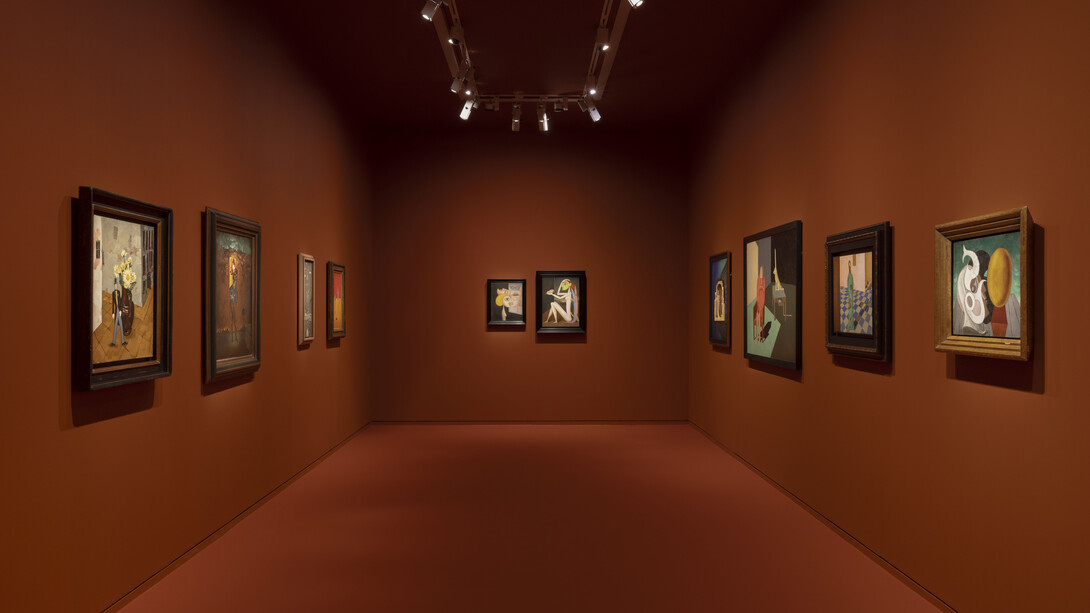
What does it mean to regard art as an adventure into the unknown? For Victor Brauner (1903–1966), one of the most singular figures of twentieth-century Surrealism, the answer lay in the possibility of transforming painting into a space where myth, autobiography, humour and magic could coexist. Victor Brauner: the magical adventure, presented at the Nouveau Musée National de Monaco’s Villa Paloma, offers an opportunity to explore the extraordinary imaginative universe of an artist whose work continues to resist definitive interpretation.
Rather than confining Brauner to the familiar narrative of Surrealism, the exhibition approaches his practice as an evolving system of correspondences. His Romanian origins, his early engagement with the avant- garde in Bucharest and his subsequent encounter with André Breton’s Surrealist circle in Paris all contributed to an artistic language in which images become vehicles for psychological exploration and symbolic transformation. Yet Brauner’s imagination cannot be reduced to the movement with which his name is most closely associated. His work draws upon esoteric traditions, German Romanticism, archaic civilisations and diverse mythologies, bringing these sources into a personal visual cosmology.
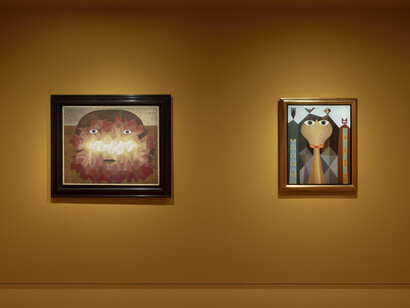
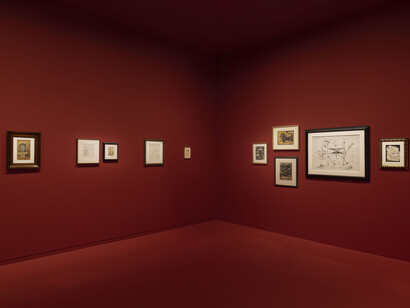
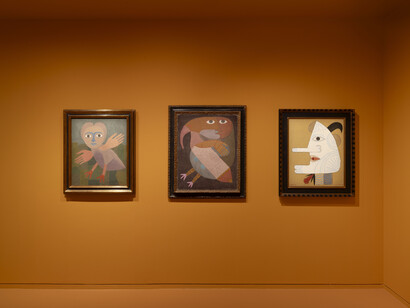
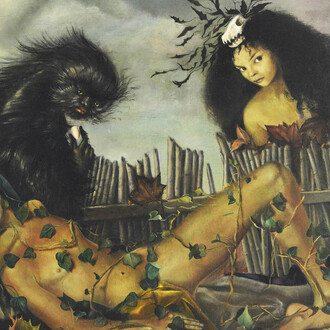
The exhibition’s particular strength lies in its presentation of a substantial private collection encompassing more than four decades of artistic production. Paintings, drawings, sculptures and objects reveal the extraordinary breadth of Brauner’s experimentation, allowing visitors to follow the development of an artistic vocabulary that moves between figuration and abstraction, the intimate and the universal, the recognisable and the inexplicable. The works do not simply represent a fantastic world; they seem to participate in its construction, as though each image were a fragment of a larger, perpetually unfinished mythology.
A particularly significant aspect of the exhibition is the dialogue between Brauner’s own creations and the non-Western objects he collected. These ten objects, presented alongside his work, open up questions about the relationships between artistic creation, collecting and the encounter with other cultural traditions. For Brauner, collecting was not merely an exercise in connoisseurship. It can be understood as another dimension of his search for correspondences between different systems of belief, symbolic forms and ways of imagining the world. The juxtaposition invites viewers to consider how objects acquire meaning through the relationships established around them, and how the act of collecting can itself become a creative gesture.
This dialogue also introduces a productive tension. The encounter between European Surrealism and non- Western artistic traditions inevitably raises questions about interpretation, cultural difference and the historical frameworks through which objects are understood. Rather than treating these objects simply as illustrations of an artist’s influences, their presence encourages a broader reflection on the ways in which visual languages travel, intersect and generate new meanings.
The exhibition’s title points towards another essential dimension of Brauner’s practice: the idea of art as an open-ended adventure. In 1941, the artist wrote that every drawing and discovery would be an extraordinary unknown place, and every painting an adventure. The statement offers more than an evocative description of his method. It suggests an understanding of artistic creation as a process of continual discovery, in which the image does not merely communicate an already established idea but makes possible an encounter with something previously unimagined.
Brauner’s commitment to this principle becomes particularly compelling when considered against the historical circumstances of his life. Like many artists displaced or threatened by the political catastrophes of twentieth-century Europe, he experienced the pressure of a world in which reality could become intolerable. His response was not an escape into fantasy in any simplistic sense, but the construction of alternative worlds capable of accommodating uncertainty, anxiety and transformation. Magic, in this context, becomes a means of confronting reality by expanding the possibilities through which it can be perceived.
At Villa Paloma, this understanding of art resonates with the very structure of the exhibition: a private collection made available to public interpretation, an artist’s personal universe opened to encounters with other imaginations. The result is an invitation to reconsider the relationship between artistic freedom and the desire to discover an underlying order within the apparent disorder of existence.
Ultimately, Victor Brauner: the magical adventure makes a persuasive case for the continuing relevance of an artist whose work occupies the territory between the visible and the unknowable. Its significance lies not only in the opportunity to encounter an extensive body of work, but also in the questions it raises about imagination, collecting and the transformative power of images. Brauner reminds us that art need not resolve the mysteries of the world to make them meaningful. Sometimes, its most radical achievement is to open a door onto the unknown—and to persuade us to cross the threshold.