English
 Español
 Français
 Deutsch
 Italiano
 Português
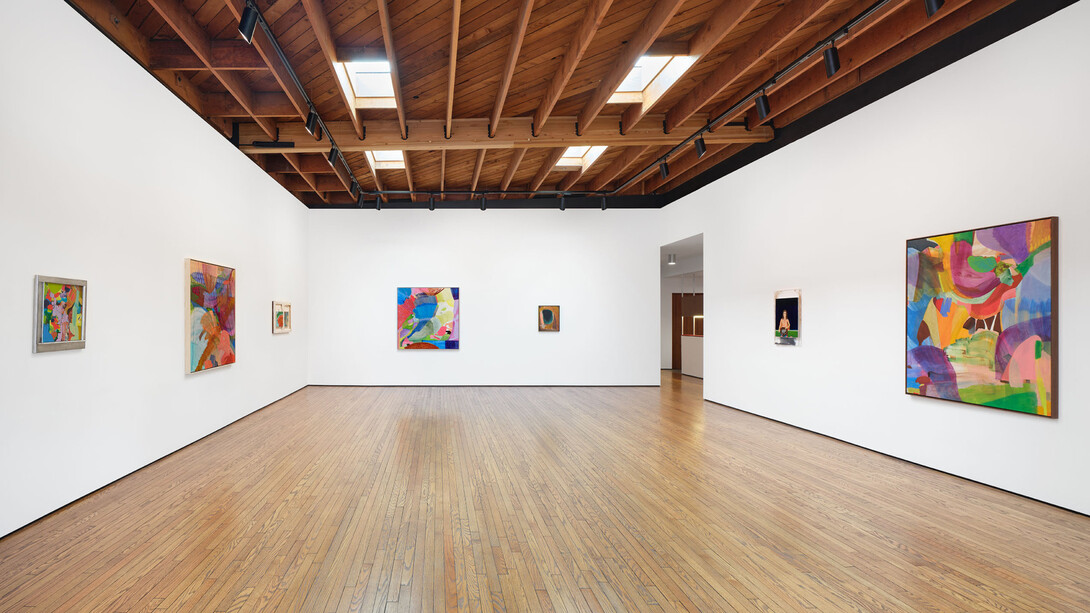
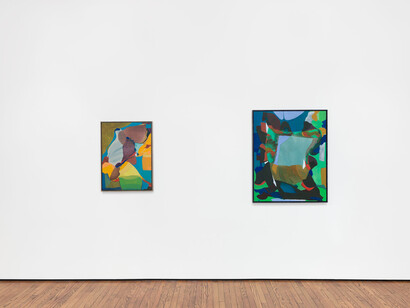
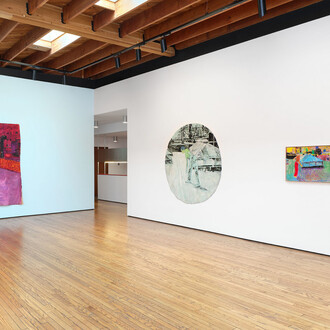
An arched portal stands against a beige ground, roughly smeared in thick strokes that leave the gesture upon the off-white canvas visible, trailing off. It rises in striations of blue, cantaloupe, lemon-lime, hunter, and grass-green bands, before culminating in a thin lavender keystone; a shape echoed in blue outline in the parasol below and the circumflex accent above. Where the portal leads is barely defined; instead, it is the structure itself that rises amid the unknown.
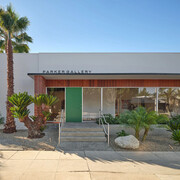
Marley Freeman draws the title for this signal work, and for a selection of others in her fourth solo exhibition at Parker Gallery, from cultural critic Joan Didion’s 2003 essay collection Where I was from. Didion’s groundbreaking writing on California here anchors, in part, the sediment of personal history, as she recalls her ancestors’ long westward crossing in the mid-nineteenth century, stone markers designating sites of temporary shelter along the way. Didion describes a photograph of a woman standing on a granite promontory in the Sierra Nevada circa 1905; this mineral landscape is legible to her, she says, through the specialized, if anachronistic, language she acquired from her grandfather, a miner.1 The photograph—like a painting—is a portal, situated at the threshold of generations and the worlds they do and don’t share in a landscape caught between enchantment and the coming disillusionment; between the promise of material comfort (the “good life”) and its mirror in a landscape ravaged by the irreversible, destructive forces of late capitalism, environmental collapse, and the breakdown of social infrastructure that continues unabated today.
There is a kind of continuum between Didion’s narrative and Freeman’s own story. Fast-forward to the 1980s and ’90s, when the wide expanses, vaunted vistas, and clear Southern California skies that graced the scenes of Didion’s culturalanthropological accounts had as though transmogrified: into ever-subdividing plots of land under a sky thick with pollution as emission laws were rolled back, as a youthful Freeman’s new home state (she was born in Massachusetts) became the ground for America’s powered-up war machine, incoming tech boom, and stalled life amid massive multi-sector layoffs. “I didn’t expect the book to take me home,” Freeman notes.
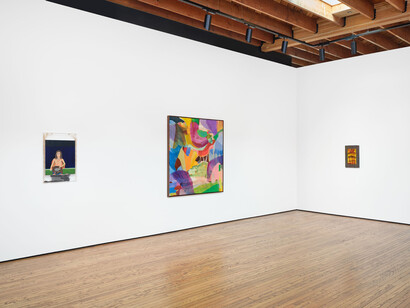
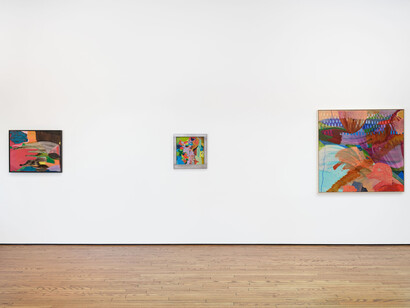
A painting might be one way to get somewhere—perhaps, to revisit home as a place (of the mind, of the cultural and literary imaginary, but also in all its materiality). In Freeman’s work, the unspoiled blank canvas often becomes an active surface upon which situatedness is never quite brought to a resting point (not a stone marker) despite the seeming resolution of a composition. Painting begins with “making a mess” and “getting anything down on the canvas” to have something to work against. Layers then accumulate, building up from an initial pour through drifting or more deliberate marks of varied opacities, creating passages. It’s worth recalling—if only to "work against"—the significance of the motif of the passage in modern painting: the frequent compression or collapse of spatial depth that occurs in the play of seemingly flat or three-dimensional planes, their ultimate rejection of a coherent perspectival space or unified pictorial surface.
For Freeman, this effect doesn’t arise through relative scale or shifts in plane-depth but rather through the intense activity of color, the distinctions and qualities of which produce dynamic and evocative formal relations. In federal cash subsidy (2026), for instance, a field of red protruding at lower left seems to literalize land-grab, as streaky black bands in the midground wipe out the composition’s topography (c.f. Didion describing the construction of the California railway, paid for by taxpayers’ money). In inhumanism and deep ecology, a blue green aperture holds at the center, encased in succeeding, color-washed rings occupied by encroaching, sinuous motifs. At the threshold described by Freeman’s colorism, forms frame what we see—how we might read an abstract composition that calls for vision beyond the human.
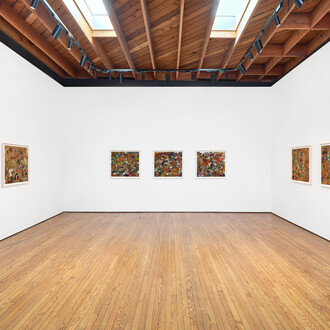
This last work’s titular reference to "inhumanism" is a call-back to environmentalist Robinson Jeffers (1937–1962), who left his native Pennsylvania and eventually lived in Carmel, California, where he would pen epic poems, and later, shorter verse, extolling a decentering of human concerns and solipsism in favor of the wholeness and beauty of the natural world. Seven works, dating from 2021 to 2026, take their titles from Jeffers’s poetry (wild muzzles, or crowded fish, or blasphemies of glow worms). They often seem to stage agonistic scenes in which loose, gestural marks impose themselves, or coexist uneasily, with their surrounds, or what came before. These paintings might, after some time and not always in a state of resolve, move from Freeman’s studio to artist (friend and former studio-mate) Lukas Geronimas’s, where he “opens them up,” in his words, responding to their formal concerns by “dressing them up” with a frame. These frames are painted, treated, and finished by Geronimas, who has chosen found and scavenged materials (from discarded supplies to garage clutter, etc.), that often index the deep ecology informing their practices across years spent in multiple shared sites of living and working.
If Freeman and Geronimas’s painting-frame collaboration makes possible not one but many ways of seeing and reading a work—which is to say, the social and material forms of labor that bring the work into view—so too does parts: studio floor, city parks, riverbank (2024-2026), a major installation on the entrance wall of the gallery made in collaboration with the artist Oga L. Linfang, Freeman’s studio assistant. The work builds off their shared process in Freeman’s Massachusetts studio, where Linfang not only stretches canvases and applies gesso to their surfaces, but has also introduced many of the three-dimensional surface effects visible in this exhibition. The multi-panel mural was produced by making small-scale rubbings of the scattered marks, drippings, and sedimented histories imprinted on the studio’s rubber floormat, which are assembled and hang on the wall by way of aluminum-cast sticks Linfang collected in city parks and waterfronts from New York to Massachusetts. Each sheet forms a record of their shared labor and artistic routine, incorporating Linfang’s drawings of arrows, signals of motion and flow—reminders of the infinite rehearsal gestures embedded in each artwork, latent in surface and its accumulations, opened up by and beyond the frame.
(Text by Rachel Valinsky)
Notes
1 Didion writes that she “knows how to distinguish gold-bearing ores from the glittering but worthless serpentine [she] preferred as a child, an education to no point, since by that time gold was no more worth mining than serpentine and the distinction academic, or possibly wishful.” Joan Didion, Where I was from (Alfred A. Knopf, 2003), p. 14. Emphasis mine.