English
 Español
 Français
 Deutsch
 Italiano
 Português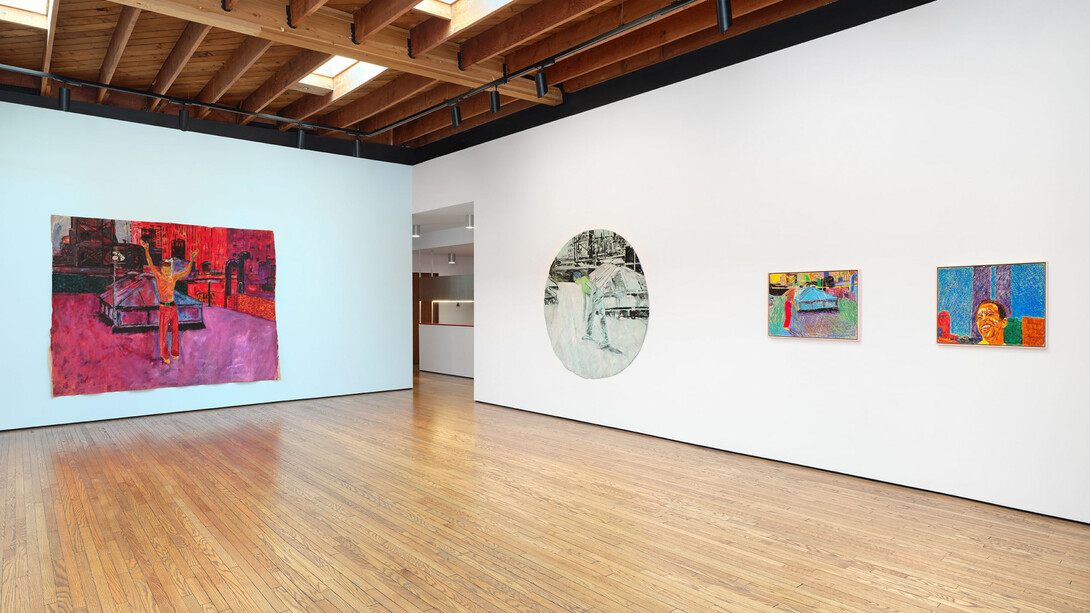
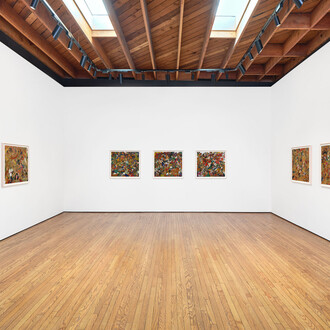
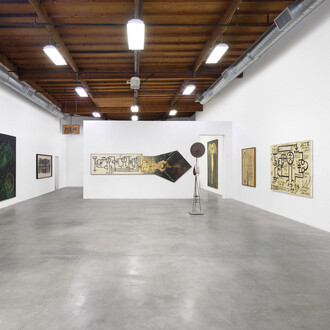
Parker Gallery is proud to present The rooftop paintings at 255 Bowery, a solo exhibition by Gerald Jackson, his second at the gallery. This exhibition focuses on a singular group of paintings and works on paper produced in the early 1980s, offering a closer look at a pivotal period in his practice.
From around 1968 to 2002, Gerald Jackson lived in an industrial loft on the Bowery in New York City. After serving a brief term in the army in the early 1960s, Jackson relocated from his native Chicago to the Lower East Side, where he quickly became part of the community of Black artists and musicians living there. The Bowery as a site of artistic inspiration and production has been widely examined, from the New Museum’s Bowery artist tribute, which documented the presence of artists through oral histories, publications, and exhibitions, to Martha Rosler’s The Bowery in two inadequate descriptive systems (1974-5). Yet much of Jackson’s life and work during his three decades on the Bowery remains to be uncovered.
I think certain minds like art. I see it more like a psychic reconstruction, the period you’re talking about. I had to deconstruct that previous construction of being a black person living on the South Side of Chicago. I had to deconstruct all of that out of my mind, and then replace it with something else.
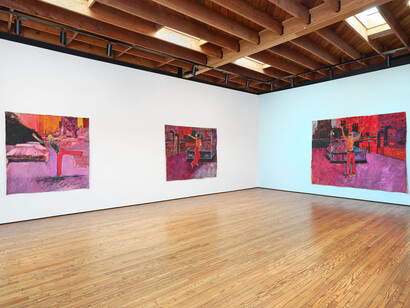
Throughout his career, Jackson has employed an expansive array of art making strategies including painting, drawing, assemblage, poetry, fashion, and performance. He frequently turned to the street as subject and resource, incorporating found materials and urban detritus into his work, allowing the environment to help reshape form and meaning. In the summer of 1980, he transformed his rooftop into a stage, producing a series of photographs of himself in movement. These images served as source material for the works presented in this exhibition, translating fleeting movements into vibrant and expressive compositions.
The rooftop becomes the central site of focus in this body of work, with the surrounding cityscape as his backdrop and collaborator. Captured midpose, Jackson is positioned between ground and sky, inhabiting a space of both freedom and tension—where the urban meets the spiritual and the physical meets the ephemeral.
In Untitled (1980s), a large-scale work on found wood, Jackson collages together photocopied images of himself on the rooftop alongside images of a woman who appears to be exercising—perhaps practicing Tai Chi. Oil crayon and rainbow-colored collage elements move through the composition, creating another choreography of Jackson. The work exemplifies strategies Jackson has employed repeatedly: transforming detritus into objects of beauty and significance; drawing upon existing cultural and spiritual languages to construct new, liberating mythologies; and exploring the power of color and light as agents of healing and transcendence.
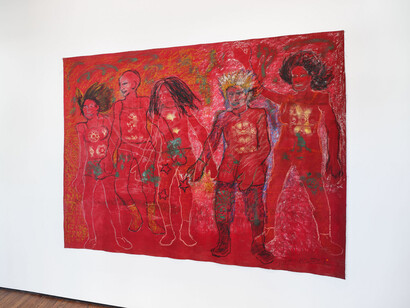
Village people (1987) was painted slightly after the other works in the exhibition and represents a slightly different subject within Jackson’s experience of New York. Here, the artist uses found stencils of stars, Native American patterns, and nursery rhyme characters and spray paints them across the outlined bodies. Through these recurring stencils, which have appeared in his work since the 1970s, Jackson has developed a distinct visual vocabulary rooted in cultural, spiritual, and mythological references. This convergence of figures evokes his memory of St Mark’s, a place he briefly lived, as a gathering place for musicians, hippies, artists, and political radicals. It was another neighborhood at the center of counterculture and artistic expression.
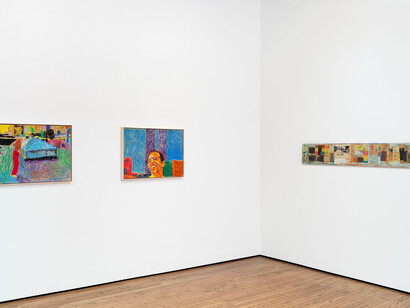
Throughout the exhibition, deconstruction and reconstruction unfold through continual translations between mediums: photography becomes painting, painting becomes drawing, and drawing becomes collage. Jackson’s artistic journey can be understood as a continual exploration of self-discovery, in which artistic expression became a means of reshaping identity.
A limited-edition publication will accompany the exhibition, featuring scans of the artist’s 35mm slide photographs from the Bowery rooftop, alongside a selection of Jackson’s original poetry.