English
 Español
 Français
 Deutsch
 Italiano
 Português
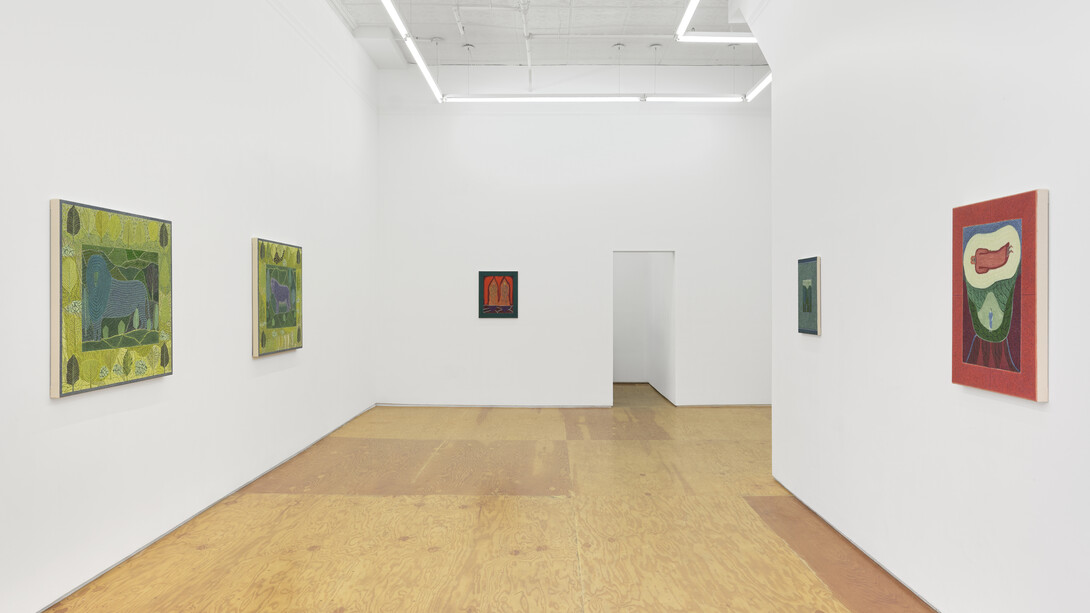
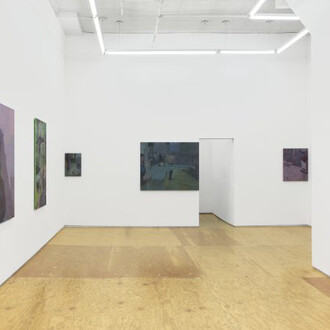
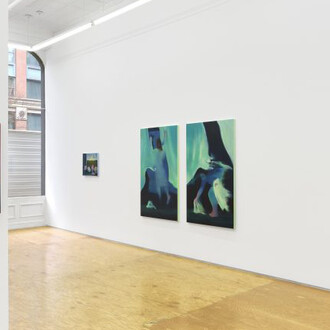
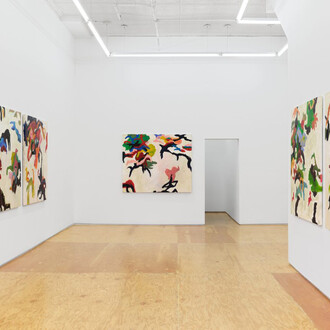
Margot Samel is pleased to present The divine comedy: hell, a solo exhibition of new paintings by Annie Hémond Hotte (b. 1980, Montreal, Canada). This is the artist’s first solo exhibition with the gallery.
The exhibition takes Dante Alighieri’s The divine comedy as its point of departure. The poem, written approximately 1307–18 while Dante was in exile from the Italian city of Florence, chronicles the tale of Dante himself having lost his way in a dark wood and his guide–an incarnation of the soul of ancient Roman poet Virgil–meticulously ordered as a descent through the circles of Hell towards Earth’s core. It is an enduring vision of the afterlife as both a moral architecture and a reflection of earthly society. The dense and symbolic poem, revealingly relevant to today, draws heavily on ancient Greek mythology and on Aristotelian ethics–the development of virtues as a moderating orientation to the world which are not innate and are fashioned through practice and control–to distinguish between actions born of reason and those (incontinence, violence, or fraud) driven by corrosive desires.
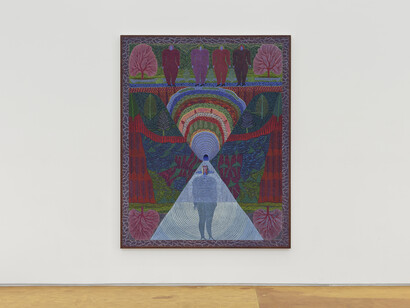
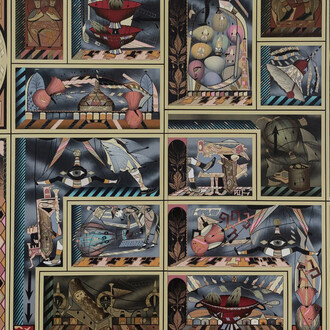
Hémond Hotte’s colorful, intricately detailed paintings revisit this subterranean geometry through an iconography developed alongside the artist’s study of the poem. Anchoring the exhibition is a large painting within which the artist crafts Hell as an hourglass, a figuration that nods to the centrality and ineffability of time’s passing within its architecture. At the top–the artist’s characteristic labyrinth women stand in the woods above the Earth’s crust. Descending, each subsequent layer of Hell is envisioned through the motifs of corresponding vices or malice (lust as wind, gluttony as muddy rain, and so forth), funneling the viewer’s gaze down to Cocytus (lamentation, in ancient Greek)–the lake of ice.
Against popular belief that Hell is a barren scape of hot flames, Dante’s final depth is a lake, cold as death and encircled by Giants, divided into four dissenting rounds. Those who find themselves at Cocytus find themselves there through traitorous reason and are trapped within ice, including the machine-like Lucifer, automative, absent of cognition, and frozen waist-high with three faces and three mouths, chewing on the traitors Brutus, Cassius and Judas. There, his beating wings that strain for freedom cool the air to retain the icy temperatures that keep him eternally grounded. Ultimately, he is his own prisoner. In Hémond Hotte’s rendition, Lucifer’s ice stretches out to the edges of the Earth like a spotlight, suspended between two red inverted trees like the breath between the lungs of the afterlife, or the stage behind red set curtains.
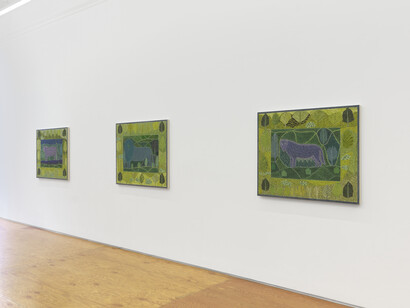
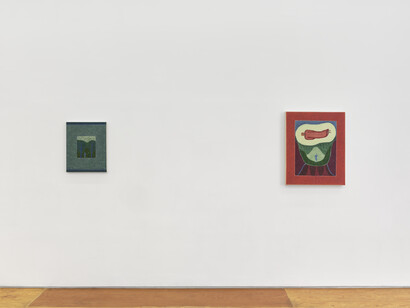
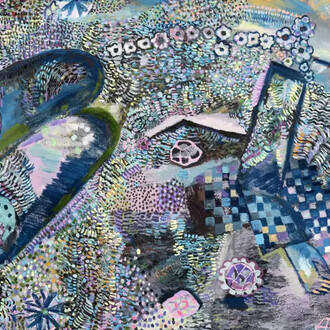
Elsewhere in the exhibition, paintings envision symbols and guides described throughout the poem. Preceding Dante’s descent into Hell, he encounters three beasts while lost in the wood. When the leopard, the lion, and the she-wolf appear in the poem, they appear as moral allergories and foreshadow three main divisions of Hell. Hémond Hotte interprets each character into their own painting, patterning their surfaces and their wooded surroundings in a distinct narrative style. The architecture of the poem itself is also important to the artist’s compositions. Made up of 100 cantos divided into near-mirrored segments through asymmetrical symmetricalities–divisions in the structural framing of the text–the reader is guided through Hell by the very experience of reading. Hémond Hotte has long used symmetry to guide a viewer through her own works, which continues to inform her paintings here. Pointillistic tapestries, these fluttering oil paintings come to life through innumerous individual motifs that communicate, build with, rely upon, and clash against each other, forming unrepeatable colors and textures through their own proximities.
After Dante, along with his political faction, was exiled from Florence during a diplomatic mission to Rome in 1302, he spent the rest of his life seeking refuge in Italian cities where the landscapes and dialects were likely unfamiliar to him. Although The divine comedy was written during this period of exile, he places the narrative, and therefore himself within it, before, in 1300. The work is peppered with autobiographical details and could be, in many ways, a reflection of Dante’s own political and artistic experiences of life in an increasingly dogmatic medieval Italy. Distinctive of Hémond Hotte’s work is an oscillation, and therefore reflection, between the universal and the particular. Each work is immensely laborious–great stretches of time made up of many individual marks in underpainted layers. In process, they recall the Aristotelian ideals that inspired Inferno, according to which virtues are something built over time, accounting to the compositional makeup of each person’s concrete life. As woven fabrics are held together and crafted through many threads, as organisms are made up of thousands of individual cells, and as no individual person in singularity builds a whole society, these paintings, as with revisiting Inferno now in our contemporary moment, tend to our universal structuring complexities and recall that comedy itself, unlike tragedy, ends with light only through many compounding narrative threads that lead there.
(Text by Emily Small)