English
 Español
 Français
 Deutsch
 Italiano
 Português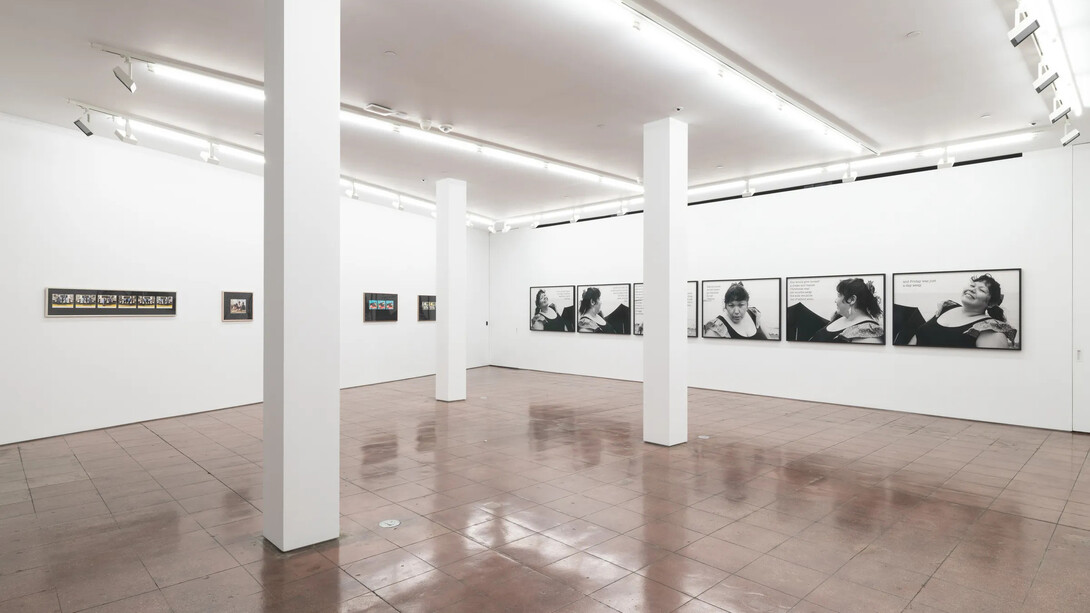
Hales is pleased to announce In her lifetime, Shelley Niro’s second solo exhibition at our New York gallery. Bringing together a focused selection of photographic works spanning several decades of the artist’s celebrated career, the exhibition explores memory, identity, and contemporary Indigenous life through Niro’s rich use of image, text, and ornament.
Coinciding with Niro’s solo exhibition at Centre d’art daphne, Montréal, and her inclusion in the Canadian Pavilion at the 16th Gwangju Biennale, this presentation follows Niro’s recent solo exhibition at the Gorman Museum of Native American Art, UC Davis, and her major touring retrospective, 500 year itch, which traveled across the United States and Canada (2023–2025). Works by Niro are recently on view in thematic presentations at the Museum of Modern Art, New York, and the National Gallery of Art, D.C., among other institutions.
Niro (b. 1954, Niagara Falls, New York) is a multi-disciplinary artist and a member of the Turtle Clan of the Kanyen’kehà:ka (Mohawk) Nation, from the Six Nations of the Grand River territory. In an oeuvre spanning more than four decades, Niro has developed an interdisciplinary practice that draws from popular culture, oral storytelling traditions, performance, and personal narrative. Humor lies at the heart of her work, becoming a powerful means through which colonial narratives and stereotypical depictions of Indigenous identity are questioned and reimagined.
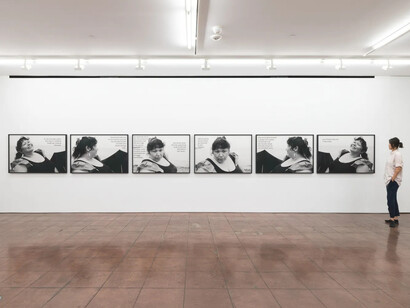
One of two large-scale photographic series in the exhibition is In her lifetime (1992), presented as a sequence of black-and-white portraits accompanied by fragments of text. The work follows an unnamed female figure, modeled by Niro’s sister, through moments of everyday life both intimate and political: passing thoughts about soap operas, laundry, children, and the passage of time hover alongside meditations on depression, aging, and the unresolved issues facing Indigenous communities. In one line, a fleeting thought starkly proclaims: “Native issues would never be resolved in her lifetime.” Rather than presenting a singular or symbolic figure, Niro constructs a multi-faceted portrait shaped by contradiction, vulnerability, and perseverance to show how personal experience and broader historical realities are linked.
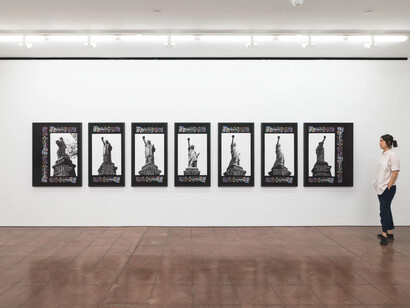
The exhibition also features For fearless and other indians (1998), another landmark photographic series combining black-and-white photography, text, and floral imagery drawn from Haudenosaunee visual traditions. Following a visit to the Statue of Liberty in 1997, the series developed from the artist’s reflections on national monuments and Indigenous memory. The floral borders that frame the images evoke Haudenosaunee beadwork and decorative traditions, positioning Indigenous visual languages alongside symbols of American nationhood. Photographing the monument repeatedly from its base, Niro questioned what was being represented through such symbols and how those meanings shifted depending on one’s relationship to nationhood and history. Throughout the series, fragments of text disclose recollections and interior monologues. Across one angle of the statue, Niro writes: “In my culture there are no monuments / no man made structures / no tourist sites.” The titular “Fearless” nods to Fearless Fosdick, a parodic character in the popular Li’l Abner comic strip, which ran from 1934–1977. Niro incorporates memories of reading the comic as a child, the casual violence featured inside them mirroring her own reflections on historical and intergenerational trauma. Rather than monumentalizing history, Niro’s photographs privilege ancestry and community as living forms of memory.
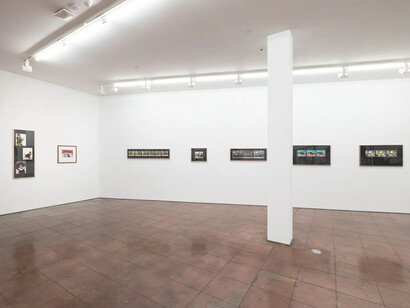
The exhibition also includes a focused presentation of iconic photographic works from the early 1990s, revisited in 2026 and treated with hand-painted elements and decorative matboards. Often arranged in multi-image sequences, the works unfold like film reels, Niro casting her mother and sisters as glamorous, self-possessed figures. For example, in Portrait of the artist, sitting with a killer, surrounded by french curves (1991/2026), four women, including Niro, don bouffant hairstyles and bold makeup, each staring directly into the camera. In The iroquois is a highly developed matriarchal society (1991/2026), Niro pairs a deadpan anthropological title with a sequence of her mother laughing under a hair dryer, replacing ethnographic flattening with lived intimacy. Originally shot in the tense years following the 1990 Oka Crisis, these multi-panel works deploy humor to assert Indigenous women’s subjectivity.