English
 Español
 Français
 Deutsch
 Italiano
 Português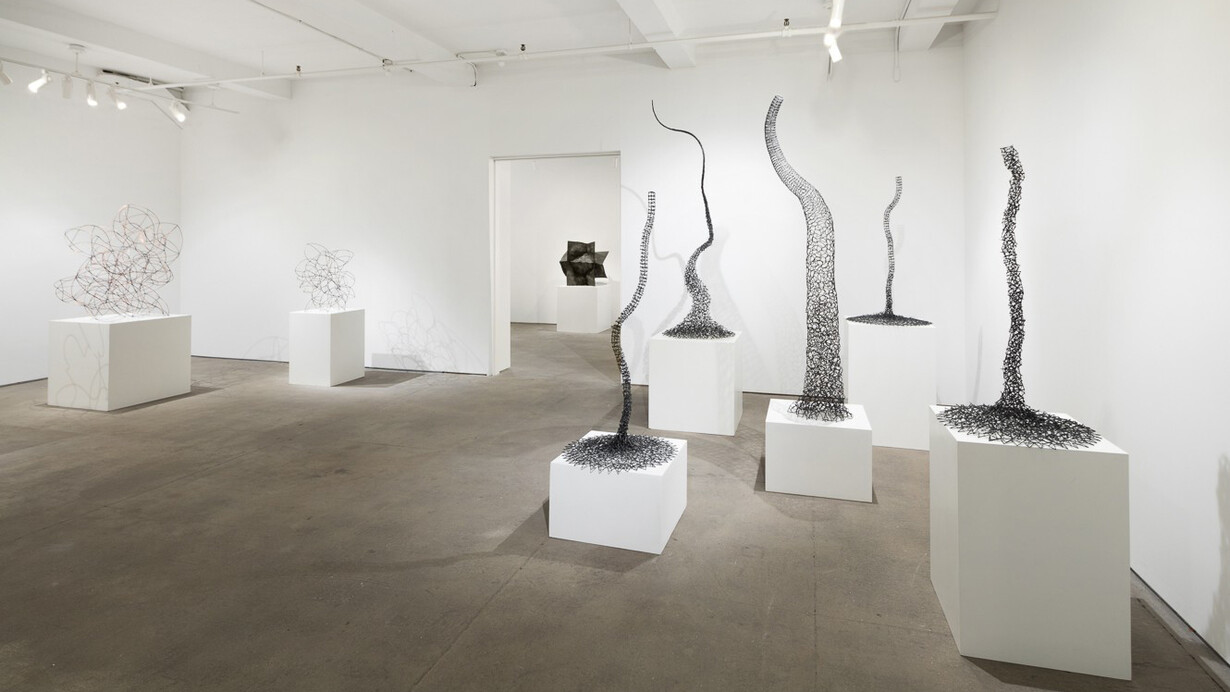
Memory is like an extended womb integral to nearly every human endeavor. It’s a bit unnerving, but then again perhaps also amusing, to think that maybe it has a life of its own.
(John Pai, In memory’s lair catalogue, Gallery Hyundai, January 28, 2013)
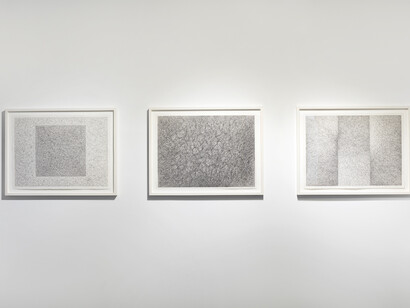
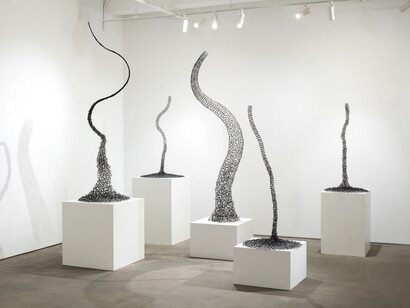
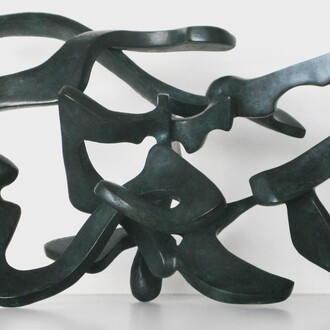
Gallery Hyundai is pleased to present Meditation: myth and memory, an exhibition of Korean American sculptor John Pai, a major force in the Korean American diaspora of the last half-century. Pai is gaining heightened recognition for his indisputable contributions to sculpting with steel, a signature method of hand-welding numerous thin, short steel rods into a “drawing in space,” as well as his groundbreaking pedagogical methods since becoming the youngest appointed professor at Pratt Institute in 1965. All of Pai’s sculptures are born out of a dynamic field of inquiry unbridled by discipline, traversing topology, physics, phenomenology, and musical processes of improvisation. The presentation opens and centers around his major and most recent series Heaven and Earth (2024) as well as the Entropy’s sirens (1997) trio, marking the first occasion it is presented as a group of three including two previously unseen pieces, accompanied also by a selection of sculptures and drawings.
This exhibition seeks to provide a space for meditation where myth and memory, as in Pai’s world, could be considered as companions, at times synchronous, and at times on their own path. In the Heaven and Earth series, a single point becomes a line, then a form, and appears to trail off to gesture to the space around it, going past the artist’s agency and into another realm. This work manifests Pai’s guiding ethos, where the artist’s mind (and the memories contained inside the artist) inform his beginning, but the development of the work is made in conversation with the material and the work. This conversational and improvisational method shows Pai’s belief that memories are not stable but are always vulnerable to change, sometimes appearing closer to myth than reality. Pai has always likened his improvisation to music, as Pai himself is a multi-instrumentalist, having grown up in a musically gifted family, and later becoming a lover of jazz. Completed when Pai was eighty-seven years old, this grouping of sculptures reveals an artist in his maturity who still remains playful, responsive, and deeply curious.
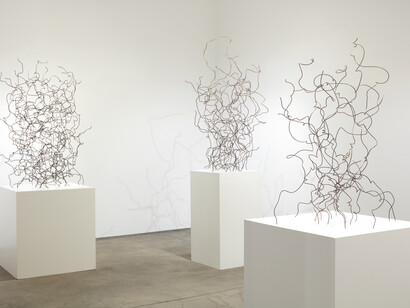
Walking further into the gallery, viewers are greeted by a trio of sculptures including Entropy’s sirens (1997) and two previously unseen pieces, Metamorphosis (1996) and Cosmos (1996). Though made three decades ago, they appear contemporaneous to Heaven and Earth, echoing Pai’s engagement with phenomenology and existentialism. While working with line or the grid, Pai disrupts so-called Western modernist notions conventionally associated with them—as art historian Yeon Shim Chung has written in her 2024 essay “John Pai: Welding and Sculpting Fluid Steel”: “[Pai’s works] catalyze variable situations marked by indeterminacy and vulnerability.” Held together not by geometry but what the artist describes as “a force of attraction and reproductive process that is both romantic and vicious,” the trio appears as equal parts freehand drawing and some miraculous natural growth, creating variable configurations of negative space with every turn of the viewer’s perspective.
A pair of works from 2012, After Matisse and Constellation, bridges the two states of energy in the Heaven and Earth and Entropy’s sirens series. Rather than the visible form of a constellation, they capture the delicate dynamics of matter as it is torn between forces of expansion and contraction—unsurprising for an artist who was fascinated by physics and topology throughout his career. Perhaps then, A reminder (1988) that reveals itself in the rear gallery, more solid and imposing than any other piece in the exhibition due to the compact welding of short steel rods, is what remains after such constellations finally give way to collapse: the embers of a Big Freeze that nevertheless contain the whispers of a new star.