English
 Español
 Français
 Deutsch
 Italiano
 Português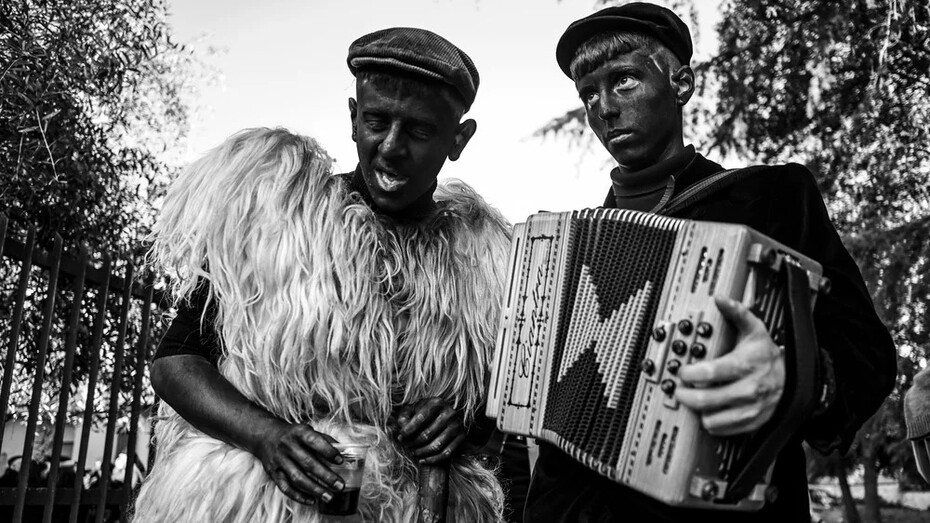
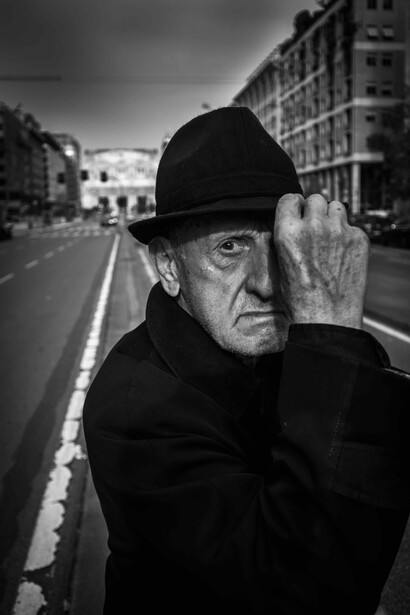
An elderly man, with a wide-brimmed hat and a dark coat, stands in backlight before a modern building. The glass and concrete façade rises vertiginously towards a leaden sky. The man is small, fragile, but his presence is enormous. His gaze, turned elsewhere, seems to be searching for something that is no longer there.
It is the photograph that closes the catalogue and the last one the visitor encounters in the exhibition. It is no coincidence: it is a kind of farewell, an invitation to carry with you the gaze of that man, his dignity, his solitude.
An old country. Where past and future collide is the exhibition by Lorenzo Barbieri Hermitte, Italian by birth but raised in London until the age of twenty-four, who returns to Italy and chooses to look at it with new eyes, but not innocent ones. His is a liminal position: that of someone who knows Italy by hearsay, through holiday memories, and then rediscovers it in its complexity, its contradictions, its elusive beauty. From this distance — anagraphic, geographic, emotional — comes an investigation that is neither reportage nor documentary, but a meditation in images.
The title is a declared homage to Un paese by Cesare Zavattini and Paul Strand (1955), but it is also an expression the author felt resonating within himself with new force during a journey in Barbagia in 2024, while photographing the Sardinian carnival. In that moment, those words took on a deeper meaning: not only an Italy that grows old, but an Italy that resists its own disappearance, clinging to ancestral rites, unsettling masks, ancient gestures, as if time could be stopped.
The exhibition unfolds in four distinct yet complementary movements, which unite in a single visual fabric the vertical streets of Milan, the pastoral solitudes of Abruzzo and the ancestral rites of Sardinia.
The first, dedicated to the elderly, stems from the photographer's personal experience with his almost ninety-year-old grandparents, with whom he lived in Milan. Here Barbieri Hermitte touches firsthand the fragility and strength of a generation that is disappearing, bearer of a memory at risk of being lost. In the exhibition, this movement opens with the face of an elderly man in extreme close-up: wrinkles, a tired but alive gaze, a wool cap pulled down over his forehead. Beside it, the hands of another elderly man, folded on his belly, in a pose that is both waiting and surrender. And then the profile of a woman, her head covered by a scarf, earrings glinting in the backlight: an ancient dignity that does not surrender.
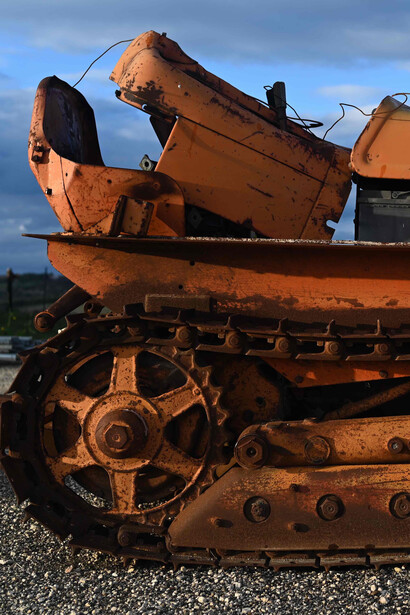
The second movement, on old artists and crafts, explores the relationship between man and work, between hands and matter, in an age when the digital revolution has made obsolete gestures that were an integral part of collective identity. The photographs are perhaps the most tactile: the rusty tractor abandoned on a gravelly terrain, with worn tracks and colours faded by rain and sun; the wooden shoes hanging from a nail, consumed by time and use; the shepherd with his dog, the hand resting on the animal's neck with a familiarity that is also tenderness. Images that speak of a world in which things were made, used, consumed, and in which work was still a form of relationship with matter and with others.
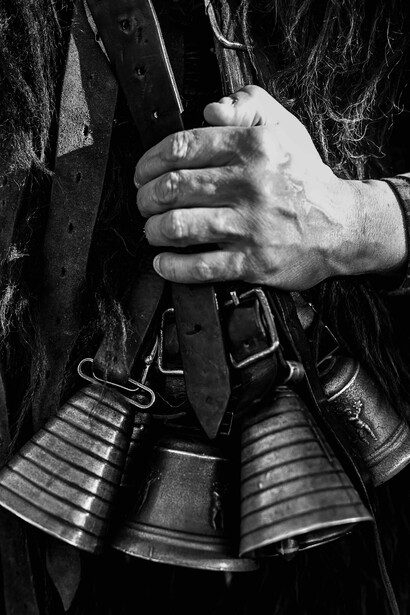
The third movement, dedicated to the Sardinian carnival and religious ceremonies, is perhaps the most mysterious and fascinating. Here the author captures the moment when the past is no longer nostalgia, but rite, myth, legend. The masks of Barbagia, with their black faces and feral eyes, are not folklore for tourists, but symbols of an archaic relationship with nature, with the animal, with the divine. In the exhibition, these images are the most unsettling and magnetic: the face covered in soot, hooded, with eyes burning with a wild light; the man wrapped in a sheepskin, with bells tied to his waist and chains tightening his wrists; the procession of children in traditional dress, with serious faces and gazes turned elsewhere. And then the hands of the women, with the rosary hanging between their fingers and rings glinting in the sunlight.
The fourth movement, the most silent and painful, is the one on disappearing villages, on inner areas emptying out, on towns that remain only as ruins of themselves. From the silences of the Abruzzo highlands to the hilltop villages of Sardinia, crumbling walls and broken windows next to a house with a "For Sale" sign become a metaphor for a deeper erosion.
Barbieri Hermitte's photography is predominantly in black and white, but it is never neutral. It is a warm, almost material black and white, restoring the grain of the skin, the roughness of hands, the consistency of wool and wood. Alongside the black-and-white images, some colour photographs restore the living matter of the world portrayed: the rust of the tractor, the sky above the highlands, the light that ignites objects. The images are often close, intimate, but never invasive. There is respect for the subjects, never pity. The elderly are not victims, but custodians: of a knowledge, a history, a way of being in the world. Their faces are landscapes, their hands tell more than any caption.
This attitude brings his work close to that of the American anthropologist Frank Cancian, who in 1957, barely in his twenties, travelled to Lacedonia, in the province of Avellino, his parents' birthplace, and spent seven months there photographing the social and cultural reality of Irpinia. Both travel to the land of their origins after growing up elsewhere, with a gaze both participatory and distant. But if Cancian looks from the outside in, with the discipline of the social scientist, Barbieri Hermitte takes the opposite path: he moves from within — from an intimate memory — to project it onto the collective landscape.
An old country is an exhibition about mortality — and about life that continues despite everything. It is a journey born from a loss and transformed into a question: what remains of us if nothing of us remains? The answer, perhaps, is in the images themselves: the gaze remains, the light that ignites within remains, the colour that resists oblivion remains.
In an age when everything seems to accelerate, the choice to stop, to look, to listen is already a political act. An old country is an invitation not to forget, but also not to idealise. It is a bridge between those who were and those who will come. It is, in the end, an act of love.