English
 Español
 Français
 Deutsch
 Italiano
 Português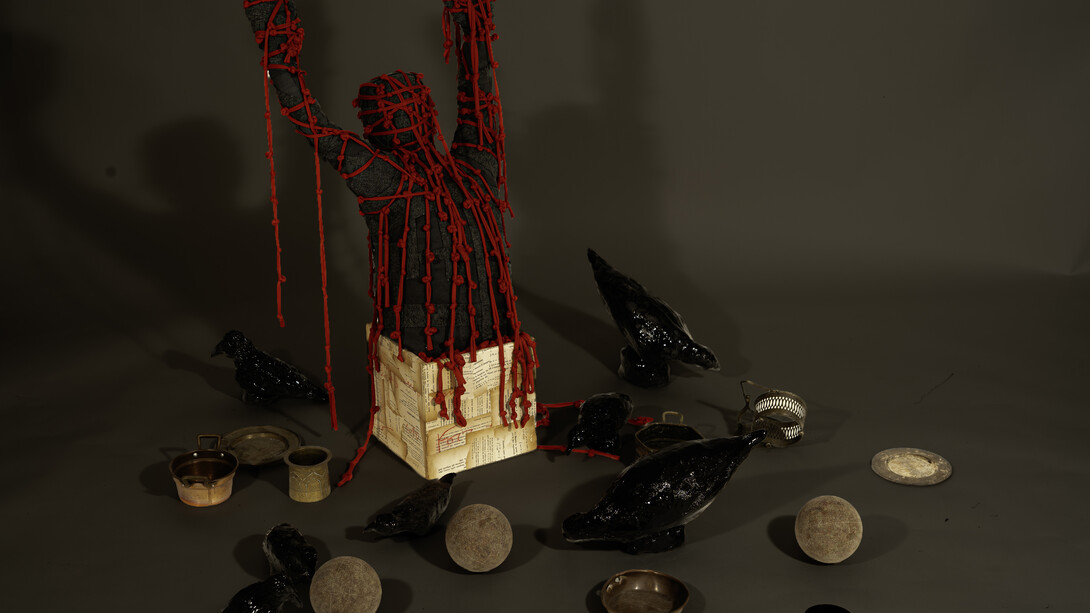
Gilda Contemporary Art is pleased to present The diaries of the black swan, a solo exhibition by Florencia Martinez, opening on 24 September 2026. The exhibition is a new project developed through nearly eighteen months of intensive research, exploring the fragilities of the present, the transformations of contemporary society, and the wounds that run through our time.
The title takes its cue from Nassim Nicholas Taleb’s celebrated essay The black swan, reinterpreting its meaning. If the “black swan” represents an unpredictable event capable of radically altering the course of history, the “diaries” become the place where such unpredictability is recorded, sedimented, and transformed into visual memory. Wars, migrations, violence, destruction, control, and displacement: events that, until only a few years ago, seemed confined to the history books and have now forcefully re- entered our present.
More than a political reflection, The diaries of the black swan offers an anthropological investigation into the contemporary human condition. Martinez observes our daily exposure to images of violence, the progressive desensitisation to collective suffering, and an emotional suspension that risks turning helplessness into a form of coexistence with horror.
Curated by Cristina Gilda Artese, the exhibition unfolds through three thematic sections — Stratifications or Morphology of Memory, Invisibility, and Conquests — conceived as chapters of a single narrative.
The first section presents Bulldozing, a series of large-scale textile works made almost exclusively from reclaimed materials: discarded fabrics, fragments, and remnants are layered, stitched, and transformed into surfaces dense with memory. Earth tones, burnt oranges, and browns evoke a landscape that is constantly demolished and rebuilt, becoming a metaphor for a form of destruction that affects not only physical spaces but also social relationships, identities, and collective memory. Each work takes the form of a material diary whose surfaces retain the traces of what time and the relentless flow of events tend rapidly to erase.
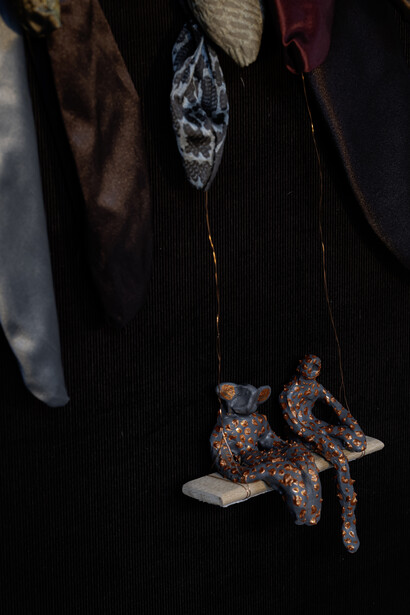
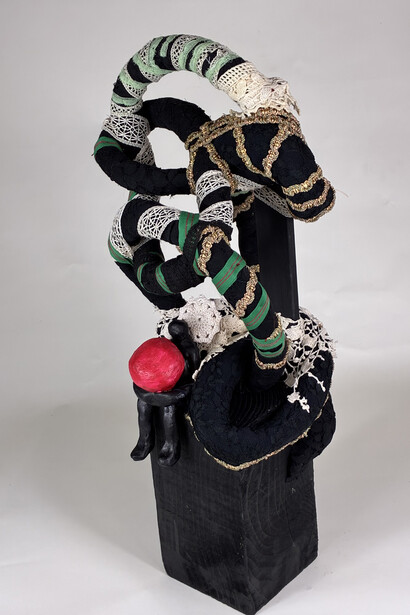
The second environment houses a powerful installation inspired by a phrase uttered during a televised debate in the context of the Israeli-Palestinian conflict, which quickly went viral: “Define a child for me.” The artist adopts this question, formulated in an attempt to challenge the innocence of victims in armed conflicts, as a symbol of the ethical disorientation of our time. Figures of children trapped within knotted structures, bowls evoking hunger, ceramic crows, and references to systems of control and power dynamics create an immersive environment that addresses vulnerability without resorting to rhetoric, confronting the viewer with the full complexity of a tragedy that concerns humanity as a whole.
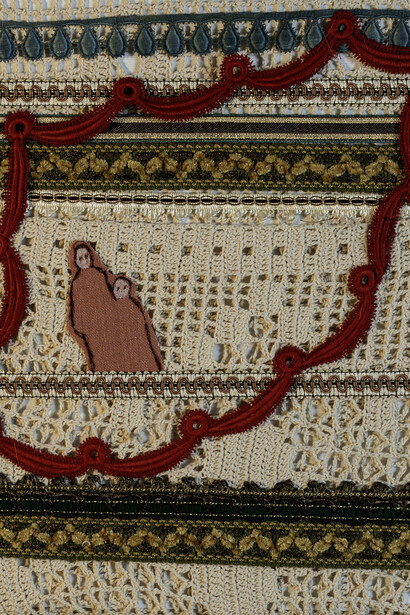
The exhibition concludes with the series Crystal Palaces, works that initially appear lighter and more decorative but, when viewed closely, reveal narratives of migration, uprooting, families on the move, and suspended destinies. A sense of lightness that is only apparent, inviting viewers to move beyond the surface of the image and grasp its symbolic depth.
Created entirely through the language of fiber art, the exhibition brings to the forefront one of the most significant strands of Florencia Martinez’s practice. The works are made almost exclusively from reclaimed materials, which the artist removes from their original function and transforms into repositories of memory. Through its layers, stitching, and mending, textile becomes a metaphor for the wounds of the present and for the possibility of reassembling what appears irreparably torn apart, within an artistic practice that has always embraced multiple media and forms of expression.
The attention to sustainability that runs through The diaries of the black swan, also reflected in the almost exclusive use of reclaimed materials, naturally resonates with the identity of Gilda Contemporary Art. Since its foundation, the gallery has pursued a concrete commitment to environmental responsibility, offsetting its CO2 emissions through Phoresta ETS. This commitment runs alongside the gallery’s cultural and curatorial activity, reflecting the belief that art, too, can contribute to fostering a more conscious sense of responsibility towards the environment.
According to Cristina Gilda Artese, director of Gilda Contemporary Art and curator of the exhibition, the project represents a significant turning point in the artist’s practice:
“With The diaries of the black swan, Florencia Martinez marks a significant evolution in her artistic practice. The autobiographical and intimate dimension of her earlier research is now joined by a broader perspective that examines the human condition in its collective dimension. It is an intense exhibition, developed with great rigour, which addresses complex issues without being reduced to the immediacy of current events or to ideological simplification, choosing instead the universal language of art.”
The exhibition also marks Florencia Martinez’s return to Gilda Contemporary Art following Tundra. A catalogue published by arsprima Edizioni will accompany the project and will also include other works developed by the artist in recent months. During the final phase of the exhibition, a selection of photographs created using infrared technology will also be presented. Conceived as a natural continuation of the exhibition, these works introduce a possible dimension of hope and open up new perspectives on the future.