English
 Español
 Français
 Deutsch
 Italiano
 Português
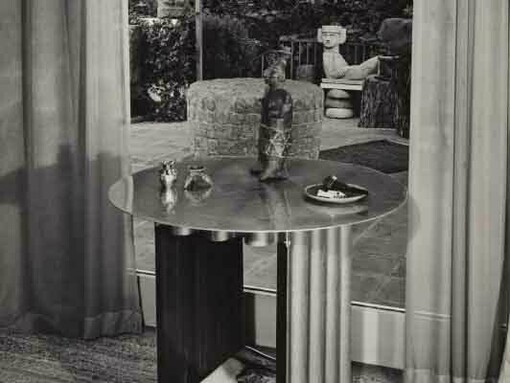
In 1921, Earl Stendahl (1888–1966) launched Stendahl Art Galleries on Wilshire Boulevard in Los Angeles and had early success selling California landscape paintings and twentieth-century art from Mexico. He introduced a new category of art to his gallery in 1935: antiquities made in Mexico before the Spanish invasion of 1519. By the 1940s Stendahl had hundreds of ancient Mexican works on offer, as well as outright fakes, and his gallery encouraged Angelenos to purchase them for their homes and gardens. The figure at right, however, is not an antiquity but a fiberglass replica of an object supposedly from Veracruz, Mexico. Stendahl Art Galleries may have sold the sculpture itself.
After World War II, the display of ancient objects from Mexico in contemporary American interiors became a sign of elite status, and their images animated advertisements for the coffee liqueur Kahlúa—with no regard for the destruction of the past. This exhibition looks at Stendahl’s influence as an art dealer in Southern California and the increased visibility of Mexican antiquities in exhibitions, films, and ads at the time.
A world of new opportunities
Pablo Picasso’s vast 1937 painting Guernica traveled to the United States in 1939 to raise funds for children orphaned by the Spanish Civil War. The Motion Picture Artists’ Committee sponsored the artwork’s trip to Los Angeles, where it was displayed at Stendahl’s gallery in August. In a year notable for major movie releases, such as Gone with the wind and The wizard of Oz, the canvas drew many Hollywood celebrities, including Dolores del Río and Edward G. Robinson.
The exhibition of Picasso’s Guernica brought a new clientele to the gallery, and they stayed to shop other Stendahl offerings.
Pre-hispanic makes the market
The American actor Vincent Price, best known for starring in horror films, was a student of art history who popularized the visual arts wherever he could. He recorded some of the first Acoustiguides, including a tour for Master Works of Mexican Art, a 1963 exhibition in Exposition Park in Los Angeles. He also shopped with Stendahl.
Because of his celebrity, Price commanded a national audience when he became a spokesperson for Kahlúa liqueur. As a collector of Mexican antiquities himself, Price was a good match for Jules Berman, who developed the Kahlúa brand and personally amassed a collection of pre-Hispanic figures, many of the type that he deployed for Kahlúa’s advertising campaigns. Other products also employed Mexican antiquities as a marketing tool. Hundreds, if not thousands, of those figures from West Mexican states were sold by Stendahl and populate museums in Southern California today.
Expanding the business
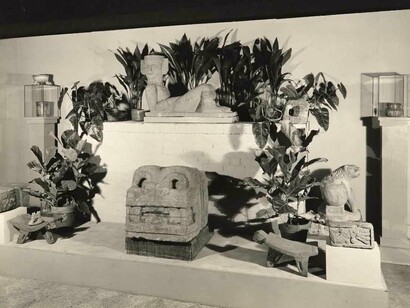
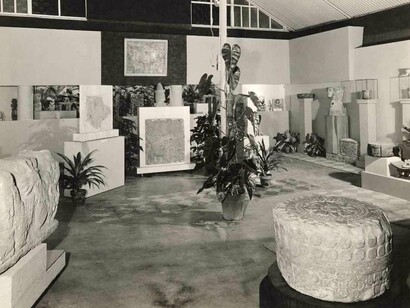
After leaving Wilshire Boulevard in 1945, the Stendahls sold pre-Hispanic art from their home in the Hollywood Hills and eventually from an apartment in New York City as well. To reach new audiences and shoppers, the gallery also developed exhibitions, publishing illustrated catalogues that were snapped up by eager students and travelers. They took over three thousand objects to the Pasadena Art Institute—the present-day Norton Simon Museum—for a show that received rave reviews, and created installations at state fairs in California and Texas, among many other venues.
Contraband: a destructive story
Where did the thousands of objects that passed through Stendahl Art Galleries come from? A 1964 article in The saturday evening post outlined what scholars would begin to sort out only several years later, focusing on the antiquities trafficking that supported the Stendahls in Los Angeles. “Earl, you’re an old bandit,” an LA collector was quoted as saying. In thrall of the piracy, he added, “But you get good things.”
On their own, some of the “good things” were not always good enough for Stendahl. One local artist recalled joining Stendahl in the basement, where they carried out “marvelous mendings,” creating hybrids such as the “dog of many parts” (on view nearby). Because of its suggestion of supernatural transformation, the figure of a dog with a human mask sold for two to three times more than a large, intact canine.