English
 Español
 Français
 Deutsch
 Italiano
 Português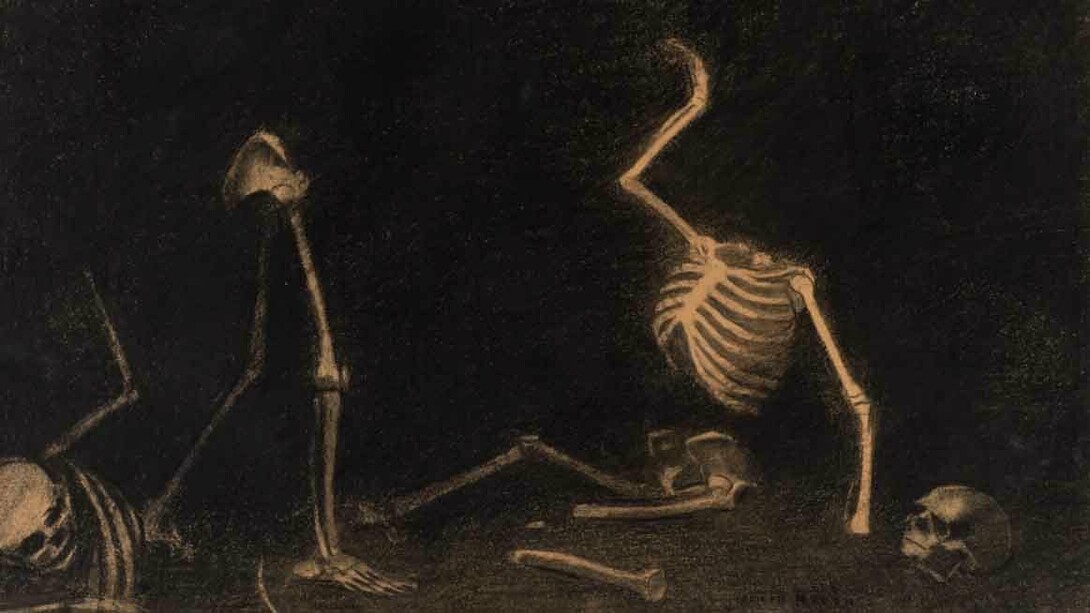
I have made an art according to myself. I have done it with eyes open to the marvels of the visible world and, whatever anyone might say, always careful to obey the laws of nature and life.
(Redon)
To view the art of Odilon Redon (1840–1916) is to enter another world. Drawing on the observed and the imagined, Redon created a distinct visual language of mysterious apparitions and strange monsters. He used his art to offer new interpretations of the familiar, rendering literary, biblical, and mythological subjects in original ways. Redon was also inspired by nature, merging modern science and fantasy to depict hybrid creatures and surreal flora.
Born in Bordeaux, France, Redon settled in Paris in the 1870s and immersed himself in the thriving cultural environment of the city. The arc of his career is marked by a striking divide, when, in the 1890s, he transformed his art from an exploration of darkness to an expression of pure color. Haunting charcoal drawings and blackand-white lithographs gave way to vibrant pastels. Across this range of media, Redon found innovative means of conveying his otherworldly and highly personal vision. This exhibition invites you to look closely and to step beyond the frame, into the depths of Redon’s imagination.
Noir
Black is the most essential color. . . . It is the agent of the spirit much more than the splendid color of the palette or of the prism.
(Redon)
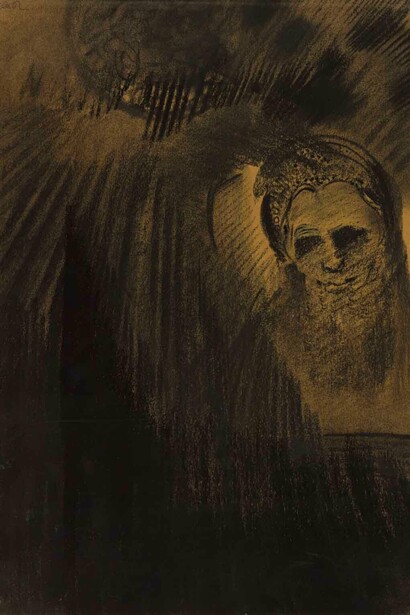
In the 1870s and 1880s, Redon focused primarily on creating what he called noirs (blacks), drawings made in charcoal and other black media that had correspondingly dark subject matter. Out of the rich black surfaces emerged shadowy specters and fantastical creatures that were suited to his chosen materials. For Redon, the power of black was matched only by his boundless imagination. He employed its various shades as a full spectrum of color, finding new ways to exploit the complex interplay of light and darkness. He often further manipulated the media—rubbing, wiping, and scratching—to achieve a range of atmospheric effects. Rather than acting as a constraint, the limited palette of the noirs helped Redon develop a pictorial style and affinity for invention that he would retain throughout his career.
Lithography
I looked at and scrutinized my noirs, and it is above all in the lithographs that those blacks have their integral brilliance.
(Redon)
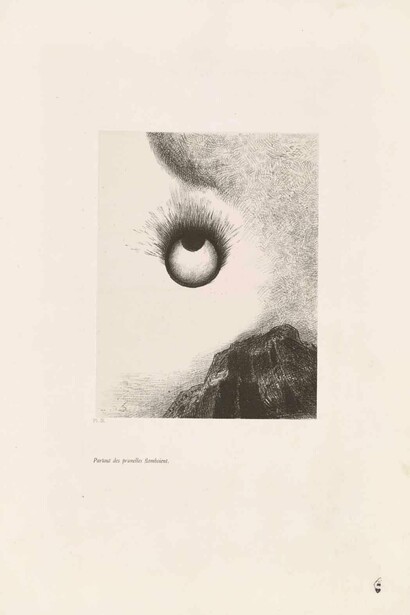
In the late 1870s, Redon began working in lithography, a planographic printing process with a close affinity to drawing. While he first viewed the medium merely as a means of reproducing and further disseminating his charcoals, Redon soon came to appreciate the independent, expressive capacity of printmaking. Over two decades he produced approximately 170 lithographs, playing with the stark contrast of black and white to convey fanciful and mysterious images. In the richness of lithographic ink, Redon unearthed another fertile channel through which to explore the darkness of his vivid imagination.
Print portfolios
I believe I have used my imagination with abandon and without restraint for exacting from the resources of lithography all that it could give.
(Redon)
In addition to exploring lithography’s expressive potential, Redon relied on its reproductive capacity to reach a broad audience. Over the course of his career he created eleven print portfolios, each one a group of lithographs with a serial structure and shared theme. The majority of these works relate directly to literary and religious texts, including three portfolios inspired by Gustave Flaubert’s visionary novel The Temptation of Saint Anthony. Redon did not employ this sequential format to create traditional illustrations. Instead, these sources served to inspire his evocative and often inscrutable imagery.
Color
If the art of an artist is the song of his life, a solemn or sad melody, I must have sounded the note of gaiety in color.
(Redon)
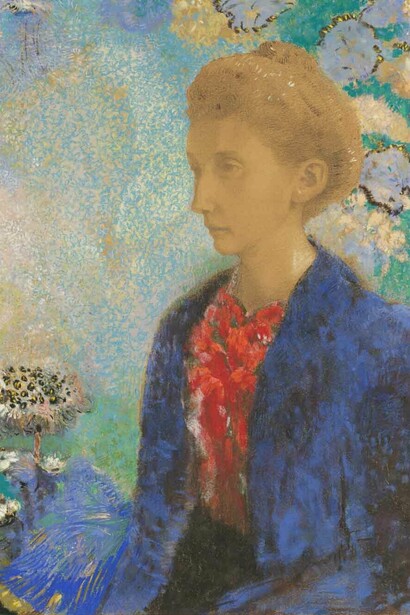
In the late 1890s, Redon abandoned his signature noir aesthetic for bold color. In pastel and oil paint he retained much of the haunting imagery of his dark works but also embraced new subject matter better suited to vivid color, including floral still lifes and portraiture. Redon even experimented briefly with color lithography, finding inspiration in the contrast of bright hues across his artistic practice. The shift away from black is often seen as a sharp break in his career, but despite the visual incongruity, Redon preserved an experimental, highly personal artistic style. With their powdery surfaces and undefined spaces, the radiant flowers of his pastels seem to emerge from the same dreamlike realm as his charcoal monsters.