English
 Español
 Français
 Deutsch
 Italiano
 Português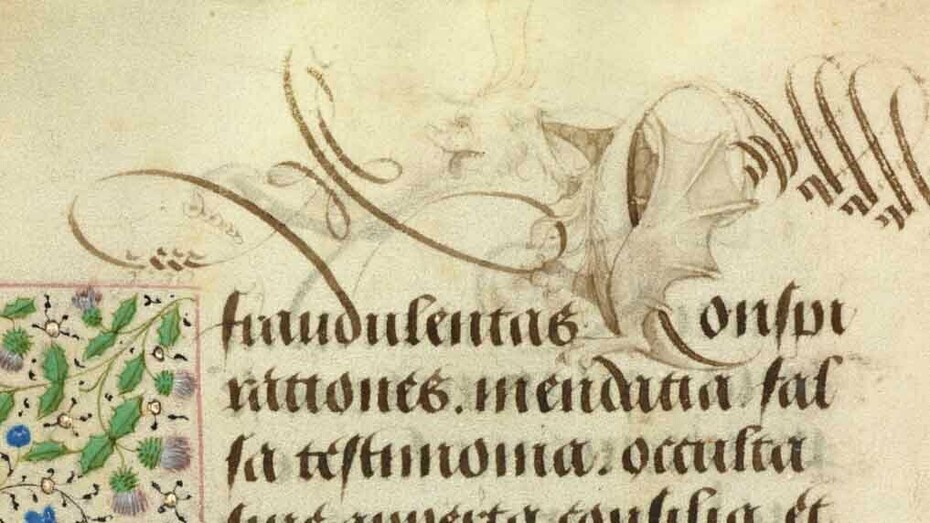
Take a close look at a book. Notice its cover, its pages of text and illustration, and the way it is held together. Whereas books today are mass-produced using computerized typesetting and machines that minimize human labor, until about five hundred years ago books were written, decorated, and bound entirely by hand. But despite differences in production and appearance, modern books resemble those made a thousand years ago in many ways.
This exhibition examines how books written by hand, called manuscripts, were produced in Europe and the Mediterranean during the medieval period (from about 500 to 1500). Steps included parchment making, writing, illuminating (applying precious metals and colored paint), and binding. In the early Middle Ages, this work might be done by a single monk in a monastery. By 1200, books were often made by specialists who lived in cities, with the production divided among four distinct craftspeople: parchment maker, scribe, illuminator, and binder.
Parchment
Most medieval manuscripts were written not on paper but on specially treated animal skin called parchment. The first step in making parchment was to soak the pelts of animals, typically calves, sheep, or goats, in a caustic lime solution to loosen and remove the fur. After cleansing in water, each skin was stretched on a wooden frame, like the one shown at left. While the skin was still damp, it was kept tauton the frame as a knife with a curved blade was used to scrape the surface. This cycle of scraping and stretching the skin was repeated over several daysuntil the desired thinness was achieved. Once off the frame, the parchment was cut into rectangular sheets and made even smoother by additional dry scraping and sanding, usually with pumice (a rough, volcanic stone).
Writing
After the parchment was prepared it was ruled, with either a stylus (a hard, pointed tool that leaves an indentation in the surface), a lead point (a sharpened piece of lead that leaves a gray mark), or colored ink. Ruling lines, added as part of the page design before the scribes began work, helped them write evenly.
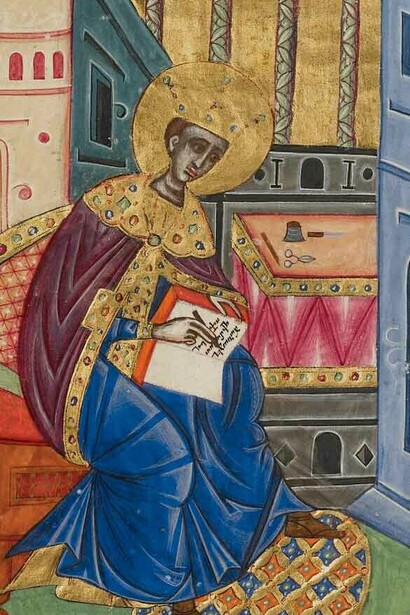
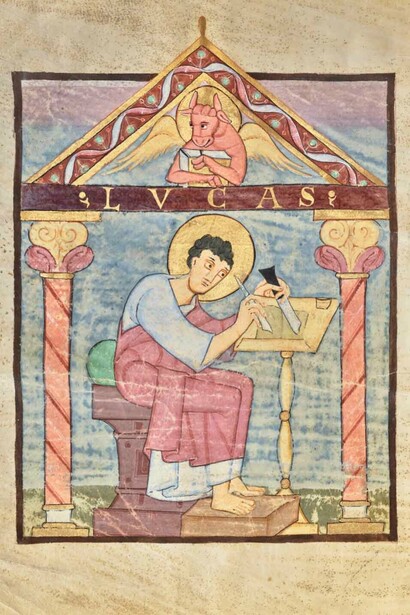
Scribes wrote with quill pens made from the feathers of a goose or swan, with one end cut to form the writing nib. It was slit in the middle to help the ink flow smoothly and shaped to vary the script’s appearance—dense or open, angular or rounded.
Black ink was made either from carbon, produced by burning a variety of materials, or from iron filings mixed with gallic acid, a substance derived from oak galls, which form on oak trees when wasps lay eggs on new leaves or twigs. Each of these colorants was mixed with a transparent gum medium to create writing ink.
Illuminating
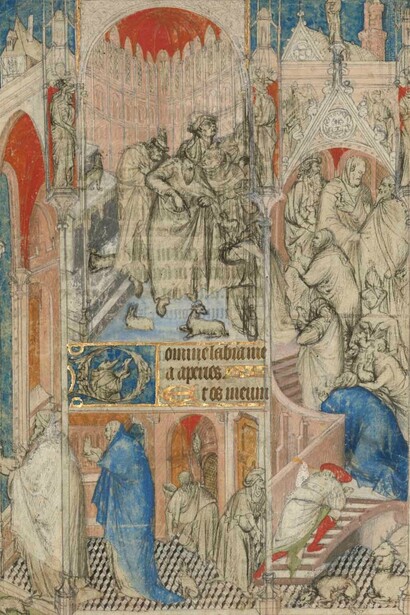
Manuscript painters, called illuminators, first drew an outline with lead point (metallic lead, sharpened for making marks) or quill and ink. Next, areas to receive gold leaf were painted with sticky substances, such as bole (a refined red clay) or gum arabic (a tree sap). Gold leaf was laid down over these areas and sometimes burnished to make it more reflective. Gold leaf was applied to the page prior to any colors.
The coloring material was made from a wide variety of substances: ground minerals, organic colorants (dyes) usually extracted from plants or insects, and chemically produced pigments. Each substance was mixed with a binding medium (either gum arabic or egg white) until it was the right consistency for painting. The illuminator applied the paint using a quill or a brush, working from paler to darker colors. Fine details such as black outlines and white highlights completed the illumination.
Binding
After writing and illuminating were completed, the parchment sheets were folded and nested to make gatherings. Cord or strap supports for sewing the gatherings were held in place by a wooden frame. The bookbinder attached each gathering, one by one in their proper sequence, onto the supports using a strong sewing thread that ran continuously through the gatherings. After they were sewn to the supports, they were removedfrom the sewing frame, and the ends of the supports were laced through channels carved into the wooden boards that formed the front and back covers of the book.
The binding was usually covered in leather or a decorative fabric. Designs could be pressed into the leather with heated metal tools. Metal fittings could be attached to the binding’s exterior to protect the leather or textile surface, and clasps were sometimes added to keep the book firmly closed, with the pages flat.