English
 Español
 Français
 Deutsch
 Italiano
 Português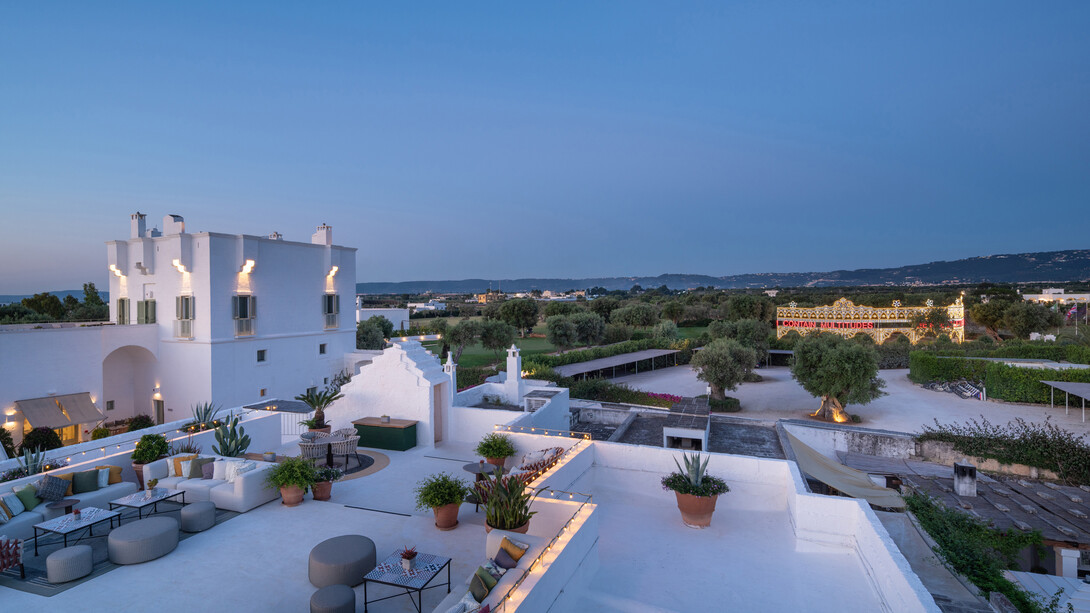
Marinella Senatore’s We rise by lifting others transforms a historic masseria in Puglia into a reflection on community, memory and the contemporary meaning of hospitality.
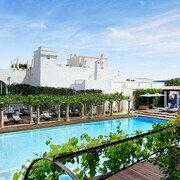
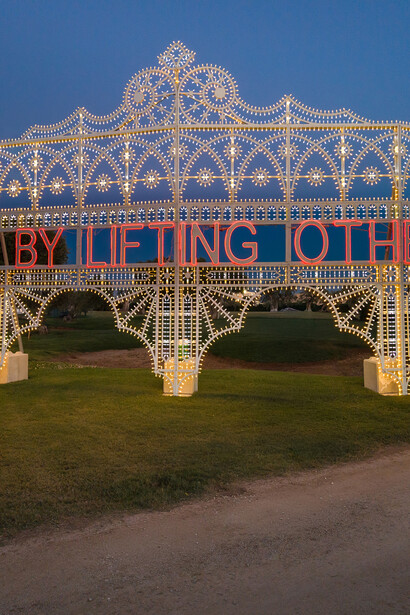
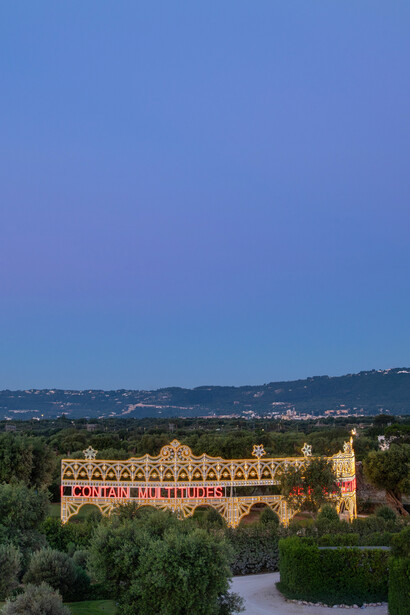
There are places where an artwork is simply installed, and others where it seems to have been waiting for the place in which it eventually appears. Masseria Torre Maizza, in Puglia, belongs to the second category. Surrounded by olive groves in the landscape of the Valle d’Itria, the historic masseria carries within its architecture traces of a culture shaped by agriculture, ritual, hospitality and collective life. Here, light has never been merely a physical phenomenon. It belongs to the visual and emotional vocabulary of southern Italy: to religious celebrations, village festivals, summer evenings, processions and the temporary architectures of the luminarie that transform streets and squares into places of gathering. It is within this cultural landscape that Marinella Senatore’s We rise by lifting others acquires a particular resonance. Presented at Masseria Torre Maizza from 29 May to 8 September 2026, the project marks Senatore’s first solo exhibition in Puglia and brings together six works distributed throughout the property. At its centre stands the monumental light architecture from which the project takes its title, positioned at the entrance to the estate and conceived on a scale that allows its presence to extend visually beyond the limits of the Masseria itself.
But perhaps the most interesting question raised by the project is not what happens when contemporary art enters a hotel. It is what happens when art encounters hospitality. In recent decades, contemporary art has increasingly entered spaces traditionally considered outside the institutional art system. Hotels, restaurants, airports, fashion stores and private residences have become new contexts for displaying artworks and commissioning artists. Yet the presence of art does not automatically transform a place into a cultural space. An artwork can remain an object among objects: prestigious, beautiful, economically valuable, perhaps even spectacular, but ultimately decorative. The more difficult possibility is to allow art to alter our relationship with the place itself. This distinction became central while developing We rise by lifting others for Masseria Torre Maizza. The aim was not to place contemporary artworks inside an already defined environment, but to establish relationships: between the artist and the territory, between contemporary visual language and local memory, between visitors and landscape, and finally between the private dimension of hospitality and the collective dimension implicit in Senatore’s work.
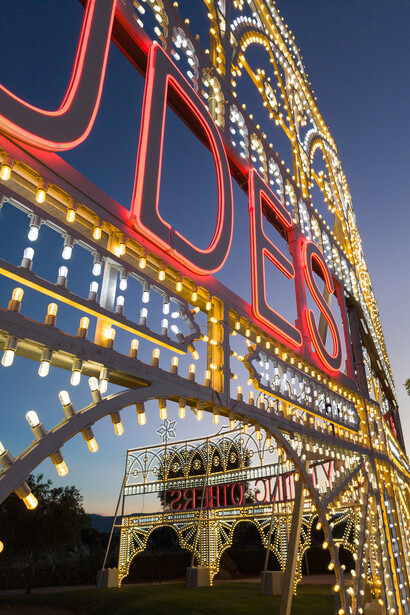
Senatore herself describes an authentic cultural experience as something capable of generating dialogue and allowing people to feel part of something rather than merely consuming an image. Hospitality spaces, from this perspective, can become cultural platforms when they create relationships between artists, audiences, territories and communities. This changes everything, because hospitality is already, by definition, relational. To welcome someone means temporarily allowing another person to inhabit a space. Art can intensify this experience by introducing another form of encounter: with an image, an idea, a memory or a question. Senatore has long used light as one of the central elements of her artistic vocabulary. Her luminous architectures draw upon the tradition of southern Italian luminarie, but they remove these structures from any purely folkloric interpretation. What interests her is precisely their hybrid nature. They are simultaneously architecture and ornament, sculpture and craftsmanship, spectacle and ritual. Above all, they exist because people gather around them. Historically associated with religious celebrations and popular festivities, luminarie create temporary spaces of belonging. For a few hours or days, an ordinary street becomes extraordinary.
Architecture is rewritten through light and the community recognises itself within that transformation. Senatore calls them “ephemeral monuments created for people rather than institutions.” Her practice takes this vernacular language, deeply embedded in collective memory, and shifts its meaning: celebration can become reflection, while ornament can become a poetic and political gesture. This is why light, in her work, cannot be understood merely as a material. It is a social device. Light attracts bodies. It establishes a centre without constructing walls around it. People instinctively approach it, stop beside it, photograph it, meet beneath it. Unlike the monument in the traditional sense — something solid, permanent and often erected to impose a particular version of memory — light produces temporary communities. It gathers rather than occupies. And perhaps this is why the language of the luminarie feels unexpectedly contemporary.
In an era characterised by increasingly individualised experiences, these luminous architectures recover something profoundly simple: the possibility of being together. We rise by lifting others. The phrase appears almost disarmingly simple. Yet its simplicity is precisely what gives it strength. It does not tell us whom we should lift, nor how. It does not define a community or establish who belongs to it. Instead, it proposes a relationship between individual and collective growth. We rise because others rise with us. The individual therefore ceases to be an autonomous subject and becomes part of a network of dependencies, relationships and acts of care. Senatore speaks of the phrase in terms of solidarity, but also of interdependence and vulnerability: individual growth, she argues, is never entirely individual. Placed in the landscape of Puglia, these words acquire additional meanings. The Masseria itself historically represents a system of relationships: between human beings and land, production and dwelling, private life and collective labour. The surrounding olive trees introduce another temporality, one radically different from the accelerated rhythm through which much of contemporary life is experienced. Against this landscape, Senatore’s luminous sentence becomes something between a declaration and a question. What does it mean to rise? And can anyone truly rise alone? Site- specificity is sometimes reduced to physical adaptation: an artwork is designed according to the dimensions, architecture or materials of a particular location.
But places are not made only of architecture. They are also made of stories, habits, gestures, memories and social practices. Puglia provides an especially fertile context for Senatore because the language she employs already belongs, in transformed form, to the cultural memory of the territory. The luminarie are not foreign objects imported into the landscape. Their history is intertwined with popular celebrations and collective gatherings, just as the masserie and surrounding olive groves are part of the region’s productive and cultural identity. The contemporary gesture therefore does not erase tradition. It reactivates it. This distinction is important. Too often, the relationship between contemporary culture and tradition is imagined as an opposition: innovation must replace what existed before, while heritage must defend itself against transformation. Art offers another possibility. A tradition can survive precisely because it continues to produce new meanings. Senatore does not reproduce the luminaria nostalgically. She recognises within it a social technology that remains extraordinarily relevant: the capacity to create a shared space through light. The past therefore becomes material for thinking about the present. There is another aspect of the installation that changes the usual relationship between art and hospitality: its scale. The central luminous architecture welcomes those arriving at Torre Maizza, but it is not entirely contained by the property. Its visual presence extends beyond the hotel and into the surrounding landscape. This creates a subtle but significant reversal.
Hospitality traditionally establishes a distinction between those who are inside and those who remain outside. Senatore’s work complicates that boundary. Although installed within the Masseria, the light refuses to remain private. It escapes. The artwork establishes a dialogue between guests and territory, interior and exterior, proximity and distance. That gesture is particularly significant for an artwork concerned with community. A work proclaiming We rise by lifting others could hardly remain enclosed within an exclusive space without generating a contradiction. Its visibility beyond the Masseria allows the sentence to address an undefined public: inhabitants, passers-by, workers, visitors, people who may never physically enter the property. Light crosses the boundary before we do. Perhaps this is where the project ultimately opens its most interesting question. What if hospitality were understood not simply as a service, but as a cultural practice? The history of hospitality is fundamentally a history of relationships with strangers. To host means to create a temporary space in which someone who does not belong can nevertheless feel welcomed. Culture operates through a surprisingly similar mechanism. A meaningful encounter with art asks us to enter temporarily into someone else’s imagination. We may not completely understand it. We may disagree with it. We may even feel uncomfortable. But for a moment, we inhabit another perspective.
Both art and hospitality therefore require openness. And both become poorer when reduced to consumption. This is why the relationship between contemporary art and hospitality becomes meaningful only when the artwork is allowed to remain more than an accessory. It must retain its ability to interrupt, question, connect and transform. At Torre Maizza, guests encounter Senatore’s works not within the controlled temporality of a museum visit but through the rhythms of everyday experience: arriving, walking, eating, talking, resting, leaving. The encounter with art becomes less ceremonial and perhaps more intimate. One does not necessarily decide to “go and see” the artwork. One lives beside it. And slowly the artwork enters memory. Senatore has repeatedly built her practice around participation, collective processes and alternative forms of education. In 2012 she founded the School of Narrative Dance, conceived as a free, nomadic and non-hierarchical school based on empowerment and self- education. Her projects have since developed across countries, institutions and communities, reinforcing an understanding of the artwork not as an isolated object but as something activated through relationships. That philosophy also offers a way of reconsidering the role of the curator. Curating does not necessarily mean filling a space with objects.
Sometimes it means creating the conditions in which relationships can emerge: between an artwork and an architecture, an artist and a territory, a visitor and an unexpected thought. Dialogue, in this sense, is not something added after an exhibition has been completed. It is part of the exhibition itself. The public conversation accompanying the project becomes another layer of the work: a space in which interpretation remains open and culture moves in more than one direction. As Senatore observes, artworks can function as living structures that change through the people who encounter and activate them. Perhaps this is also the deeper affinity between art and hospitality. Neither reaches its fullest meaning through objects alone. A hotel is not hospitality simply because it contains rooms, just as an exhibition is not culture simply because it contains artworks. What matters is what happens between people. At night, the landscape changes. The physical architecture of the Masseria recedes slightly into darkness and another architecture emerges: an architecture made of light. We rise by lifting others. For some, it may remain a sentence. For others, an image to photograph. Someone may associate it with a person they love. Someone else with something they have lost. Another visitor may simply walk past it. And that multiplicity is important.
The artwork does not demand a single interpretation. It offers a space in which different experiences can coexist. At a historical moment marked by isolation and polarisation, Senatore describes even a luminous phrase as potentially becoming “a small gesture of care.” Perhaps that is enough. Contemporary art does not always need to provide answers. Sometimes its role is to make visible something we risk forgetting. That no individual exists entirely alone. That places contain memories. That traditions can continue without remaining unchanged. That hospitality can mean more than welcoming a body into a room. And that light — something immaterial, impossible to possess and capable of travelling beyond every physical boundary we construct — can still gather people around a shared idea. We rise by lifting others. But perhaps the sentence can also be read in reverse. We rise because others have lifted us.