English
 Español
 Français
 Deutsch
 Italiano
 Português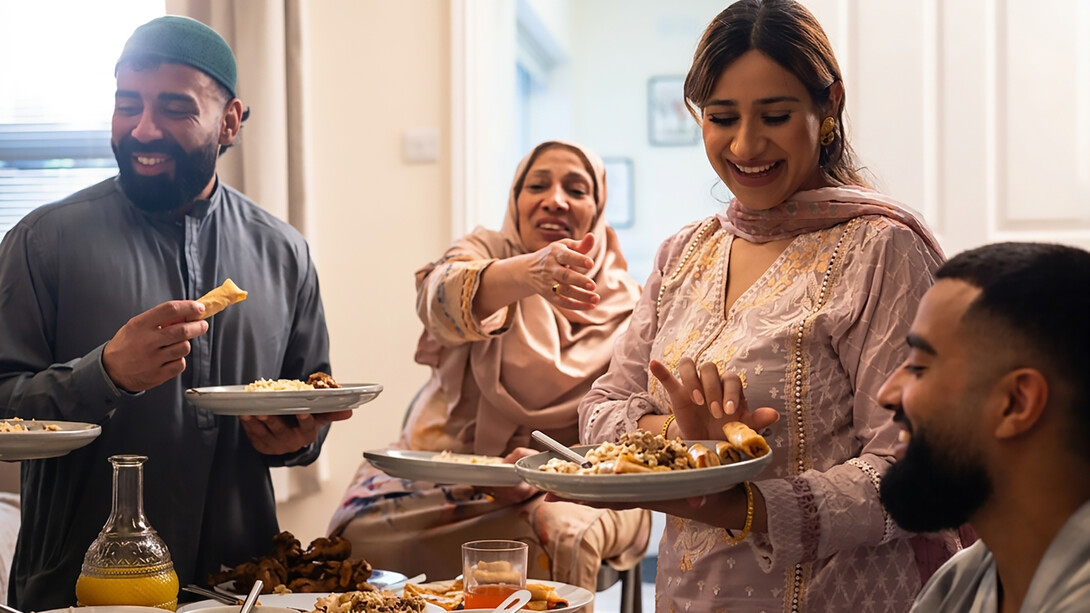
The flavors of Pakistan and Türkiye have been in a quiet, unspoken conversation for centuries, tied together by trade, empire, and the slow drift of culinary traditions across Eurasia. Yet when you live between these two worlds, hunger becomes something far more complex than appetite. There is a hunger that belongs entirely to memory. It strikes unexpectedly—in a sudden smell of roasting garlic or the exact angle of dusk settling over a neighborhood—and reaches back decades to a childhood you thought was settled in the past. It speaks through food: not the dishes you order from a menu and seldom the recipes you can recreate in a kitchen miles away.
Growing up in Pakistan, food was more than sustenance, more than culture. It was the primary language in which love was expressed, boundaries were tested, and ordinary days were made sacred. My grandmother’s hands were always stained with turmeric and moved through the kitchen with a surety I have never seen replicated. She didn't measure. She intuited. Some of this and some of that till it feels right. I’d sit on the kitchen floor, watching her make haleem for Eid, the meat breaking down for hours into something greater than the sum of its parts, and I knew, wordlessly, what it meant to be part of something bigger than myself.
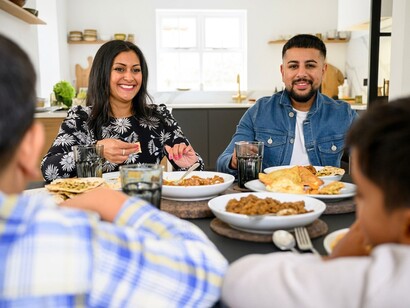
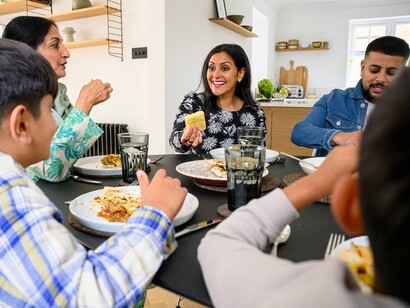
My childhood kitchen was moist, loud, and always alive. A few pots boiled at the same time, each demanding its own precise moment of attention. The air was thick with a mix of ghee, cumin, cinnamon, ginger, garlic, and coriander—the kind of aromatic mixture that just meant "home." On Sunday mornings we would gather around nihari, chicken chole, paye, and halwa puri—slow-cooked meat that would almost liquefy on contact with the tongue. Afternoon naps were accompanied by parathas layered with potatoes and cilantro, steaming in trays off the hot tawa. Sweets were never just a treat. Kheer, gulab jamun, and barfi were codes for exchanges. My mother's sticky jalebi, which she pressed into my palm before I left for school, was never just sugar; it was a promise held in syrup, a silent confession, and an unspoken comfort.
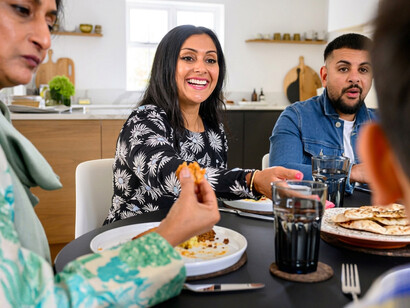
Food was our way to talk about things we couldn't talk about. When my dad was stressed about money, my mother would make his favorite biryani. The meat was slightly undercooked, and the rice was perfumed with bay leaves, Karachi style. When I was ill there was daal and chawal, plain and restorative, the kind that tastes like somebody saying, 'I'm here. The kitchen was the center of hospitality when relatives came, and we would spend entire days preparing spreads that would be over the top anywhere else but just right in our house.
And then I was gone. First for college, then more. The move to Türkiye was later but no less final than the rest, a plane trip that felt like it could be forever even if I didn’t want to admit it.
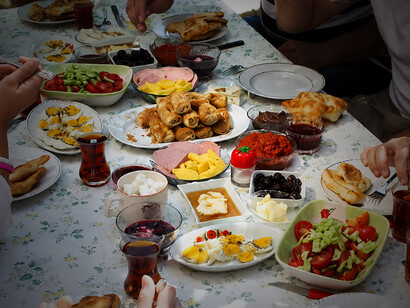
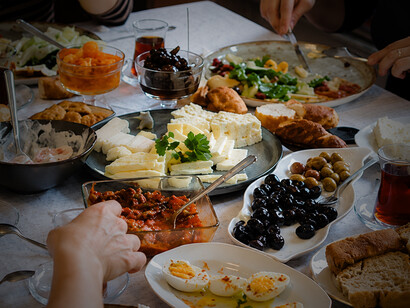
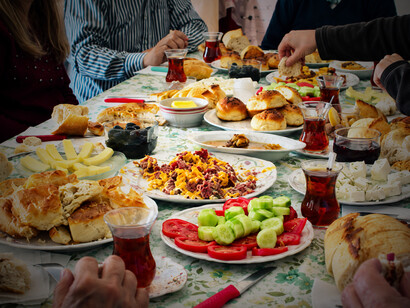
The food of Türkiye is incredible. I’ve learned my way around a plate of meze and a plate of kebab, learned to tell the slight differences between regional styles of köfte, and learned to appreciate the kind of precision that Turkish bakeries bring to simit and börek. There are times when I am truly present, truly content—eating a perfectly made pide straight from the oven or sharing a meal of çiğ köfte and ayran with work colleagues. Turkish food has its own logic, its own type of beauty.
But it's not my food language.
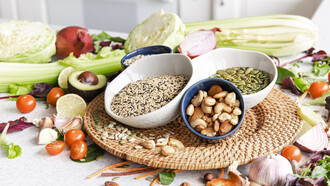
There is a grocery store in Istanbul, in a neighborhood I seldom have cause to visit, that sells Pakistani spices and lentils. Maybe I go there twice a year, and it is always a strange experience. The shopkeeper, himself Pakistani, knows exactly what I want before I do. I’ll take cardamom and chana dal and jaggery with me, promising myself I’ll use it to recreate something from childhood. Sometimes I do. More often they sit in my cupboard, growing more abstract with time, less like ingredients, more like talismans.
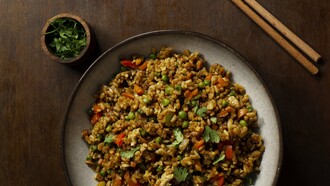
The truth is you can’t re-create these foods. I know how to make the nihari in my apartment in Istanbul. I have the recipe. The right spices. The patience to let it simmer. But it tastes of nostalgia, not of grandma's kitchen. The paratha tastes of hard work, not of ease. And maybe that’s the point. Perhaps the real food was only there, in that context: in that kitchen, with those hands, at that time in my life when I had not yet left.
But that doesn’t mean I don’t know these foods. It’s not handed in. I find myself looking for flavors in Turkish cuisine that remind me of something familiar. Love the cardamom in Turkish coffee. Reminds me of my grandmother's chai. Sumac brightens a dish the way lemon brightened my mother. I've begun to see these two food traditions not as separate but as conversations across my own biography. Türkiye has its own spice logic, its own way of layering flavor and time into a meal.
What’s striking me now is how food has become my main way of navigating my own displacement. When I feel homesick—which is not the same as unhappy, not the same as wanting to go home—it's not usually people or places I think of. I think of flavors. The sweetness of the gulab jamun, the texture of the paratha, the warmth of the chai as my family served it—not because it was tradition but because it was ours. These foods are anchors to a version of myself that lived in a certain geography.
I recently tried my hand at making kheer for a dinner with Turkish colleagues. Rice, milk, cardamom, condensed milk, pistachio nuts. Easy. I went through the process with great care, almost with reverence, as if the precision might in some way bridge the gap between Istanbul and Peshawar. When I served it, one of my guests asked if it was like rice pudding. And it is. On the surface. But there’s something about kheer that goes beyond texture and taste. It’s complicated by memory, by context, by the fact that I was making it alone in a foreign kitchen for people who couldn’t understand the layers of longing folded into every spoonful, however welcoming.
I don't know what to say about this. I have not “solved” the problem of nostalgia through food, and I don’t think you can either. But I’ve made peace with the fact that these foods—the ones from my childhood, the ones shaped by my grandmother’s hands—exist now only in memory, which is perhaps where food lives most vividly anyway. Taste is only half the experience. The other half is the when and where and who of you eating it.
And maybe it's no loss at all. Maybe this is the most honest way these foods could stay with me. not kept in amber, not endlessly copied, but alive in the space between longing and belonging, between Pakistan and Türkiye, between who I was and who I am becoming. Every time I go into that Turkish spice market and my eye catches a jar of garam masala, I’m not trying to turn back. I'm trying to take something forward.
Food, in the end, is how love and communication speak across the world. It is a map written in flavor, in texture, and in the muscle memory of hands that fold dough without thinking, hands that balance spices simply by calculating in the mind. I carry Pakistan on my taste buds in every spicy, juicy, rich flavor, while Türkiye has played an eminent role in who I was and who I am becoming. And in the spaces in between, in kitchens that are neither here nor there but somehow both, I am learning to live with a certain kind of hunger. A hunger that is, it turns out, not meant to be entirely satisfied but to serve as a constant reminder of where I’ve been and who I’ve become along the way.