English
 Español
 Français
 Deutsch
 Italiano
 Português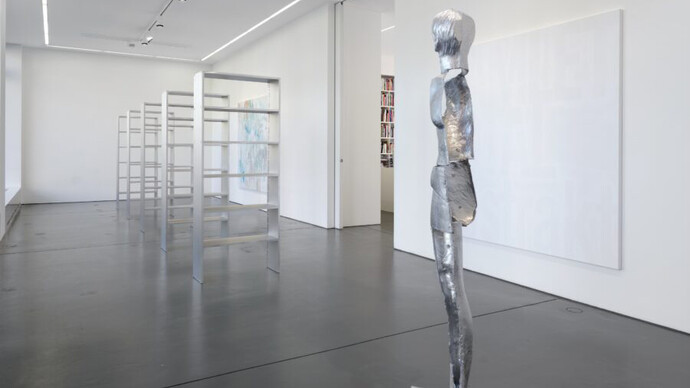
One has to flee modernity for fear that it won’t save itself.
(Frank Perrin, Symposium Villa Arson, Nice, 1991)1
Heimo Zobernig started his artistic practice at the end of the 1970s, at a time when skepticism about what art can do (or be) was already rather old. Since Hegel it has been clear that art is made, but no longer true; since Adorno that nothing else about it can be taken for granted. At no time since Modernity has art been apace with its own theory.
An interest in the material and proportions of standardized objects from everyday life runs through Zobernig’s entire sculptural oeuvre. Cardboard boxes, toilet paper rolls, mannequins—things that seem to slip into our perception almost incidentally—take center stage in Zobernig’s work. From the very beginning, he has repeatedly featured the Ikea Billy bookshelf, the world’s most widely distributed mass-produced bookshelf. Zobernig creates replicas of Billy bookshelves or their parts made of particleboard or plywood, reassembles deconstructed Billy bookshelves into new sculptures, or uses store-bought ones in which he places amorphous fabric dolls in video green, red, or blue.
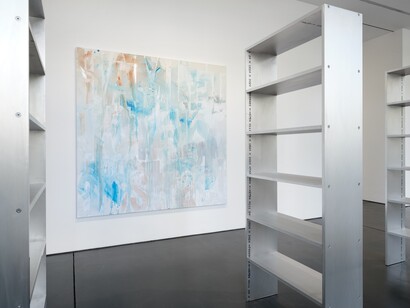
The latest series that we are now showing in Berlin—which could be described as a kind of “super-series”— consists of solid aluminum shelves that evoke a number of references: contemporary design, industrial aesthetics, but above all the sublime serenity of “Volumes” known from Minimal Art. Naturally, Zobernig leaves the material labels printed on the aluminum sheets by the supplier in place. The shelves are empty but have inscriptions. These inscriptions remain abstract to the art audience.
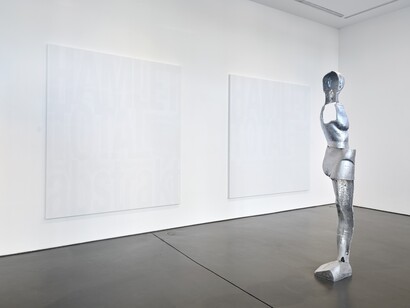
In addition, there is a fragmented human figure, also made of cast aluminum.
I was Hamlet. I stood on the coast and spoke with the surf Blabla.
At my back, the ruins of Europe.(Heiner Müller, Hamletmachine, 1977)
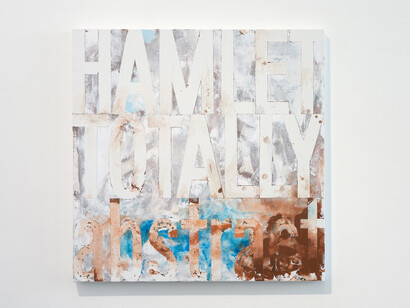
When asked by New York curator Matthew Higgs which book is the most important to him, Zobernig chose the Reclam edition of Shakespeare’s Hamlet. From Hamlet, one can learn that the dead are not dead; they return as ghosts. The new Hamlet paintings, which Zobernig presents here alongside the Ikea Billy bookshelf sculptures, feature the words “Hamlet total abstrakt” or “Hamlet totally abstract.” In Zobernig’s work, these canvases fall into the category of typographic compositions that generally do not evoke specific content, but rather present tautologies or individual terms—such as “painting,” “video,” “Real egal,” or “Love”—as if they were presented on a stage.
Zobernig, who studied stage design and who, in 1982, created a set for Heiner Müller’s play Quartett before devoting himself exclusively to his work as an artist, brings Hamlet's ghost onto the stage of his art and, at this time and in this place, also the ghost of Heiner Müller.
Notes
1 In the accompanying exhibition, Heimo Zobernig displayed a black cardboard cube in a kind of staged setting. When Dirk Snauwaert invited him to a solo exhibition at the Kunstverein München in 1992, Zobernig “reenacted” the Nice Symposium there.

![Various artists, [ materialistin ], exhibition view. Courtesy of Hamburger Bahnhof](/attachments/fd8f4fd76b73be0a02d398535c29d017e1309b65/store/fill/330/330/3f54331fd7869a13166dfe67a9e91306c6e180b2e29b9fd308d958b87ad2/Various-artists-materialistin-exhibition-view-Courtesy-of-Hamburger-Bahnhof.jpg)