English
 Español
 Français
 Deutsch
 Italiano
 Português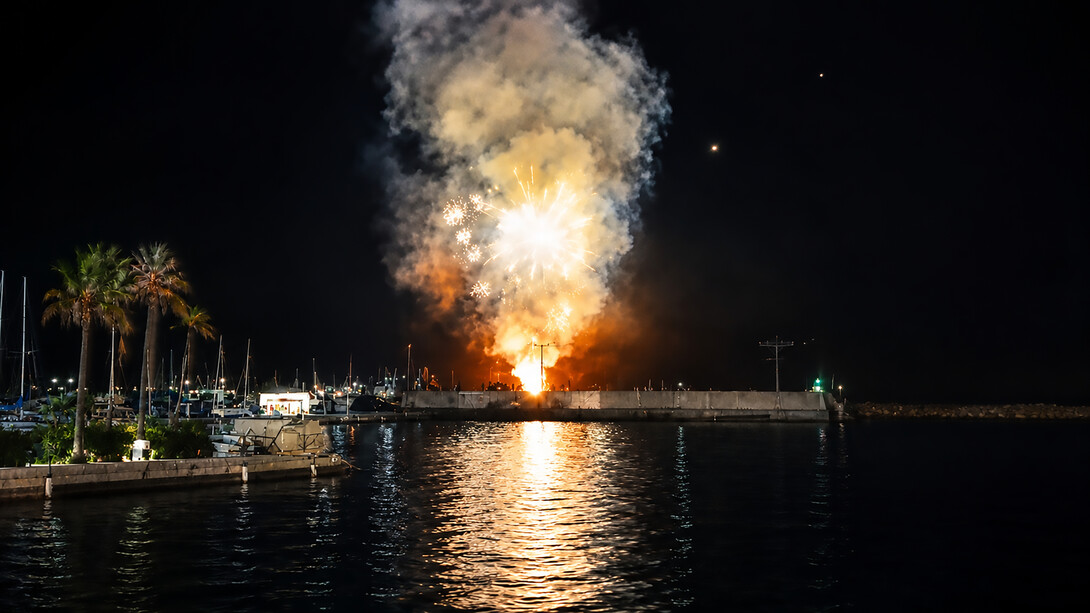
Extreme weather, nuclear threats, and AI-controlled surveillance of individuals, groups, and populations are in the background; in the foreground, lifeguards and life jackets are in short supply. Lethal fires precipitate the evacuation of people in both the countryside and town; sudden rains stop play and theatrical performances, and the world is in dire straits and bottlenecks, with humanity having to deal with social dementia. Under such conditions, dysfunctional human behavior is equivalent to suicide. The strengthening of mutual understanding between countries is commendable and philosophically correct. Patching up relations between countries at loggerheads with each other is vital. It becomes most urgent should they be in the nuclear weapons league. Here is where the World Philosophical Forum must play a more active role. Peace must be given its greatest chance. A return to Greek classical philosophy is necessary before it becomes homeless, relegated to the status of having no fixed abode.
As a result of such conditions, one side of humanity’s coin points to demise; the other depicts the infinite talent of mankind and his civilization. As an Earth citizen, I ask, I wonder which side will turn up tomorrow or the day after. Now, on one side of humanity’s coin is seen the fading light of civilization, while on the other is depicted the infinite talent of mankind. As an Earth citizen, I ask, will it be heads or tails? Both sides of the coin model are dynamically complex. Stimuli on either side can improve, reverse, or yield counterintuitive outcomes with varying degrees of uncertainty; violence may not be absent on the creative side, while beauty may be present on the side of demise.
Somewhere, and in many places, each day can be pleasant; somewhere, and in too many places, each day can be dreadful, while somewhere, today can be the first and the last. Today, the Aegean is most pleasant. As the honorary president of the World Philosophical Forum, I add that peace will depend on a shared reality of the cohort of all thinkers with a global citizen reach. Thinkers from the past like Tesla, thinkers for today, and thinkers for the future are all necessary.
As already indicated in my article A voice for Nikola Tesla making a case for his global recognition and enduring relevance, I would hold a small event at the time of his birthday, 10th July, 2026. In autumn, the World Philosophical Forum, Athens, will once again conduct a special event in Delphi at the center of the universe to promote a philosophical retrofitting and dialectical rebooting of man today to expunge social dementia from the face of our Earth before sunrise tomorrow. In continuum, the Forum believes that a Tesla revival by greater recognition of his merit can provide an extraordinary boost.
His greater recognition by the United Nations, as I outlined at the end of 2025 and in the inspirational setting of the Palais des Nations, Geneva, seemed like a credible, preventable act in the preservation of humanity on Earth or, stated differently, to steer mankind clear of potential self-destruction, as the United Nations Secretary-General has elegantly described. UNESCO’s Memory of the World does pay tribute to Tesla and his significant influence on the technological development of our entire civilization, and Serbia is investing in the renewal of his museum.
In 1897, he released controlled energy at Niagara Falls from the world’s first hydroelectric power station. When the switch was flipped, the Niagara River seemed to flow uphill, and power reached Buffalo at midnight. John O'Neil, Pulitzer Prize winner and science editor of the New York Herald Tribune, pointed out that Tesla believed that prosperity and progress could be achieved only through the conservation of nature and the proper use of energy and underscored his priceless contribution to international peace. Tesla, he wrote, lived and worked to bring peace to the world, to bring an age of peace, plenty, and happiness to the whole human race. The Teslas of our world are imbued with technological and ethical knowledge and systemic and philosophical wisdom and do not need weapons to secure their place in the world, while those without wisdom will not be saved by their weapons.
Although Tesla’s signal grows and the consensus to promote his fuller recognition spreads, the call for a just evaluation of his yet-to-be-valued contributions goes unheard in the waxed-up ears of the international community. Our consensual resolution to change things was not even read. It would, we hoped, fan Tesla’s still glowing embers into a flame that would illuminate the prestige of the international community. It didn’t! I cannot take refuge in the plethora of other issues also ignored!
As we cautiously light 170 candles over water and blow them out by the Aegean wind, we think of the man: a global citizen, a good Samaritan, a well-meaning adventurer, charismatic, generous, open-minded, practical, and a dreamer. As we eat his cake, we contemplate the need for his thinking to examine the loose coupling between radiation, brain activity, and neural damage in the context of artificial intelligence, and I wonder what my next step will be. He offered mankind the ideal of a scientist who feels and knows that the truth of scientific progress can never and must not be separated from the welfare of mankind.
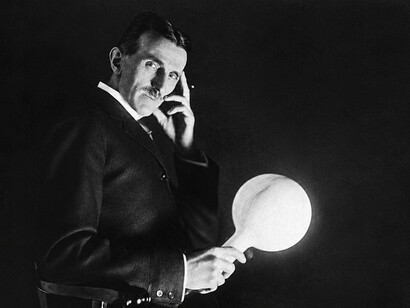
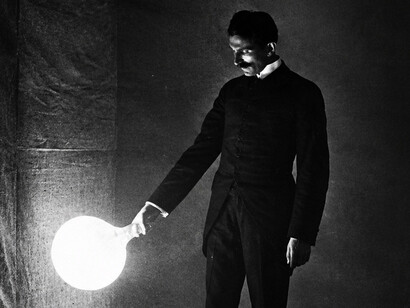
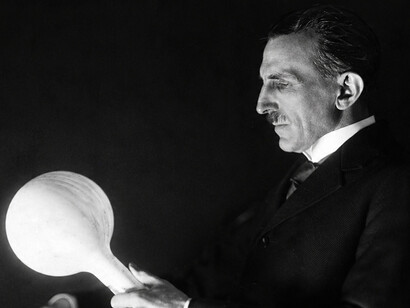
Today, on July 11th and from a temple dedicated to Apollo on a Greek island, I greet you with his light mixed with Tesla lightning. Nikola Tesla was born in 1856, a Serbian physicist and inventor, one of the pioneers in the use of alternating current, and much more. Set aside by the world that he enlightened, abandoned by the business world, and in economic hardship, he died far from home (1/7/1943) but was well remembered by thousands of ordinary people who attended his funeral in New York. He departed the world knowing that he had changed it but not knowing by how much.
We know how much he continues to shine! He did not fade into oblivion but was never given his due in an oblivious world. He theorized about the dangers of electromagnetic radiation to communication and the human brain when he spoke about a death ray. He theorized that the application of electricity to the brain enhanced intelligence. Dull students could be motivated with infinitesimal electric waves vibrating at high frequency through the wired walls of the schoolroom, which could be converted into health-giving and stimulating baths of electromagnetic fields.
Since his death, the Supreme Court of the United States has granted him priority on radio patents, the world of physics has drawn upon his name to designate the strength of a magnet in magnetic tomography, and the business world has given his name to the electric car. But a special day in the name of Nikola Tesla remains a pipedream. So far there is no light at the end of the tunnel, no spark to kindle that can lead the way. So we have 170 candles unseen by the international community over the waters of the Aegean but well-noted by Prometheus and hopefully picked up by some satellite or skytrain overhead.
As the World Philosophical Forum registers its failure to convince the United Nations to establish a special day in commemoration of the legacy of Nikola Tesla, it has not given up on the man admired by the public at large. Sometimes in the course of history, when ideas grow too big or when their implications can upturn society, visionaries can be silenced. Sometimes the corridors of power act as a communications conduit, while at others they often act as a wind tunnel, ripping up the signal and adding noise. It is just possible that the ideas of the man with several hundred patents and who envisioned global communications and clean, green energy can still enlighten the ongoing debate on 5G, fifth-generation wireless technology, communications, disruptive technologies, and artificial intelligence, as well as e-waste and greenhouse gases. At this time of geopolitical crisis, his name is a current reminder of electricity, which is the end goal of all fuel use, including alternative energy sources (solar), the need for which he foresaw. E-waste and greenhouse gas
Happy birthday, Nikola Tesla.
Should the coin fall fully on the side of demise, the chimes of Big Ben will not make it to the 12th chime, no baby will cry, no cherry will ripen, and the olive branch will be obsolete. Languages will fall silent, and radio and television will fail to broadcast. At that apocalyptic moment, millions of years of evolution will unravel, and the complexity to sustain human consciousness will disintegrate. Only by ridding the world of nuclear weapons and politics recognizing the true dimensions of climate change and the need to temper civic education with wisdom and morality embedded in classical Greek philosophy will the coin come down in favor of creativity. Otherwise, despair is never better expressed than by Aeschylus: pain so intense, not forgotten even in sleep, falling from the heart, drop by drop, until in our despair, against our will, wisdom comes through the terrible grace of God. The wisdom in Aeschylus is philosophy, which provides a road paved by logic to peace. Philosophy is marginalized in Greece, can’t find a place in the United Nations, and this world suffers more and more from social dementia.
Let me end with two quotes referenced in Italy, the first from the Rome Declaration, 2026: When nuclear weapons were first being developed, the world had a chance to avoid living in a permanent dynamic of fear. We failed…AI (now being) built into nuclear systems leaves little time for human judgment in a crisis… Without facts there can be no truth; without truth there can be no trust; and without trust, no dialogue, no verification, and no restraint among nations. And from Milan and my presentation 60 Years of Association of Schools of Public Health in the European Region (ASPHER, 1966-2026) during the 1st European Congress on Education and Training in Public Health, which I ended with a statement made by Andrija Štampar to those who actually governed China on leaving in 1936: social and economic questions cannot be solved by cannons and guns.
Happy birthday, Nikola Tesla. Like Štampar, you came from the Balkans, where Eleftherios Venizelos once said that there can be no peace unless the agrarian problem is solved and rural health is ensured.
Taste my Tesla cake baked with imported dough!
This article is dedicated to those who missed my party.
To their health and their community's health…
This is for Tesla, Nikola, that is!
This is for philosophy and philosophers who hear the Sirens.
This is for all with waxed-up ears, for those who don't hear.
Or don’t want to hear the Sirens.