English
 Español
 Français
 Deutsch
 Italiano
 Português
Before reading the next sentence, inhale gently through your nose. Then exhale a little more slowly than you inhaled.
Well done. You just influenced your nervous system without needing a self-help book, an app, or any special device.
Breathing is one of the most ordinary things we do, so we rarely think about it. We take about 20,000 breaths each day1, but most go unnoticed. Over time, breathing became automatic enough to ignore, yet it still shapes how we feel, think, move, and connect with the world.
Long before we spoke our first word, we took our first breath. Before language let us talk to others, breath was the body’s first language, a silent exchange between the brain, heart, lungs, and every cell that needs oxygen to live.
Modern neuroscience is showing what contemplative traditions have suggested for centuries: breath is much more than just moving air. It is one of the few body processes that can turn physical needs into mental states and even let the mind respond in return.
Before we had words, we had breath
The first announcement of human life is rarely a smile. It is a breath. That first inhalation inflates lungs that have never encountered air before. Moments later comes a cry, not because babies are giving speeches, but because breathing and sound are inseparable. Breath quite literally gives voice to life.
Our final breath often becomes the defining symbol of life’s end. Between these two moments stretches an entire existence measured not only in years but in millions of inhalations and exhalations.
This symbolism appears almost everywhere. In many cultures, breath and life share the same word or concept. In yoga, prana refers to the vital life force carried through the breath. Ancient Greek philosophers used pneuma to describe both breath and spirit. In Hebrew, ruach can mean breath, wind, or spirit. The connection seems almost universal.
Autonomic nervous system
Most of the time, it happens automatically thanks to the autonomic nervous system2, which regulates essential bodily functions without conscious effort. Yet breathing has a curious exception.
At any moment, you can decide to breathe faster, slower, deeper, or pause briefly between breaths. Unlike your heartbeat or hormone production, respiration belongs to two worlds simultaneously: it is automatic enough to keep you alive and voluntary enough to allow conscious influence.
This unique quality makes breathing one of the most interesting systems in the human body.
Researchers3 now often describe slow, controlled breathing as a practical way to affect the balance between the sympathetic nervous system, which triggers our “fight or flight” response, and the parasympathetic nervous system, which is linked to rest, recovery, and restoration.
Studies have shown that slow breathing can improve heart rate variability4, reduce perceived stress5, and enhance emotional regulation6.
In other words, breath is not just an air pump. It is more like a conversation between the conscious and unconscious mind.
Every emotion has its own breath
Imagine you're about to give a presentation at work. As your name is called, your heart starts beating faster. Your shoulders tense, and without realizing it, your breathing becomes quick and shallow. Your body is preparing for what it perceives as a challenge.
Now fast-forward a few hours. You're sitting on a quiet beach at sunset, listening to the waves. Your shoulders drop, your jaw relaxes, and your breathing becomes slower and deeper without you making any conscious effort.
Nothing about your lungs has changed. Your emotions have.
Our breathing constantly mirrors what is happening inside us. Different emotions tend to produce different breathing patterns:
Fear: short, rapid breaths.
Anxiety: fast, shallow breathing, often in the chest.
Anger: forceful, heavy exhalations.
Sadness or grief: sighing or irregular breathing.
Joy: deeper, more open breaths.
Calm: slow, steady, diaphragmatic breathing.
It’s interesting that we usually notice our emotions before we notice our breathing, even though our breath often changes right away.
Now imagine the presentation again. This time, before you begin speaking, you pause for a minute and take five slow breaths, inhaling through your nose and exhaling a little longer than you inhale. Your heart rate begins to settle, your shoulders relax, and your mind feels clearer.
The presentation and the audience are the same. But your body now gets a different message: you are safe.
This is exactly why researchers are so interested in breathing. Psychologists and neuroscientists have shown that emotions and breathing are deeply interconnected7. While our feelings naturally change the way we breathe, intentionally changing our breathing can also influence how we feel.
Put simply, your breath does more than just react to your emotions.
Nose or mouth? Your body has a preference
We may not think about it often, but how we breathe is just as important as how much we breathe.
For most everyday activities, our bodies are designed to breathe through the nose. As air passes through the nasal passages, it is warmed, filtered, and humidified before reaching the lungs. The nose also produces nitric oxide, a naturally occurring molecule that helps support healthy circulation and efficient oxygen delivery throughout the body.
We need to breathe through the mouth during hard exercise, when we’re congested, or when the body needs a lot of air quickly. But if mouth breathing becomes a habit during rest or sleep, it may not be as efficient as breathing through the nose.
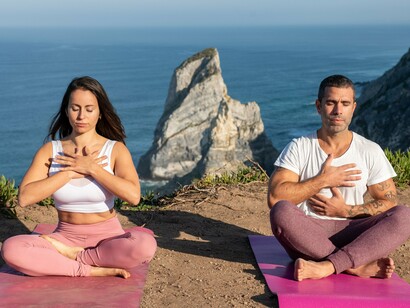
You don’t have to breathe perfectly. It starts with simply being aware. By noticing your breath and letting it return to its natural rhythm, you can help your body and mind without adding anything extra to your day.
Breath through ancient traditions
Earlier, we saw that many ancient cultures used the same word for breath, life, and spirit. This was not just poetic language. It showed a shared belief that breathing was more than a body function; it was seen as the essence of being alive.
This perspective appears across cultures that developed independently from one another. Despite their different beliefs and philosophies, many placed breath at the center of their contemplative practices:
Yoga developed pranayama, a collection of breathing techniques intended to cultivate physical, mental, and spiritual balance.
Zen Buddhism invites practitioners to begin meditation by simply observing the natural rhythm of the breath.
Taoist traditions emphasize effortless breathing as a way of aligning with the natural flow of life.
Christian contemplative prayer, Sufi practices, and many forms of Buddhist meditation also use the breath as an anchor for attention and presence.
Modern science hasn’t proven these traditions right or wrong. Instead, it is starting to explain the body processes that might show why these practices often help with focus, stress, and emotional well-being.
In my previous exploration of Holotropic Breathwork: A Trip Full of Oxygen8, I discussed how specific breathing techniques can produce profound psychological experiences. Later, in Breathwork vs. Meditation9, I explored how both practices approach the same destination through different paths.
Breathing is not just a way to get ready for meditation. It can be the practice itself.
Perhaps change begins with a single breath
All our lives, we’re taught to manage our minds. We try to think more positively, shift our perspective, or quiet unwanted thoughts. These methods can help, but they all start with the mind. Breath gives us another way to begin.
As we've seen, breathing is one of the few functions that connect the conscious and unconscious parts of the body. By changing the rhythm of the breath, we can influence the nervous system, which in turn shapes the way we experience our thoughts and emotions.
Of course, taking a few slow breaths won’t solve all of life’s problems. It won’t fix conflict, take away grief, or remove uncertainty. But it can help you respond with more clarity instead of just reacting automatically.
Calmer breathing often leads to a calmer nervous system. When your nervous system is calm, it’s easier to think clearly, make better decisions, and feel more present.
In my previous article, Detox Your Mind in One Day10, I explored the idea that mental clarity doesn't always come from consuming more information. Sometimes, it comes from creating space.
Breathing might be one of the simplest ways to create that space. Not because we’re escaping reality, but because we’re meeting it with more awareness; one inhale and one exhale at a time.
The conversation that never stops
As we go through life, we learn new languages to understand the world. English, Spanish, French, and Mandarin; each lets us connect with others, discover new cultures, and see the world in new ways. But as we learn these languages, many of us lose touch with the first one we ever knew: the language of breath.
Long before we spoke, our breathing showed what was happening inside us. Without words or grammar, it honestly reflected our inner world. Every emotion, challenge, and peaceful moment has always shaped the rhythm of our breath.
Today, science helps us understand why. Although they approach the subject from different perspectives, both ancient wisdom and contemporary research arrive at a remarkably similar conclusion: paying attention to the breath changes the way we experience ourselves and the world around us.
Perhaps that is why breathing continues to fascinate neuroscientists, psychologists, physicians, athletes, meditation teachers, and yoga practitioners alike. They may use different methods and speak different scientific or philosophical languages, but they all return to the same practice: noticing the breath.
Our bodies have been communicating with us since birth. Maybe the oldest language we learned has been speaking to us all along. The real question is not if our breath has something to say but if we are willing to pause and listen.
Notes
1 2020: The Year We Lost Our Breath. American Lung Association.
2 Autonomic Nervous System Disorders. National Institute of Neurological Disorders and Stroke.
3 The influence of slow-paced breathing on stress and the autonomic nervous system. Frontiers in Physiology.
4 Heart Rate Variability Biofeedback: How and Why Does It Work?. Frontiers in Psychology.
5 How Breath-Control Can Change Your Life: A Systematic Review on Psychophysiological Correlates of Slow Breathing. Frontiers in Human Neuroscience.
6 Breathwork Interventions for Adults With Clinically Diagnosed Anxiety Disorders: A Scoping Review. Frontiers in Psychiatry.
7 Respiratory Feedback in the Generation of Emotion. Cognition & Emotion.
8 Holotropic Breathwork: A Trip Full of Oxygen.
9 Breathwork vs. Meditation.
10 Detox Your Mind in One Day.