English
 Español
 Français
 Deutsch
 Italiano
 Português
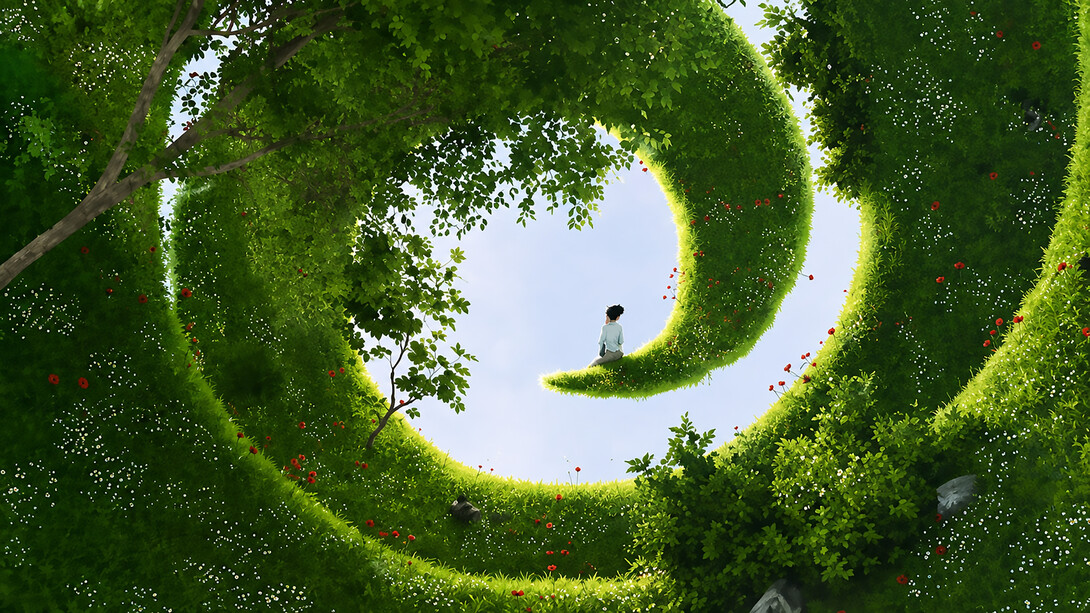
As a humble observer, I see time and infinite space as interconnected realities. (I got a hint from Albert Einstein and his teacher, Hermann Minkowski). Even though they are both endless, the difference is that movement in time is limited to going forward. We cannot stream backwards, and we can’t skip ahead. What we can control is the current moment and plan the next step.
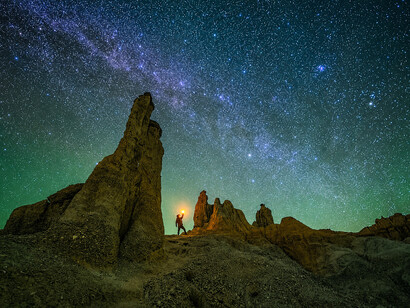
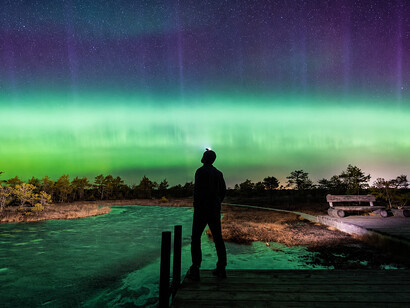
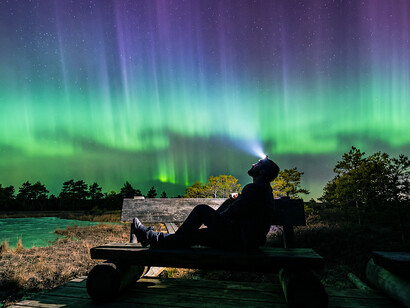
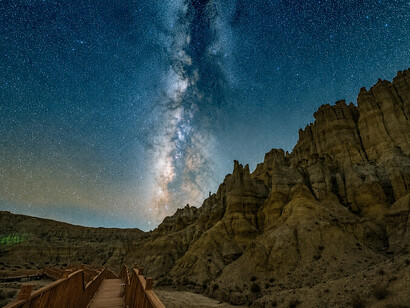
Looking up and out into the beyond, we are in awe of the calm, the inspiration, the possibilities. A free expanse of hope with the energy of yes.
If you are a humble observer like me, the great quiet of the unbounded starlit sky and the untouchable horizon overwhelm us. A soft strength of wow.
As we narrow our wide scope of wonder to our immediate circular moment, we realize that the great hopeful calm projects to a chaotic buzz. Around flowers, for example. Observing them from a distance, the field of colored flowers blissfully delights us. As we peek in up close, bees are waggling in a frenzy from one flower to another, pollinating and vitalizing nature. Without bees, there is no beautiful meadow. Just like without a moment, time would be empty.
And when we focus on the present time, as you are reading this, it becomes the past yet has great potential for the future.
Could it be that’s why we are so obsessed with time’s promise in the urgency of the present, before now becomes then?
As much as we are privileged by time’s generosity, we can never have enough. We’ve all said at least once, “If only we had more than 24 hours in a day!” When in reality, only we delineate time. By itself, time knows no limits.
We didn’t always feel this way. Over the past hundred years, our lives, our routines, and our tasks were greatly facilitated by a multitude of inventions and technology. The telephone helped us immediately communicate instead of waiting for a letter by the post. The radio spoke the news to a mass of people before newspapers printed headlines for individuals to read. Planes transported us quickly across continents, unlike those long ship journeys. This progress reinforced time’s hope. To create, accomplish, and enjoy more. Except the notion of time freeing us has changed. Today, time is synonymous with anxiety.
How could this happen?
From a simplified routine opening up precious hours to complicated days constrained by not having enough hours.
We went from defined tasks in our daily routine to multitasking every aspect of our lives.
Making matters worse, we are bombarded by media outlets and influencers who heavily guilt us about the mismanagement of our time. Except it’s not just media outlets and personalities anymore. It’s the inventors of the technology that entice us with products to optimize our time so we can be released into the freedom of space.
And then I hear this:
Humans want to get in the car, send that last email they didn’t get to send, and check on the kid that’s screaming. But we’re trying to drive and do that. So, this really gives you the chance to take care of all of those things, and then let the Waymo driver safely get you to - from Point A to Point B.
(This is a quote from Waymo co-CEO Tekedra Mawakana in a 2025 60 Minutes interview with Anderson Cooper.)
She confidently speaks as though she’s reassuring us. Do you feel better? All I feel is stress, disorganization, and confusion. I am not reassured at all.
Where did we go wrong? We’ve invented technology to buy us time, but all it bought us was urgency. Like the bees, we are expected to waggle frantically from task to task, dizzying our attention until we are exhausted. But without the buzzing bees, there is no garden of flowers, so how do we manage?
Tekedra Mawakana, as well as other tech leaders, is selling us an image of freedom that doesn’t describe freedom at all. Her quote described unaccomplished work, an insecure child missing their mom or dad, and tied-up hands unable to drive oneself. I should be turning off distractions to focus on my final email. Hold my child’s hand while strolling to the park. Or sing my old-time favorites driving back home.
Mawakana’s quote is actually multitasking at its worst.
It’s more than that. Human nature thrives on productivity and ventures for gain, not rest. So, when we invest in optimizing time, we will use that spare time not by freeing up its space but to increase our prosperity all the more. Making time earn for us as much as possible. Time is money, so they say.
And so, tech magnates easily tempt us with new and improved designs of AI models and facilities.
Except, the people building these technologies appear unable to use their free time for personal enrichment, discovery, creativity, and wandering. They don’t do it themselves but expect us to do things differently.
The tech visionaries are caught in their own trap. Striving to augment human capabilities. Working harder, faster, and smarter to reach the unattainable when they already have enough. Why are they so afraid to pause? They have forgotten that the pause to awe is what set the path to their success today.
But the opposite is happening. They expect us to behave ideally. And just like them, our human nature nudges us to compete and aim for more. By adopting their cutting-edge digital assistance, we demand of ourselves to perform and crush it! A race against time in space, if you remember.
From the enhanced comforts of life, ensured to us by AI agents and models, we’re forcing ourselves to quantify every aspect of it. Clearing space for leisure and loved ones, I’d like to know: have any of you taken advantage of this bonus time?
AI agents and advanced technology do their job right. With excellence, to be honest. Using a small example, dictating and writing a professional email has become a whisper. (Whisper AI, get it?) Designing a website, a PDF, or an Excel sheet is AI child’s play. Developing a strategy, done by noon. Technology is not the problem.
Our mindset is.
We have to remember that the buzzing bee also observed, from far above, that field of flowers. Those inviting colors inspired the busy bee’s production of delicious honey. The bee stared into a wide expanse of hope, then buzzed through a chaotic pursuit to be satisfied by savoring its labor.
Technology can free up time. We create presence.
Individually, we set boundaries between vital work and wandering our gaze into the vast sky. We need to distinguish between the value of monetary wealth and the value of time in space.
Looking closely, we realize that money will always have its momentary frenzy. Within the endless dimensions of time and space.
Between immediacy and wondrous hope, it’s up to us to define what reality we value most.