English
 Español
 Français
 Deutsch
 Italiano
 Português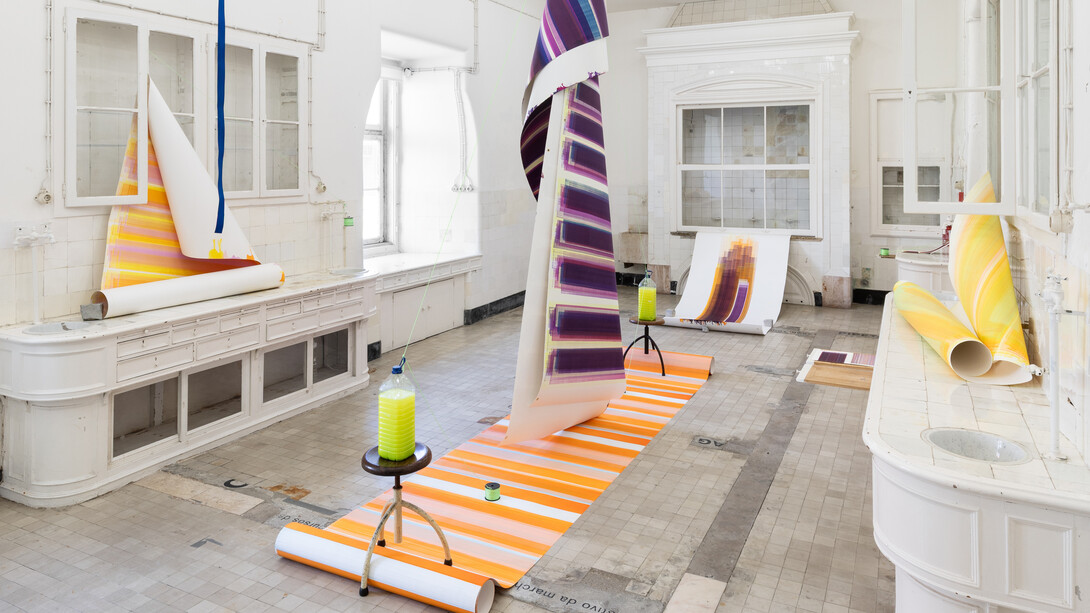
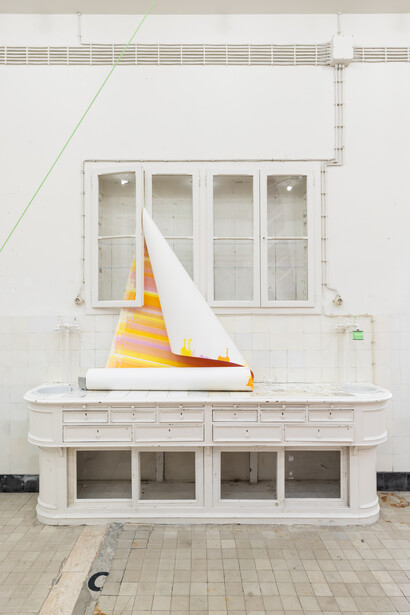
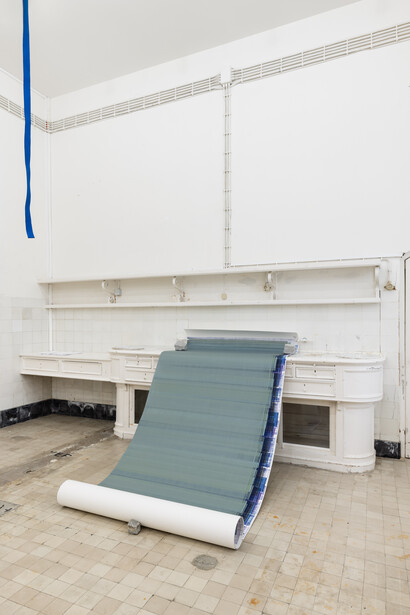
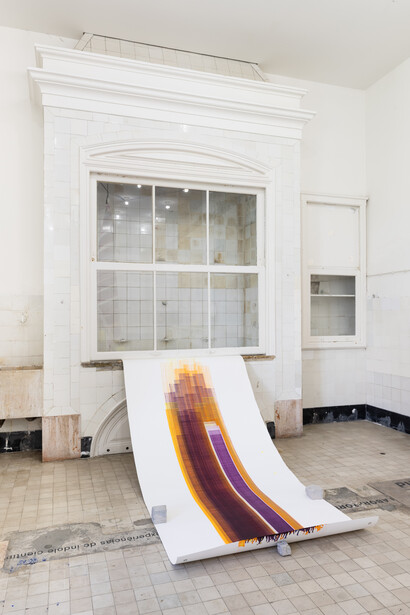
Galeria Nave is pleased to present Scrollpainting153 caput mortuum metamorphosis, the second solo exhibition in Lisbon of the German artist Elisabeth Sonneck. This time in MUHNAC National Museum of Science & Natural History of Lisbon and curated by Sofia Marçal in the historic chemistry laboratory, Sonneck will present a site specific using a mineral substance as starting point, the name of which is also the name of a colour.
It traces the scientific discipline of chemistry back to its roots, alchemy, which has been the study of the properties and reactions of substances since the 1st/2nd century. Caput mortuum is a worthless by-product of sulphuric acid production and, at the same time, a key colour in the history of painting up today.
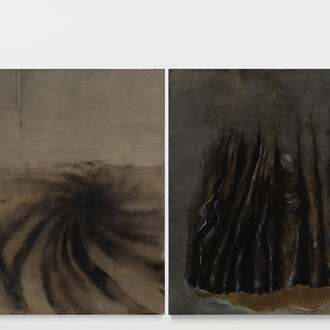
Elisabeth Sonneck colouristic research for the site specific installation Scrollpainting153 caput mortuum metamorphosis ranges from small works on paper to large Scrollpaintings, not so as to examine the Caput mortuum on the basis of its monochromatic, opaque pigment, iron(III) oxide, but rather to create a multicoloured spectrum around the Caput mortuum that also encompasses complementary colours.
The artist is not concerned with a mimetic reproduction of the Caput mortuum. Her research focuses on the countless possibilities that arise from approaching this colour, rather than on achieving it. The search itself is expressed in colour.
In the exhibition Scrollpainting153 caput mortuum metamorphosis, this direct link between the waste product of a chemical production and a characteristic hue in painting – Caput mortuum – is embodied in flexible sculptural formations. These arise from the inherent material tension of the paper itself and only come into being during the installation process, which activates the historic chemistry laboratory in its current state. The paper retains the potential for ongoing metamorphosis; it does not solidify into a final form, but remains, for the duration of the exhibition, in a fragile state of equilibrium that transforms the venue – the laboratory itself – into a space of colour.
The curator Sofia Marçal, about the artist practice: “Elisabeth Sonneck's work generally addresses a relationship with science, especially chemistry: it explores the relationship between substances, their compositions, and, above all, the reactions between them. Thus, as scientific research is part of her reflection and method of investigation, the artist aims to reveal the conditioning factors in her work; the paintings directly show her physical-temporal creative process. The installations are balanced with physical precision and without hidden defenses in the location.