English
 Español
 Français
 Deutsch
 Italiano
 Português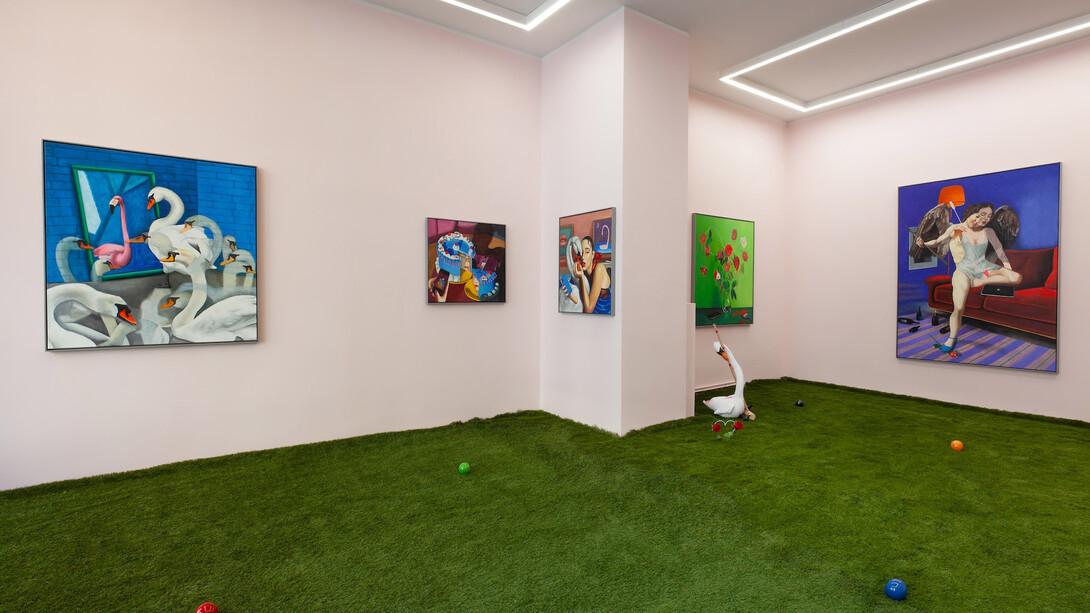
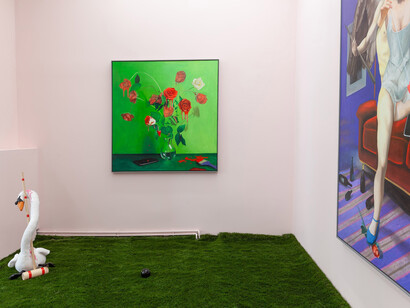
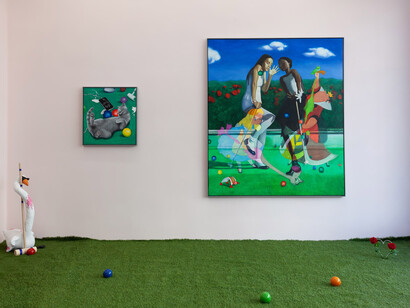
Zohar Fraiman’s exhibition Queen of hearts welcomes visitors with an immersive aesthetic experience of green artificial grass and pink walls. Hearts, roses, flamingos, and smartphones drift across the canvases as recurring motifs, here and there familiar faces. Swans pose in a state of metamorphosis. The site-specific installation the artist designed for her solo exhibition at Galerie Russi Klenner draws on the animated universe of Disney’s Alice in Wonderland (1951), which she also integrates into her new paintings. Love is a Losing Game references a scene in the Queen of Hearts’ garden: Alice is involuntarily drawn into a game of croquet with the tyrannical Queen of Hearts, in which flamingos are brutally misused as mallets. This visual level slides in front of the central motif of a pair of female figures with croquet mallets like a dream sequence. But instead of playing, the protagonists are fending off balls flying towards them.
Just as the game turned into an attack, the croquet in Wonderland follows neither fair rules nor any inner logic. In the end there are no winners, only the bitter realisation that this game was lost from the start. This is also reflected in the work’s title, which quotes Amy Winehouse: “Love is a losing game / One I wished I never played [...]”. Transferring that “dark side of love” to the digital world the trivialisation of the concept of love into the mere symbol of the heart becomes apparent: the Like, which stirs maximum desire but can also lead to maximum vulnerability.
The work Queen of hearts, which lends the exhibition its title, combines a hand mirror and chalice with poisongreen liquid into an amalgam that unites not only container and reflection, but also Disney’s Snow White’s stepmother (Chaotic evil!) and Kim Kardashian (Goat) in the form of overlapping, fragmented faces. The influencer and businesswoman Kim Kardashian has set new standards in beauty and fashion through skilful social media marketing and is considered a contemporary icon. Snow White’s stepmother personifies jealousy and malice. She hates her reflection; Kardashian sells hers. Both are part of a toxic mixture of beauty and power. In literature and art, the mirror has long served as an ambivalent symbol of identity-seeking and self-knowledge, but also of vanity and illusion. In Lewis Carroll’s Through the looking-glass it embodies a portal between reality and fiction. Through the interlocking of visual layers and motifs, Queen of hearts deconstructs identities and reveals the complex relationship between inner and outer world, self-perception and the perception by others in the digital age.
In Genuinely pretending, too, Fraiman places the mirror at the centre, this time as a projection surface. A swan searches for its own reflection, yet reality and image do not align, as if hidden truths were being uncovered through the reflection. The work’s title hints at it: the swan attempts to be something it is not. It desires the unfamiliar. But the flamingo in the mirror turns out to be a mirage, a construct of likes and filters, and thus a (self-)deception.
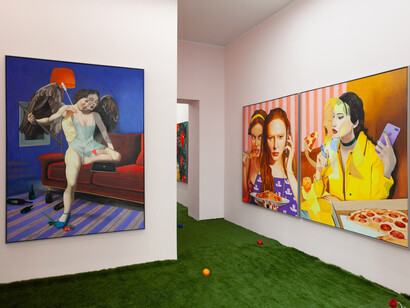
In Cupidon, an antagonistic hybrid of the love angel Cupid, quoting Caravaggio’s Amor Vincit Omnia (1602), and a Madonna-like woman, sits on a red sofa in a blue room. While the female figure aims the tip of a white arrow at the tablet lying in front of her, the mischievously grinning Cupid draws a dark arrow, ready to disrupt his counterpart’s action. The target is the halo emoticon on the screen, symbolising innocence and naivety, but also serving to relativise cheeky, suggestive behaviour through playful innocence.
It is not the fictional Alice in Wonderland but Ovid’s original myth of Leda and the swan that forms the basis of Leda and me. According to this myth, the Greek father of the gods, Zeus, transformed himself into a swan to seduce Leda, the wife of the King of Sparta. While numerous depictions (among others by Correggio and Rubens) interpret the myth as an erotic scene of seduction, authors such as W.B. Yeats and Hölderlin classify it as a symbol of violence, fate, and new beginnings.
Zohar Fraiman initially inverts the legend: holding a smartphone, the female figure compels the swan into taking a selfie, forcing it into an artificial pose. Red lips and a lustful gaze reinforce the erotic undertone of the Leda subtext. A background painting depicting a swan in a naive childlike style opens up a fascinating interplay of interpretations and simultaneously provides the perfect selfie backdrop. Yet the protagonist’s bold mask begins to crumble, and the supposed selfempowerment reveals itself as a hollow performance.
Who are we when we constantly move between virtual and real spaces? What is real, what is fake? In her works, Zohar Fraiman dissects the fragile facade of digital identity and translates its fragility into the analogue world of painting. Her vibrant visual worlds merge, morph, overlap, deconstruct, and question virtual and physical realities: what remains of individuals when they define themselves through clicks, likes and algorithms? In a seemingly parallel society with its own set of rules, influencers and selfie cults reign under the currency of social recognition. Mirror, mirror on the wall, who gets the most likes of them all? Fraiman’s hybrid visual worlds probe the interfaces between virtual self-staging and physical existence. By interweaving fiction, myths, and fairy tales with fragments of reality from the digital realm, she develops unflinching reflections: between self-staging and external control, between the desire for authenticity and the construction of a perfect facade. Her art becomes a seismograph of an era in which the boundaries between reality and simulation blur, and in which painting itself resists the transience of the digital.
(Text by Magdalena Mai. Translation by Emanuela Anders)

![Various artists, [ materialistin ], exhibition view. Courtesy of Hamburger Bahnhof](/attachments/fd8f4fd76b73be0a02d398535c29d017e1309b65/store/fill/330/330/3f54331fd7869a13166dfe67a9e91306c6e180b2e29b9fd308d958b87ad2/Various-artists-materialistin-exhibition-view-Courtesy-of-Hamburger-Bahnhof.jpg)