English
 Español
 Français
 Deutsch
 Italiano
 Português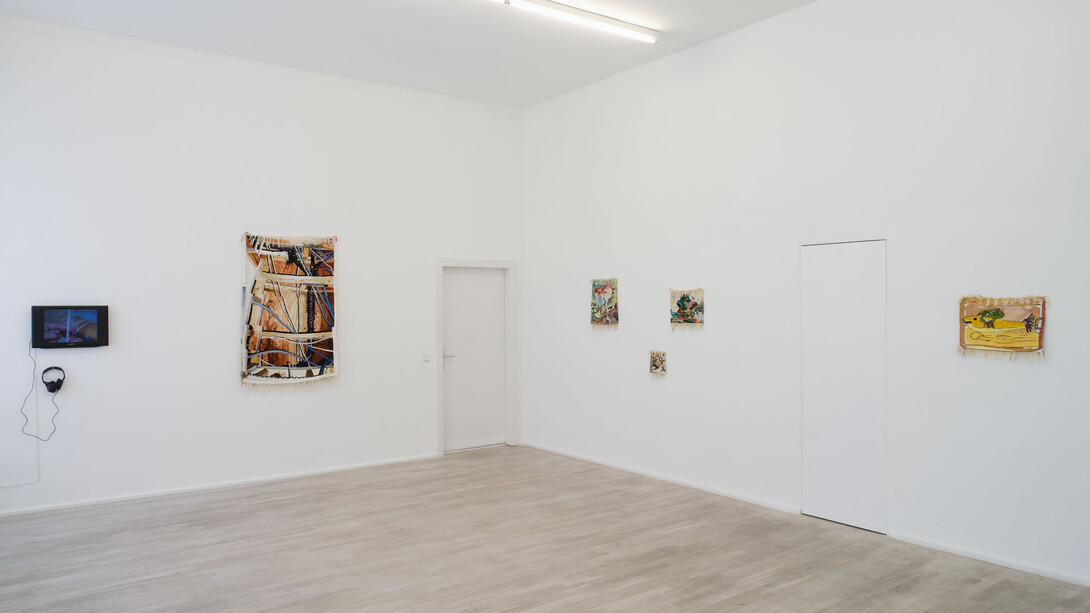
We are delighted to announce the fourth solo exhibition at the gallery by Ingrid Wiener, born in Vienna in 1942. Gobelins, films and dreams brings together a selection of her recent tapestries, a series of her intimate ‘dream drawings’, videos, records, and books. To complement this, we show a film by Oswald Wiener from 2015. This film, which takes the weaving as an artistic practice of his partner Ingrid Wiener as its starting point, was discovered in the estate of the writer and cyberneticist, who passed away in 2021. It is being screened publicly for the first time.
Ingrid Wiener has been weaving tapestries since the mid-1970s. Barbara Wien already worked with Ingrid Wiener in 2003, devoting a solo exhibition to the history of the joint tapestries by Ingrid Wiener and Dieter Roth, which were created between 1974 and 1997 as a result of the equal collaboration between the two artists and occupy a special place in their oeuvre. In 2008 and 2019, the gallery presented solo exhibitions featuring weavings, works from Canada and dreams by Ingrid Wiener.
Among Ingrid Wiener’s important institutional exhibitions in recent years were: Die teppiche von Dieter Roth und Ingrid Wiener/The tapestries of Dieter Roth and Ingrid Wiener, 2007/2008 at the Kirchner Museum Davos and the Neue Galerie Graz, curated by Karin Schick; northwest passage, 2020 at the Austrian Museum Hartberg, curated by Michaela Leutzendorff Pakesch, who has been expertly supporting the artist and her work for years; the exhibition with Martin Roth, Von weit weg sieht man mehr, 2023 at Kunsthaus Graz, curated by Katrin Bucher Trantow together with Michaela Leutzendorff Pakesch; also in 2023, a solo exhibition at Kunsthalle Bremerhaven, curated by Stefanie Kleefeld with Michaela Leutzendorff Pakesch; and in 2025, Einfach machen und tun at Marta Herford, curated by Kathleen Rahn.
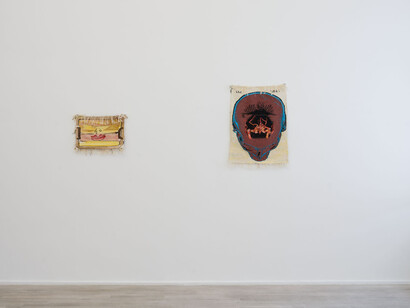
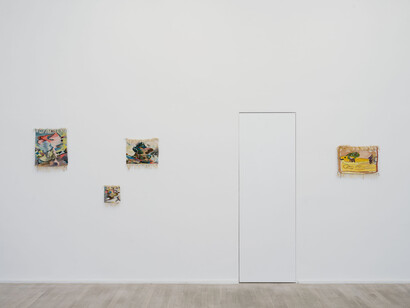
The current exhibition in Berlin features ten tapestries by Ingrid Wiener, including Aorta (2023), Gehirn (2025, engl.: brain), Schneidebrett mit fisch und frosch (2025, engl.: chopping board with fish and frog) and Plumbing (2020). As is known of the artist, these were created using the intricate Gobelin technique, in which there is no continuous weft thread; instead, the sections of colour are woven individually onto different needles, much like in painting. In Oswald Wiener’s film, one can observe Ingrid Wiener at work on a Gobelin tapestry, while at the same time hear Oswald Wiener reading Hegel’s Phänomenologie des geistes (Phenomenology of spirit) and Gertrude Stein reciting from her own texts. Ingrid Wiener’s tangible, artistic and craft-based activity is thus accompanied and commented – “tongue in cheek”, as the Austrian literary scholar Thomas Eder writes – at an intellectual and philosophical level.
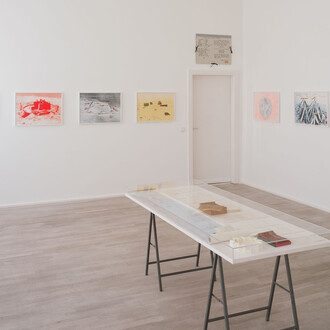
The motifs in Ingrid Wiener’s tapestries always draw on the artist’s immediate surroundings and everyday life. For instance, Plumbing depicts the pipework beneath the bathroom floor in the wooden house close to the Yukon River (Canada). Or they explore her own body and livelihood: Aorta and Gehirn can be traced back to Wiener’s X-rays. As Wiener has stated: “I’ve always enjoyed exploring hidden, invisible connections.” (Interview with Michaela Leutzendorff Pakesch in Spike art magazine, no. 78, winter 2023/2024). Even more personal are the ‘dream drawings’ on which the artist has been working since the mid-1990s. In these combinations of images and text, she offers glimpses into the world of her dreams through small scenes rendered in watercolour and a short narration written in the first person. Much like the Gobelins, these frequently touch on themes such as the kitchen, health, communication and existence within the art world. The reason she began recording her dreams was a discussion with Oswald Wiener, who doubted that we dream in coherent stories and images (see Oswald Wiener’s text in Ingrid Wiener – Träume / Sogni, Naples 2001).
In memory of Ingrid Wiener’s early artistic practice, characterised by experimentation and improvisation, the exhibition also looks back at her formative years in the cultural milieu of (West) Berlin in the 1970s.
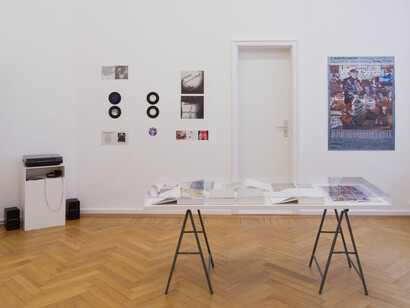
After fleeing “bourgeois” Vienna, she founded – on what was then known as the “Island of Freedom” – several legendary venues together with Oswald Wiener, Michel Würthle and others, including Matala, Exil and Ax bax, which developed into vibrant hubs of artistic and intellectual exchange. Ingrid Wiener took on the important role of head chef there. She also explored the “fringes of the culinary world, namely, with offal”, which, as she herself reports, also delighted “gourmands”. But there were also “Wiener Schnitzel, Tafelspitz, Palatschinken.” (Interview with Michaela Leutzendorff Pakesch, Spike art magazine). Vinyl records from precisely this period can be seen and heard in the gallery. These represent Ingrid “Monsti Wiener”’s performances as a singer and musician in the Berlin club scene, including collaborations with Valie Export and others.
Ingrid Wiener recounts: “It was a productive period and once my culinary skills had been featured in all the appropriate magazines, I decided it was time to otherwise engage myself. I was fascinated by the art of weaving gobelin tapestries, but at the same time I realised that there was no money to be made in that and, back then, it was viewed as a craft in the Worpswede tradition, if discussed at all. So it was all the more exciting to do something with it. Valie Export and I had already woven tapestries in Vienna and had initiated the first Hundertwasser tapestries. But it wasn’t our thing. I wanted to make something new out of this old-fashioned art form, since ‘anyone can paint’. Dieter Roth seemed to be the right person to help me with this project.” (Die teppiche von Dieter Roth und Ingrid Wiener/The tapestries of Dieter Roth and Ingrid Wiener, Kirchner Museum Davos and Neue Galerie Graz, 2007/2008, p. 23).
Revisiting this project, Barbara Wien is exhibiting a selection of rare copybooks compiled in the 1990s by Dieter Roth – himself a former guest and the wallpaper designer of the Berlin Exil – and Ingrid Wiener. As bound collections of sketches and ideas, they offer an insight into the collaborative working process behind the Roth-Wiener tapestries, which were created between 1974 and 1998 and in which text, image and material, as well as very different imaginary worlds and realities of life, interweave visually in everchanging ways. Their joint work, the Large tapestry (1981–1986), is now part of the collection at MoMA in New York.
To illustrate the exchange and dialogue between the two artists between Dawson City and Basel, Switzerland in the years 1988 to 1990, whilst they were collaborating on their third joint tapestry, we are showing the Videobriefe (engl.: video letters) published by Barbara Wien in 2003, which appeared in the form of an experimental video.
The artist offers a further insight into her life and work in the former gold-rush town of Dawson City on the Yukon River in Canada – where Ingrid and Oswald Wiener lived between1985 and 1992 and ran the Claims café – in the videos Yukon quest (1986) and northwest passage (1988). In Yukon quest, produced by ORF – the Austrian Broadcasting Corporation – and commented by Ingrid Wiener, Oswald Wiener and Valie Export, viewers can follow a typical Canadian dog sled race and the related events. In northwest passage, Ingrid Wiener takes us out into the snow, where she sings passages from Stan Rogers’ 1981 song of the same name, in which he recalls the history of early explorers and compares their activities with his own journey through Canada.
Today, Ingrid Wiener lives in Austria again, in southern Styria, and continues to work on tapestries.
(Text by Barbara Buchmaier)

![Various artists, [ materialistin ], exhibition view. Courtesy of Hamburger Bahnhof](/attachments/fd8f4fd76b73be0a02d398535c29d017e1309b65/store/fill/330/330/3f54331fd7869a13166dfe67a9e91306c6e180b2e29b9fd308d958b87ad2/Various-artists-materialistin-exhibition-view-Courtesy-of-Hamburger-Bahnhof.jpg)