English
 Español
 Français
 Deutsch
 Italiano
 Português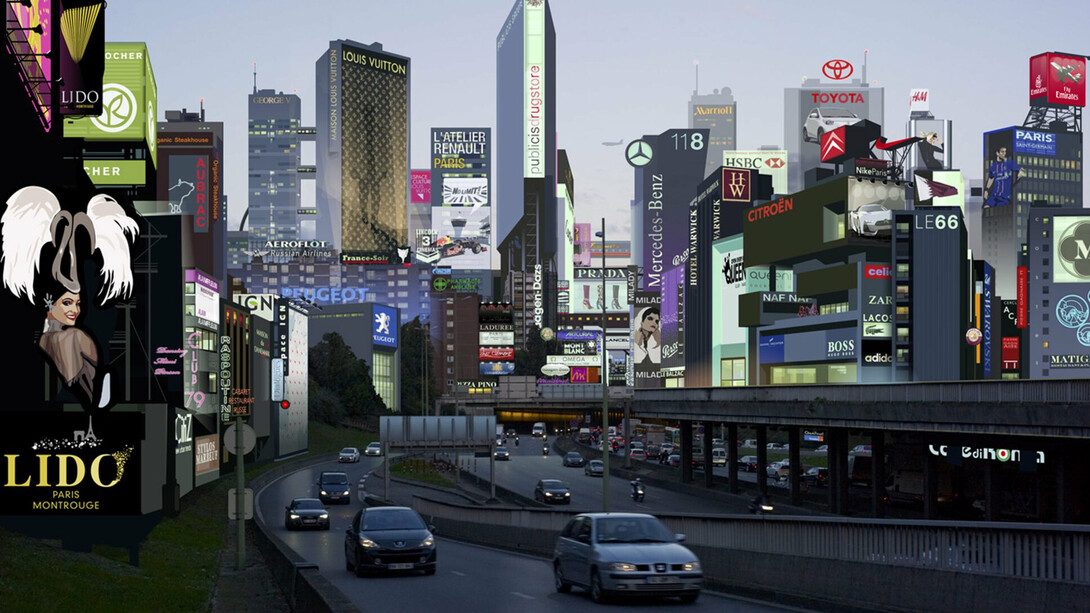
To alain bublex, nothing is ever still. Thus, looking back at his work is akin to observing futures bound to never land. The exhibition drifts through imaginary cities observed through various prisms. In a gallery turned inside out, like a sock, and reinstalled like it was years back, the visitor enters the exhibition through a never before seen version of the Pavillon des points de vue, a belvedere created by Quoddy Mamco, 2023 bublex for the La Défense building site, specially set before the worksite of his own research.
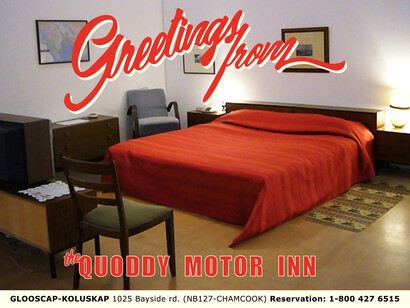
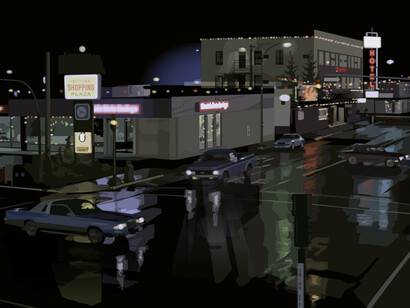
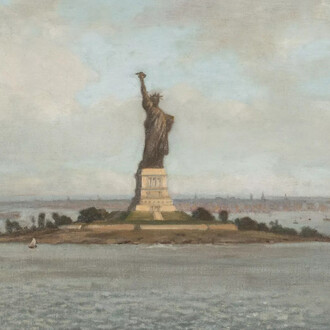
Some pass through walls; bublex passes through images, in this case, a landscape, Passamaquoddy Bay Northshore, at the border between Canada and the US – the real-life location of Glooscap. The matrix is a theater curtain. At the work’s prehistory, the hypothesis of a city inspired by the North coast of Canada. Since 1992, it has given way to a set of trompe l’oeil variations through supports ranging from murals to photography, to postcards, or to ghosts. To him, ghosts are a genre of painting. Glooscap was Sim City before its time. Rem Koolhas would have written “Delirious Glooscap.”
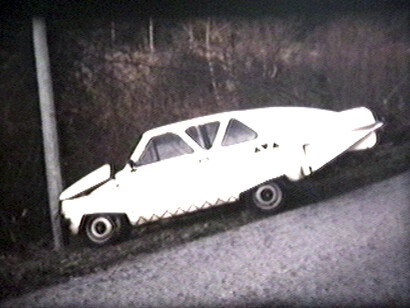
Similarly to postcards, some images race through the exhibition and punctuate it. Such as the Aérofiat, vehicle of its own strangeness, bublex’ œuvre resembles a vectorial sketch scaled to his universe, reminiscence of his creations as designer and engineer on the Île Seguin for the Renault automobiles. Shadows have a diagrammatic becoming, and diagrams unfurl like flowers in a cup of tea.
In the gallery’s main space, one enters into the reality of the works, that of large projects. Other spaces are satellites, as if bublex himself circled his subject, manipulating it under a microscope. In fact, in one of the many images, he shows Paris from the Centre Pompidou to the Place des Victoires. He installed his studio at the extremity of a train, leading from millstone houses to an American suburb’s twin. In his images, there are never any humans, because they are the ones making the city. The proof is in the pudding. Exiting the offices towards the main room, we find bublex’ blockbusters.
Alongside the images of Plug-in city (2000) and the Plan Voisin, we look again at the Mont Fuji series (when Switzerland meets Japan) and An American landscape (when Rambo is shot in Savoie). They inhabit the memory of the walls. In the musical chairs of hang arrangements, and of reincarnation, they sometimes reinstall themselves in the very spot where they have already been shown, or elsewhere. A romantic in the city.
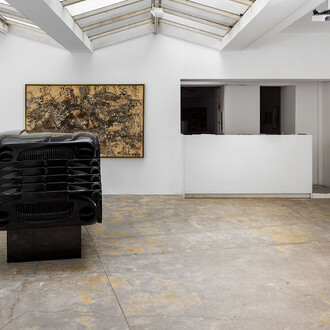
Scales disorient us and turn back between truth and fiction. Passing the threshold of the reception desk is entering the gallery’s engine, in the place of memory and thought, alain bublex’ meta-world. Because this desk/counter was designed by alain bublex and Ania Martchenko (aka AaMb) in 2005. White for anything visible, wood for the invisible – unseen by non-initiated visitors. Much like Glooscap’s model it is a divided space. It becomes sculpture in the exhibition and a plinth for copies of the magazine landscaping which can be browse a mock catalogue raisonné is devoted to Albert Marquet and his 'cordiality of the real', a patient nonchalance, he does not seek to analyze space, but to receive it. Reality seen through the viewpoint of a mechanic – technical and impartial, as in a user manual. Marquet is one of bublex' heroes – as is John Singer Sargent. On the countertop, little huts are set, such as Pissenlit le kiosque à soupe. At the end of the long table on which everything happens in this space, sits the Awareness Box, a camera which does not record pictures. Each image is everything that precedes it.
Outside in the courtyard, after the opening, Le Chant du départ will have faded from the car radio. For the car will have driven off. We will walk back out into the city’s flow with a few pages of another project in progress, a book on the automobile. Like back to square one on which one does not linger over. Travel through space and time. Is it possible to touch upon reality?
(Text by anaël pigeat)
![Mary Cassatt, Fillette dans un fauteuil bleu [Enfant dans le salon bleu] (detail), 1878. Courtesy of Musée d’Orsay](/attachments/3ddcf3630b2e6b21d055a8488350d949784be8fa/store/fill/330/330/9b97dc5b17cad42577b6453f0968e961b1231ceb2b8b5ceb2c09057b2695/Mary-Cassatt-Fillette-dans-un-fauteuil-bleu-Enfant-dans-le-salon-bleu-detail-1878-Courtesy-of.jpg)