English
 Español
 Français
 Deutsch
 Italiano
 Português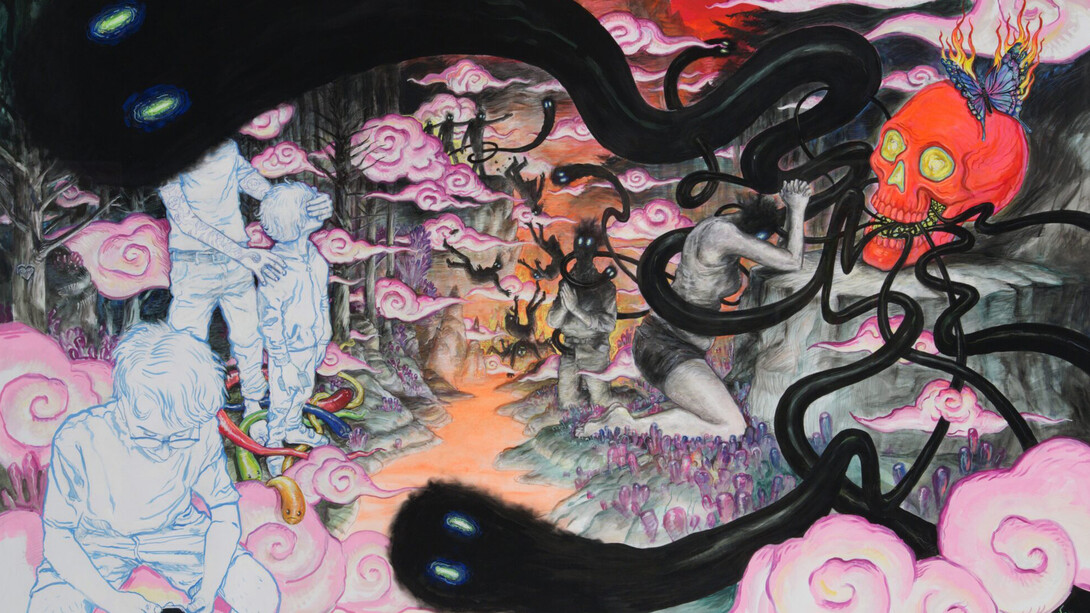
It swarms, it overflows, it seeps and it crawls.
It deals with contagion, of branching, of virality. With time stealing by.
Here we stand before a seemingly unfamiliar world, and yet it is only our own. A landscape whose outlines we recognize.
Of course, one thinks of hybrid beings and the fantastic figures from the late Middle Ages.
One thinks of the Mouths of Hell, of demonic creatures and blazing pits. We grasp the macabre and the terrifying; we sense that dreams and hallucinations are not far away.
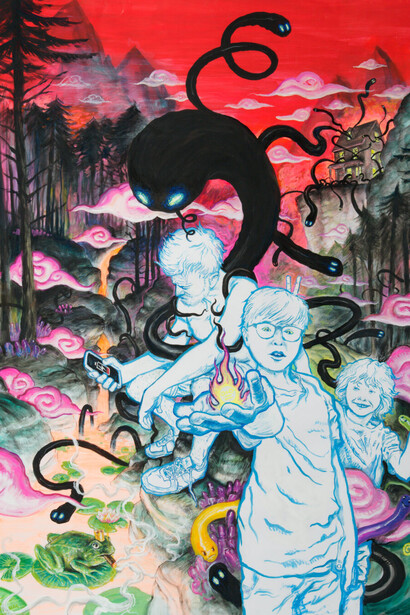
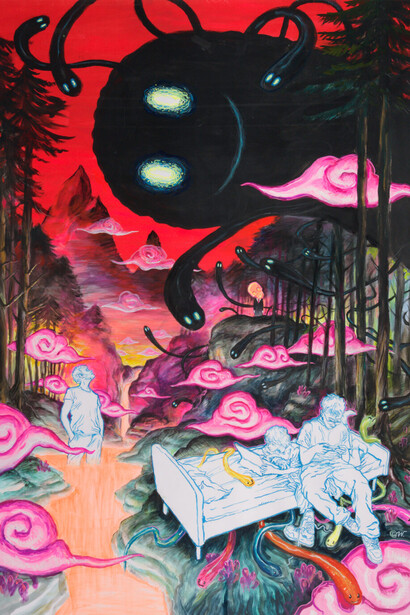
These are images one sees a hundred times, because there is always something new to The Dark House, 2025 uncover: golden-crowned toads, floating hybrids, anthropomorphic growths, houses we know to be haunted, and butterflies that will not escape the flames.
It is a fantastic proliferation of toxic clouds and rainbows one should beware of. At once exuberant and confrontational, cryptic and lucid. Often unsettling and humorous. Absurd and complex.
We feel disorder and ruin, the grotesque and the satirical intertwining. There is life, still, with death approaching.
We think of Matthias Grünewald and Hieronymus Bosch, we remember Herri met de Bles and Jan Mandyn, and that singular imagery.
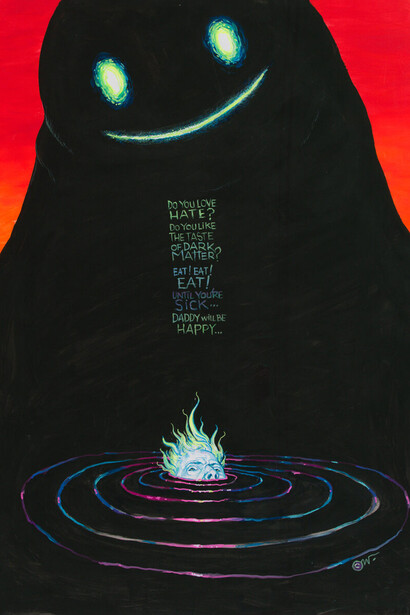
We stand before Winshluss’s monumental drawing. It is an image of the world — and it is infernal.
We take a breath and look beyond the color. Beyond the apparent sweetness, beyond the childhood refuges that sometimes comfort us. We step forward, and our bodies tense.
One must accept being halted mid-stride and take the time to draw closer still. To discover dense, dark forests, the deathly dance of oversized serpents and forms that might be monsters. Then skies on fire, like open mouths leading straight to hell. Flames, an eruption, a punishing furnace.There is energy, a force, wherever we look. A movement that surges forth, rushing toward us, threatening to swallow us whole. We sense that Winshluss consorts with unease, that he composes with a strange beauty, wrestling with the vast and monstrous crowd of our fears.
For those who did not take the time to linger, he places himself at the center — he and his children. Realistic, recognizable. To hold our gaze a little longer, to keep us from looking away too soon.
To say: we knew.
It is now a matter of no longer turning our eyes away.
(Text by Carine Roma-Clément)
![Mary Cassatt, Fillette dans un fauteuil bleu [Enfant dans le salon bleu] (detail), 1878. Courtesy of Musée d’Orsay](/attachments/3ddcf3630b2e6b21d055a8488350d949784be8fa/store/fill/330/330/9b97dc5b17cad42577b6453f0968e961b1231ceb2b8b5ceb2c09057b2695/Mary-Cassatt-Fillette-dans-un-fauteuil-bleu-Enfant-dans-le-salon-bleu-detail-1878-Courtesy-of.jpg)