English
 Español
 Français
 Deutsch
 Italiano
 Português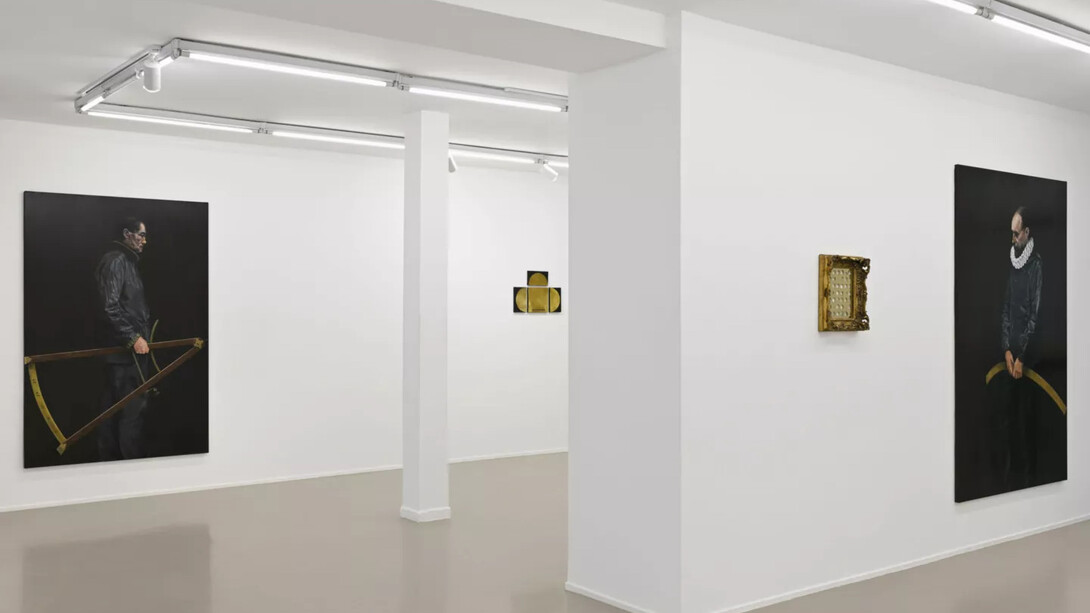
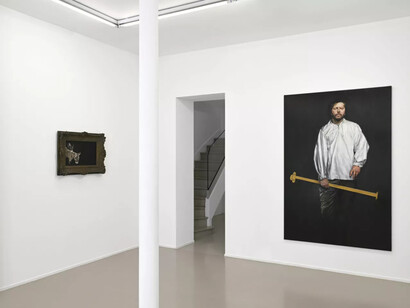
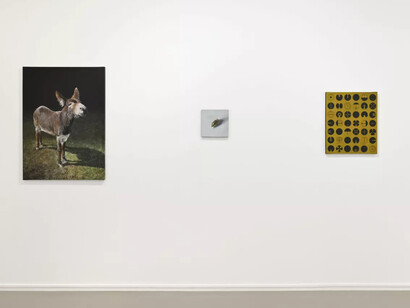
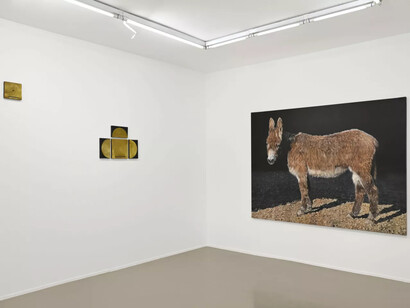
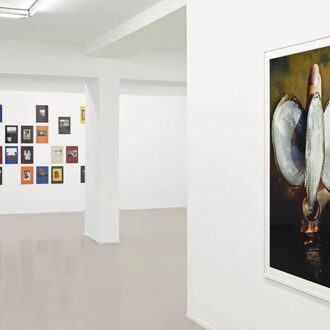
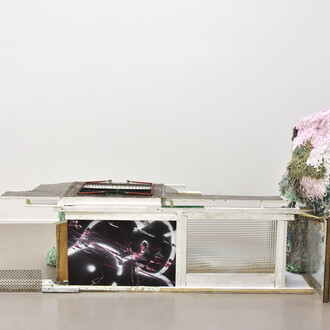
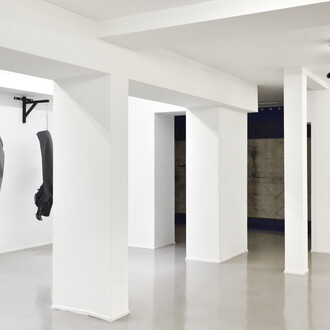
The question, from the outset, is: what do we see? Paintings, of course: three full-length portraits, two framed busts (one old, one modern), others depicting donkeys, alidades (those movable rulers used to measure angles, equipped with a sighting vane, repeated across two canvases), and then various iterations (plumb line, screw detail, brass sheets), along with several sculptures placed on the floor or suspended from walls and ceiling. There appears to be a kind of heterogeneity in the subjects, genres, and figures, with this strange extension toward objects that nevertheless, like the small paintings representing a simple “thing,” seem to have emerged from the large formats in order to isolate a discreet element within the larger sentence of the exhibition. One senses an overall syntax, a discursive arrangement that Youcef Korichi seems to have composed like a score, a narrative — a painting multiplied and expanded into the space of the gallery.
If we agree to explain (from the Latin explicare: to unfold, to unroll), we may begin with a name, a figure who conceals himself as much as he reveals himself in the triple life-sized portrait against a black background, borrowing equally from history painting — if indeed it is the portrait of a king painted by Velázquez — and from the fantasy of a shifting identity where parallel destinies collide. One detail gives him away: the prosthetic nose is said to be the one Tycho Brahe lost in a duel at the age of twenty, making him less a comic figure than a wounded student, replacing with a brass prosthesis what still allowed him to have a face, while simultaneously signaling its absence. This might serve as a first lesson: the artifact does not function as deception, but rather allows the figure to preserve its form and the face its intentionality.
A few words here on Tycho Brahe (1546–1601): a Danish astronomer standing at the threshold between two conceptions (geo- and heliocentrism), he practiced naked-eye observation and, thanks to revolutionary instruments for his time — quadrants and sextants that he built himself — achieved astronomical measurements of remarkable precision. Without abandoning the immobility of the Earth within the solar system, he revealed the movement of the other planets around the sun. This hybrid conception (geo-heliocentrism) nevertheless opened the path to modern scientific revolution for Kepler, who had been his assistant.
We thus have a beginning, which could be unfolded as follows: Youcef Korichi composes in space a fragmented portrait of Tycho through a system of aiming (alidades, sighting vanes), breaking down into diverse fragments the facets of a character (in the sense of a mask) who mirrors both the aim of the scientist and that of the painter. These two sites of knowledge are complementary here, resulting in a fragmented narrative that proceeds along the ridge between knowledge and error, obscurity and revelation, truth and plausibility, fiction and objectification. Ultimately, only intentionality matters — that which directs consciousness toward things. There is no more truth in art than in science, but rather two faces of a Janus with a brass nose.
This does not, however, imply a questioning of the hermeneutic approach that has shaped modern consciousness: there is no critique of science, no crisis of representation tinged with postmodern overtones. Tycho is a dramatic hero dressed in the garments of comedy, because he stands on the impossible edge of reconciliation between Aristotle and Copernicus; fundamentally, he becomes the emblem of stubborn humility — embodied by the donkey, whose representations function here as metaphors for such virtues. We traverse the night of consciousness with before us the obscurity of the world waiting to be deciphered: the work of the astronomer and of the painter alike.
If the viewer’s gaze seeks to identify repetitions and paths leading from one object to another, it nevertheless cannot reconstruct the coherent narrative of a staged composition, but rather distinguish the fragments of a pictorial inquiry. That of an art inseparably linked to fiction and to the practical interrogation of the fictional within the act of painting itself, blurring the deceptive boundary between truth and plausibility. The original question remains, active and joyful: what do we see? Tycho and Korichi aim into the night of things: the quality of what is seen is not overwhelming but clear — painting is a tribute, a reverence to the beauty of the visible. It is its delight, perhaps even its truth.
(Text by Yannick Mercoyrol)
![Mary Cassatt, Fillette dans un fauteuil bleu [Enfant dans le salon bleu] (detail), 1878. Courtesy of Musée d’Orsay](/attachments/3ddcf3630b2e6b21d055a8488350d949784be8fa/store/fill/330/330/9b97dc5b17cad42577b6453f0968e961b1231ceb2b8b5ceb2c09057b2695/Mary-Cassatt-Fillette-dans-un-fauteuil-bleu-Enfant-dans-le-salon-bleu-detail-1878-Courtesy-of.jpg)