English
 Español
 Français
 Deutsch
 Italiano
 Português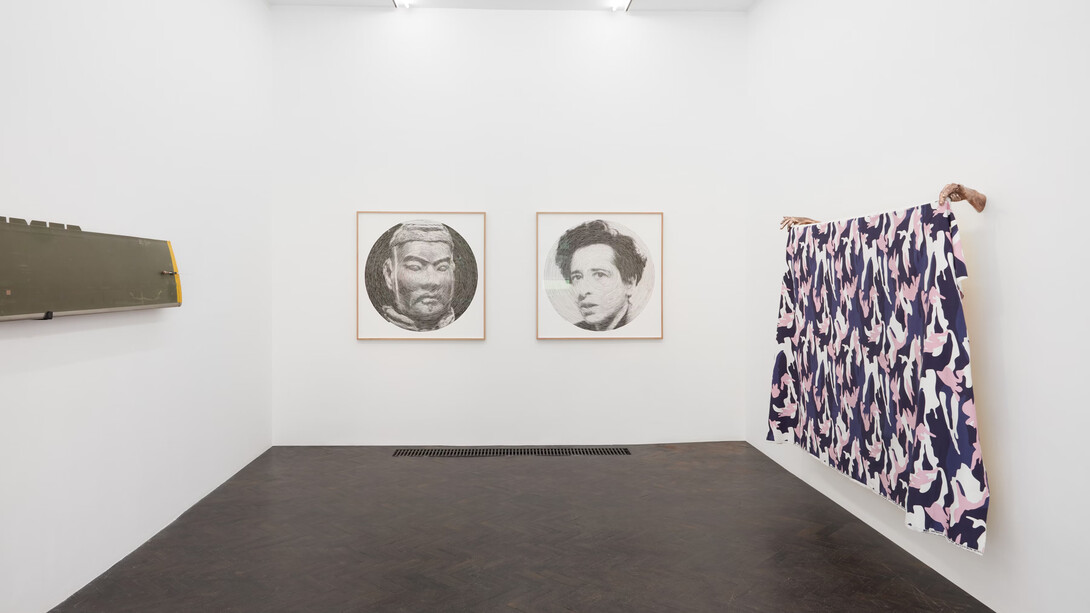
Long drawn to measuring the world and its natural phenomena, Evariste Richer turns here toward something more political, while allowing himself optical detours and a weight of existential gravity.
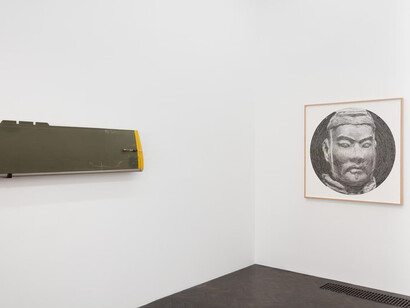
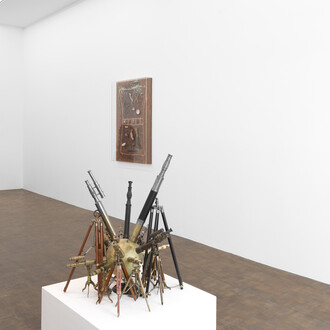
In the left room, the visitor is confronted from the moment of entry by Apocalypse: a long helicopter blade extended by a conductor’s baton. A work that sets the tone for the exhibition, that directs the gaze. Two objects with nothing in common, suddenly brought together. A blade, which in its rotation lifts a helicopter off the ground, and a baton, wielded by a conductor to guide an orchestra. Or: how to create meaning by bringing into relation a regular, insensible, mechanical movement (here at rest) with an organic, sensible, human movement (equally at rest). Connecting a machine that brings either aid or death (depending on whether one thinks of rescue or combat helicopters, and in the latter case, the reference to Apocalypse Now seems far from superfluous) with a cultural artifact, universal yet whose language remains indecipherable to the common mortal.
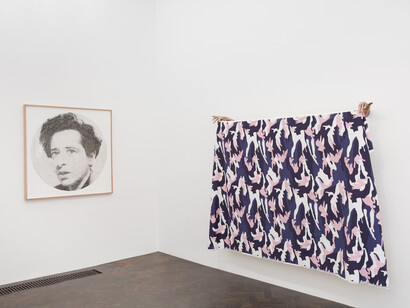
It is under the watchful eye of two authors who produced major texts with philosophical, political, and moral implications that this room comes to life. On one hand, Sun Tzu, the author of The art of war, written in the 4th century BC in a China in full ferment, alternates strategic counsel, wisdom, and theories of war. Certain passages describe how to put intelligence at the service of temperance in order to foresee and act so as to avoid conflict. Alongside him, Hannah Arendt, political theorist and philosopher of the 20th century, whose work on the rise of totalitarianism was, and remains, formidable. In her view, the alienation of labor opens the door to dehumanization and an absence of autonomous thought that can lead, in the end, to the worst atrocities. The technique employed is singular and references a portrait of Christ engraved in a single unbroken line by Claude Mellan in the 17th century. Evariste Richer, for his part, paints his spirals in ink, carefully softening or intensifying his stroke to sustain the optical illusion. The spiral portrait is an eloquent choice: it figures at once the movement of thought and the repeated, eternal nature of folly.
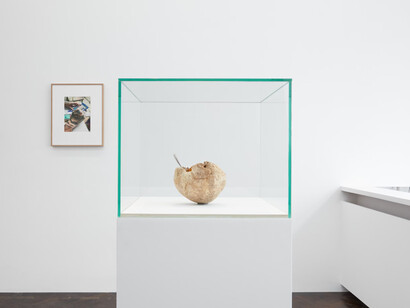
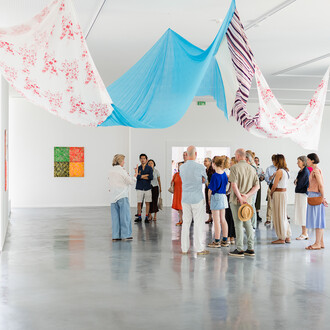
Another illusion with Abracadabra, a fabric printed with an unusual camouflage pattern (pink, blue, white), suspended in the air and held by the artist’s hands cast in bronze. In a conjurer’s gesture, the fabric conceals its reverse side, a survival blanket, which reveals itself on the wall behind in a subtle golden halo. On one face, a military pattern long since absorbed by fashion, through the kind of appropriation it is accustomed to; on the other, the reality, so often rendered invisible, of the injured, the disaster-stricken, and the displaced. The notion of masquerade, which recurs across several works, is brought to a dramatic vanishing point in L’Or, a human skull whose cavity has been gilded with gold leaf and which offers itself up to the voracity of an invisible predator.
As counterpoint, a photograph titled Le comptable compresses into a single furtive snapshot the potential relationship between mass death and calculation (why not, then, invoke Arendt’s Eichmann in Jerusalem). Today, it is algorithms and artificial intelligence that are deployed to «kill more cleanly,» to «target more efficiently.» It is by elliptical means that Richer approaches this technological revolution. Indeed, few will recognise the portrait of Jianwei Xun, a virtual philosopher who crystallised the concept of hypnocracy. Although a face has been assigned to him, he exists not as an individual but «as a configuration of meaning emerging from a network of exchanges.» This use of artificial intelligence opens onto a vast field of questions, but the concept developed is a compelling one. «Hypnocracy is a regime that acts directly on consciousness through the modulation of attention and continuous hypnotic suggestion (...) an articulate analysis of the way in which this form of power manifests itself in contemporary dynamics has been developed, with particular attention to its tutelary figures such as Trump and Musk.»
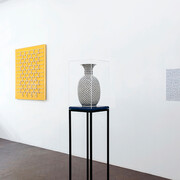
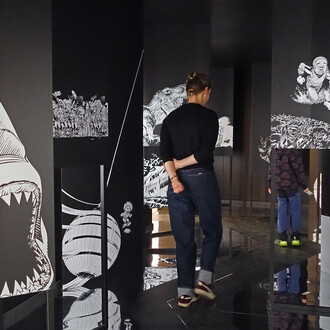
By reproducing the complete series of Rotoreliefs created by Marcel Duchamp in 1935, Richer places us before concentric illusions that seem to hypnotise us. Designed to produce the illusion of volume and depth, the twelve Rotoreliefs are here revisited and titled It’s gonna rain, to warn us against any form of sleepwalking. Formally, the analogy with the spiral of an atmospheric vortex or an ocean current is underscored by an installation that entirely envelops every visitor. The exhibition space becomes a landscape. Finally, in a gesture of warning, nestled in the hollow of an ammonite whose age is measured in tens of millions of years, the artist’s raised index finger reminds us of the vigilance that must run through us if we are to remain at the center of ourselves — at the center of our time.