English
 Español
 Français
 Deutsch
 Italiano
 Português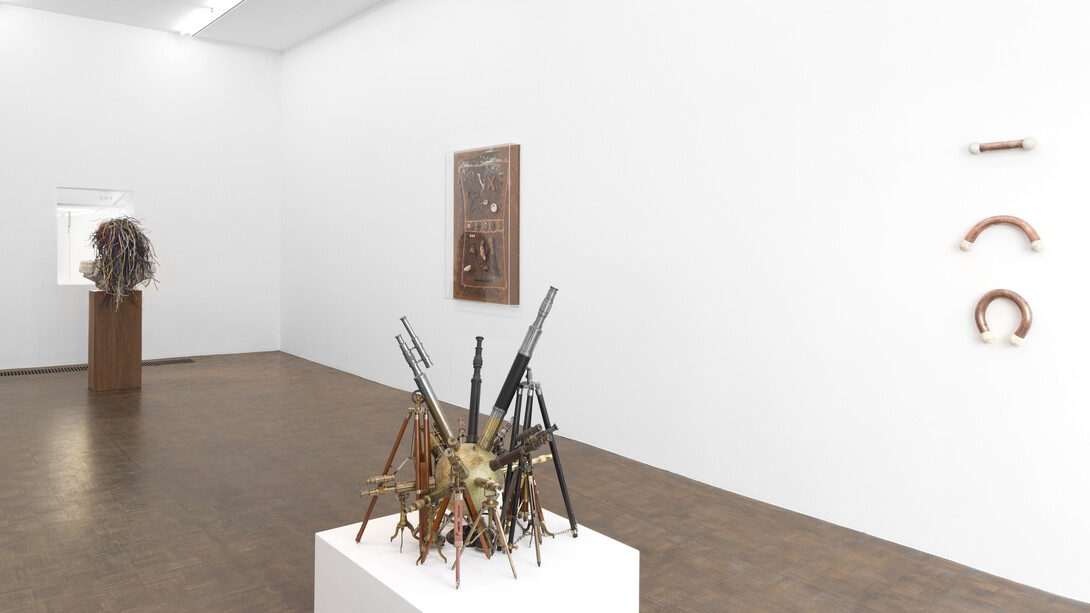
With Hoaxing histories, his fifth solo exhibition at the gallery, Maarten Vande Eynde (b.1977) questions Belgium’s colonial history. The works in the exhibition evoke events that have shaken the world (the triangular slave trade, the manufacture of the atomic bomb, mining operations in Africa among others) and are placed in a dialogue steeped in propaganda, glorification and distortion of reality, but also in nostalgia, fear and trauma. Hoaxing Histories examines the lasting influence of white colonial culture and gathers ghosts from the past alongside complex, often contradictory narratives. The subject is polemical.
From the outset, one might wonder to what extent a Western, white artist can offer a legitimate perspective on the colonial question. Is it meaningful to conceive new narratives in order to reweave bonds, to restore the conditions for a complex relationship between Belgium and the Democratic Republic of Congo (DRC)? Political and diplomatic progress remains modest. Even where it exists, one must acknowledge that it is cultural actors, and artists in particular, who dare to venture into the margins and tackle the uncomfortable questions head-on.
Maarten Vanden Eynde has been engaged with these questions for some ten years, and it was clear from the outset that they needed to be understood within a broader framework than his own personal practice. With this in mind, he co-founded the I.C.C., the Institute for Colonial Culture, which brings together various actors from the DRC and Belgium (independent researchers, artists but also institutions such as the National Museum and the University of Lubumbashi) to explore the shared heritage of both nations during the years 1884–1960. It is therefore important to note that Maarten Vanden Eynde’s approach is rooted in a commitment to collaboration and exchange, in order to move beyond an ethnocentric vision and broaden the perspective.
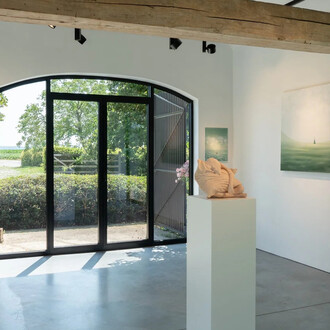
In the room on the right, the sculpture Close encounters is composed of telescopes and binoculars encircling a globe dating from before the Berlin Conference (1884–85), on which the inscription Association internationale du Congo can be read at the location of present-day DRC. This work illustrates in a certain way how the organisation and division of the world by Western powers fuelled Leopold II’s desire for a colony. This globe is closely scrutinised and surrounded by scientific instruments used for the discovery and exploration of the world. Such a large number no longer allows the world to be seen in its entirety and opens a reflection on the Western extractivist logic that is still ongoing today. See everything, know everything, exploit everything. The question is as much political as ecological and remains deeply contentious.
The plundering of the riches of the Belgian Congo (as can be seen in Guilty pleasures, sculptures composed of copper and ivory) was made effective by establishing administrative, religious and economic structures that can be found in the three panels Malice, with forms inspired by the Lukasa, traditional Congolese memorial boards. The ambivalence of these works deserves attention. While denouncing a system forcibly imported from a ‘civilised’ Europe to an Africa
‘in need of education’, Vanden Eynde also alludes to the African origin of humankind; to the symbolic system of repre- sentation observed and analysed in Africa by palaeontologists and archaeologists, to the networks of exchange, to the development of tools that enabled our species to evolve, to migrate and to discover new territories. As David Van Reybrouck writes: ‘Central Africa was a region without writing, but not therefore without History (...) thousands of years of human history preceded the arrival of the Europeans.’
From behind, a bust concealed beneath a torrent of electrical cables turns out to be that of Leopold II, looking towards the back room. Placed on a massive block of azobé — an exotic wood with numerous properties — an official portrait of the somewhat brainless sovereign evokes both the race for the resources needed by exponentially growing new technologies technologies and the megalomaniacal delusion that led the King of the Belgians to exploit a colony for his own personal account.
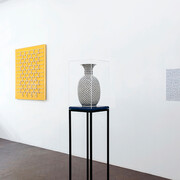
In the room on the left, Vanden Eynde turns his attention more specifically to the extraction of uranium that was used to manufacture the atomic bombs of the Second World War. Meticulously crafted by three lacemakers Ulrike Dehaeseleer, Ingrid De Dobbeleer and Rita Van Cotthem, Little boy 3D is a reproduction of the bomb dropped on Hiroshima. The explosive force of the work stands in contrast with the delicately assembled lace and allows Vanden Eynde to underline that the greater part of the uranium used in the Manhattan Project came from the Shinkolobwe mine, in Katanga, in what was then the Belgian Congo. The uranium was subsequently shipped from Antwerp to the United States. This journey is, moreover, not unlike — albeit in a different direction — the triangular slave trade that characterised the cotton trade from the 16th to the 19th century (enslaved people from Africa > exploitation in the United States > sale of cotton in Europe).
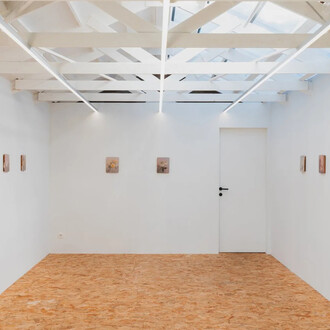
As a counterpoint, the series of seven postcards Greetings from Chinkolobwe depicts the mine itself, reproduced on lead, which is a direct reference to uranium (lead being the final stage of the radioactive disintegration of uranium). Opposite it, Tenerife tech is a combination of interwoven copper wire, inspired by patterns in silk or cotton specific to the Canary Islands. This technique was adopted by the Sisters of Charity of Ghent who made a stopover in the Canary Islands before continuing their journey to the Congo. Initially presented as a form of civilisational reform aimed at transforming young Congolese girls into morally irreproachable Catholic housewives, this craft developed to such a degree that it became a mass industry of tourist souvenirs.
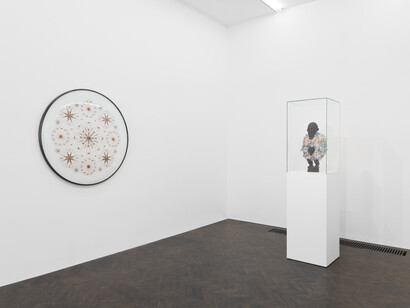
Finally, displayed under a glass dome, Return is an ambiguous work. In the manner of a nkisi — a ritual object serving as a receptacle for spiritual forces — a recent Songye statue is covered with a thick layer of postage stamps and air freight labels from the collection of Maarten’s late grandfather, who was a postman. It is at once a deeply intimate work and an expression of the ongoing and indispensable yet far too slow efforts to restitute plundered Congolese objects.
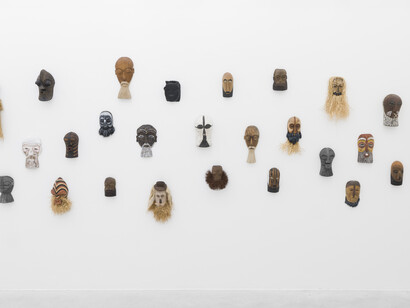
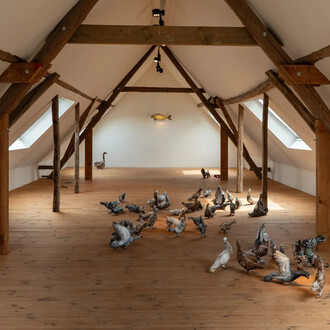
In the back room, Leopold’s ghost is an ensemble of 35 masks gathered by the artist over the past eight years. Made by local sculptors and craftsmen, they evoke, not without humour, the lasting presence of Leopold II in Congolese culture. To realise this work, Maarten collaborated with Congolese artists (Muhindo Luvatsungana Jean-Charles, Paulvi Ngimbi, Kaluhitukako Lubeni Jusquin, Muhemeri Kataliko Emmanuel, Zingwa Beni, Kisha Bongo, Théophile Nzonza Ndombasi, Ka Bamba Luyembwe) who reproduce and imitate their own style while freely incorporating the features of Leopold II. The fact that these artefacts are reinserted into the circuit of the contemporary art world, a priori Western, raises questions, and Vanden Eynde plays deliberately with this. Who directs the spectacle and what is expected of the visitor, the viewer, the buyer?
Using a Western mode of presentation and a private collection typology, this installation plays with the troubling codes that accompany the way masks from another culture are exhibited. Ultimately, one of the central questions remains: what to show, by whom, why and how? Opposite the lightness of the masks hangs, with its full weight, the sculpture Bounty orders, composed of dozens of art objects and sculptures held together and weighed by an old set of scales like a bale of cotton. When tourism to the Belgian Congo was encouraged and normalised in the 1950s, it was natural to bring a souvenir back home, for the family. For these souvenirs to fit into the narrative of the civilisational contribution to peoples assumed to be devoid of any cultural or historical significance, they had to be ‘poorly made’, that is to say of poor quality and without refinement. What is known today as airport art was mass-produced in Catholic mission schools and brought back to Belgium.
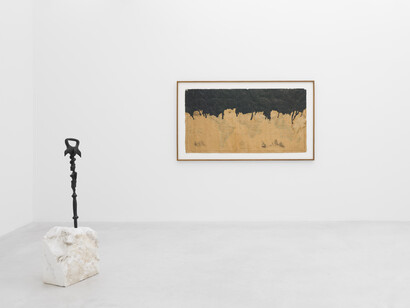
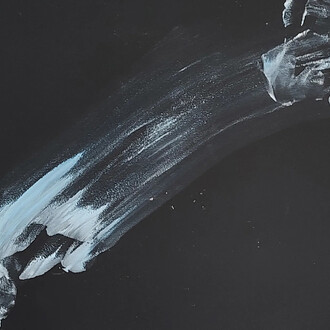
In response to this levitating sculpture, Mobutu magic seems to anchor itself in the ancient rock while evoking the legend of King Arthur. In a striking contrast, a replica of Mobutu Sese Seko’s emblematic cane, planted in a block of white Carrara marble, revives the myth that his cane was so heavy that four people were needed to lift it. Finally, Black out is an old world map half-covered in black ink. It obscures Europe, effectively erasing it, while flooding the rest of the world. The ink, which in the colonial era was the symbol of power and control, here covers the Western hemisphere with a black wave that obliterates the dominant nations.
With paradoxical and asymmetrical works that invite contradictory readings, Maarten Vanden Eynde attempts to reweave bonds through the exchange of ideas, the sharing of techniques and genuine encounter. Through invitations, collaborations, exhibitions and residencies at the ICC, Maarten seeks to give visibility and a voice to the artists and thinkers who struggle against historical distortions and the fantasies of colonial heritage, both in Belgium and in the DRC. Certainly, the power of images can make us overlook certain stakes, but those same images open up dialogue, a better understanding and recognition of our past in order to write a viable common future.