English
 Español
 Français
 Deutsch
 Italiano
 Português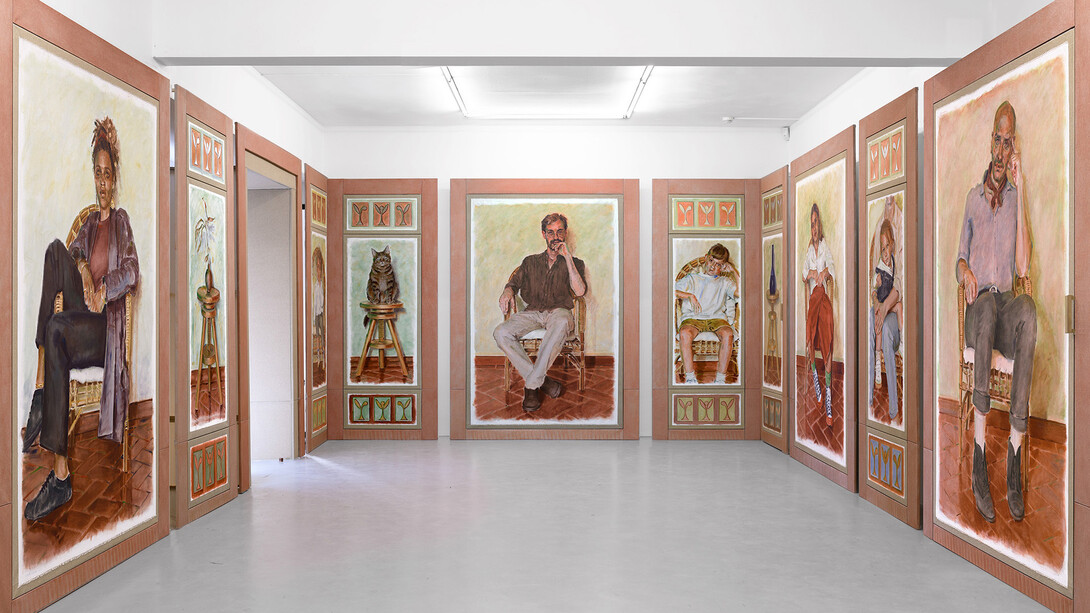
Having explored the human figure through the formal abstractions of his earlier works (exhibitions such as Eveil passager, Romantic imagism, and I told you when I came I was a stranger), as a half-open window onto the mysteries of the human soul, Charles Laib Bitton continues his quest for the essential – for the significance of the gesture and the present moment – to dispel the illusion and the omnipresence of the virtual in our society, and to respond, through a refreshing break from the norm, to the urgency of the senses and emotions. Those evoked by bodies powerfully embodied in a physical reality that is tranquil and benevolent.
To paint what is, relentlessly and unvarnished, in all its diversity, multiplicity, obvious existence, physicality, and infinite gentleness, within the simplicity of everyday life. To breathe new life into emotion through the line and the urgency of a liberated, vivid, incisive, instinctive pictorial gesture, without compromise or regret. For the artist, it is a matter of reconnecting with the greater whole, with universality, by celebrating the coexistence of humanity, the animal and plant kingdoms, and the material world.
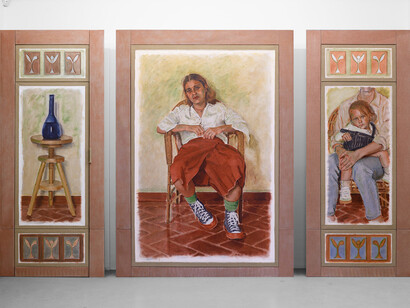
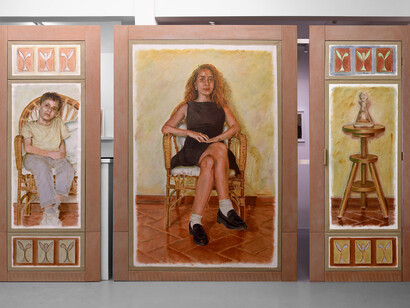
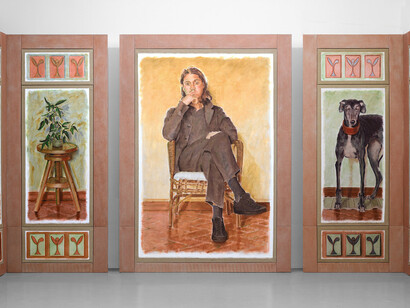
An object, a body, a friend, a child, a pet… They are there, displayed, posed, illuminated by the same light at the moment of creation, frozen in the intensity of the instant, and linked by the magic of warm chromatic harmonies: shades of green, red, yellow ochre, sienna, and burnt umber, undoubtedly inspired by Italian Renaissance painting and the Florentine countryside where Charles Laib Bitton has been living for four years.
What are they thinking? What do they expect of us—these strange, silent witnesses frozen in time, emerging from the painted canvas, seated on the same chair, in the same spot, connected by the brick-red ceramic floor, unchanging and silent, and yet very much alive? They stare at us intently, with the force of their directness, in this very workspace, this studio, this place of memory, like a gallery of portraits and gigantic silhouettes, presiding over a patrician mansion from another era, elements of whose imaginary architectural decor can be found in the artist’s imagined scenography.
This space for wandering is at once unique and multifaceted, replicated, open yet enclosed, universal and personal, staged to the fullest in all its dimensions—both real and dreamlike—drawing its intrigues and mysteries from Florence’s past. In these melancholic gazes—by turns disillusioned, amused, dreamy, or scrutinizing, questioning and direct—we find an inner dialogue, today and forever, a tale of presences and absences, of intimacy that is alternately hidden or revealed to us, the passersby.
(Text by Béatrice van Schendel)