English
 Español
 Français
 Deutsch
 Italiano
 Português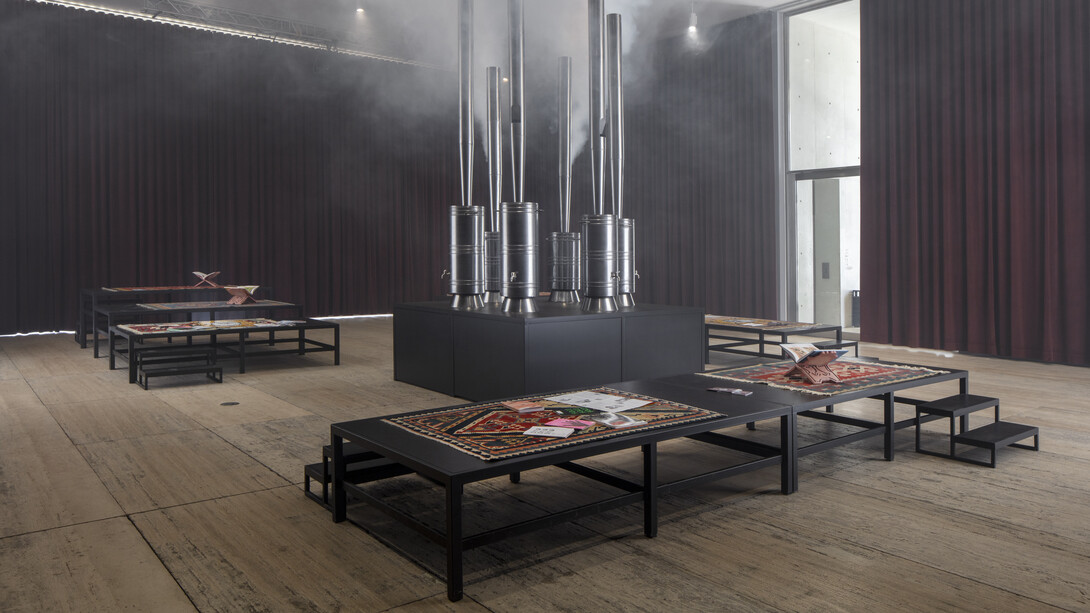
Slavs and Tatars (S&T) began as a reading group in 2006, at a moment when ten new member states from Eastern Europe joined the European Union. Before consolidating as a collective, S&T operated as a call to study and engage—not only at the level of personal identity or belonging, but with what lies outside the self.
From the outset, books and collective reading emerged as a core social practice and as a means of engaging multiple subjectivities. Reading became detached from its conventional understanding as a solitary act and instead understood as a dynamic embedded in social exchange and oral processes.
The name of the collective maps a geopolitical imagination, evoking regions and peoples stretching from Berlin to the west of the Great Wall of China—an expansive territory commonly known as Eurasia. “Slavs” refers to a linguistic and ethnic group distributed across Central, Eastern, and Southeastern Europe; “Tatars,” by contrast, designates a far more complex and unstable category.
Tatar evokes images of distant lands, the Golden Horde,1 marauding armies, so-called “barbaric” beheadings, as seen in medieval caricatures. The term accrued a heavy historical legacy, becoming an in-between category used by Orientalists and colonial travelers to label peoples they could not otherwise classify. While Tatars historically settled in regions such as Crimea, the Volga, and the Urals, they are not ethnically homogeneous or directly related to one another. The name is at once fictive and real, fraught and contested. As artists, Slavs and Tatars take this ambiguity, this not-knowing, as a point of departure. Operating as a faction of politics and intimacies, their practice explores the geographic politics and literary traditions of Eurasia, complicating how language, ritual, and identity are understood through publications, exhibitions, and reading, intimate or public.
Translation, transliteration
Language lies at the heart of Slavs and Tatars’ practice. Given the dense linguistic diversity of Eurasia, the politics of language constitute a profound commitment for S&T; within this framework, translation becomes equally central. Their practice unfolds through work cycles grounded in extensive research, typically spanning a minimum of three years. These cycles are translated into artworks, publications, and lecture-performances, across which playfulness, fa miliarity, and satire consistently emerge as key strategies.
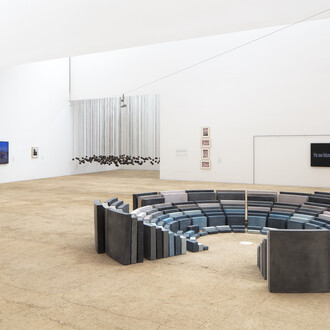
Works such as RiverBed, presented internationally, belong to the work cycle Régions d’être. This “region of being” operates simultaneously as an imagined, poetic geography and as a concrete political and historical terrain. For S&T, encountering a familiar object within an art institution—such as a takht, also referred to as a riverbed for its communal character—is a deliberate gesture aimed at generating kinship and proximity with the audience. These vernacular beds, commonly found in shrines, mosque entrances, and contexts of hospitality across Iran and Central Asia, anchor the work in shared cultural memory.
Humor and satire are also essential tools for establishing intimacy and connection with the public, as seen in works such as Tranny tease (pour Marcel), one of the longest-running series developed by S&T since 2009. This body of work delves into the politics of the alphabet embedded in processes of transliteration—particularly in regions where populations have experienced multiple script changes over the past century. Each vacuum-formed panel renders spoken language through a non-corresponding alphabet—such as Cyrillic, Latin or Arabic—producing a visual clash between sound and script that foregrounds linguistic displacement and historical rupture across a wide range of geographies.
Language acts
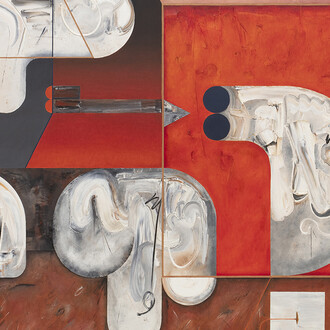
The work cycle Language arts disentangles the politics of phonetic alphabets: the fraught, often forgotten yet still palpable attempts by nations, cultures, and ideologies to assign a specific letter to a sound.2 This inquiry necessarily foregrounds the orality of language and its performative dimension. Noses, tongues, mouths, and hair appear as visual surrogates for sound and speech in Slavic—particularly Polish—Turkic, and even Maya languages.
In their recent exhibition Mayatepek (2025) at Galerie Nordenhake in Mexico City, S&T interweave an unlikely connection between Turkic and Mayan languages. The exhibition takes its point of departure from Hasan Tahsin Mayatepek, the first Turkish ambassador to Mexico following the fall of the Ottoman Empire, whose linguistic research sought common roots and resonances between Turkish, Mexican, and Mayan languages. In False friends (2025), two reversed mirrors display graphically rendered words such as “Lord”—Kaan in Maya and Khan in Turkish—and “Tea”—Çay in Turkic and Tai in Maya—revealing speculative shared heritage and near-phonetic affinities between the two cultures.
In Rahlé for Richard (2014), a large tongue protrudes from the rahlé—a stand for holy books in Eastern cultures and a recurring element in S&T’s practice, given their sustained engagement with books and language—which becomes the central sculptural form. This gesture carries a witty, pop-inflected quality, yet the work also proposes the rahlé as a bodily subject, suspended between oral tradition and print culture. Drawing inspiration from the American artist Richard Artschwager, particularly his work Pianofart (2008), the volume and mass of the rahlé, together with its painted surface, establish a figurative bridge to teeth and mouth, simulating depth and interiority.
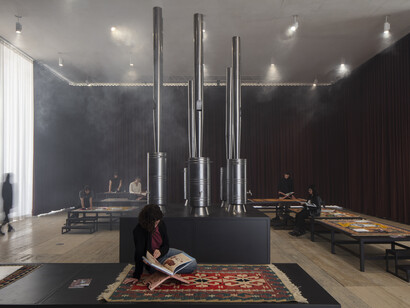
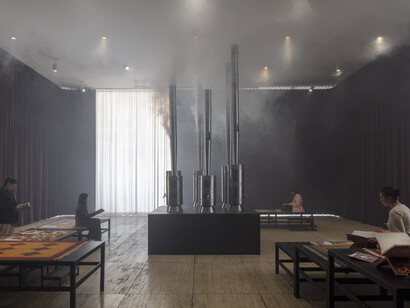
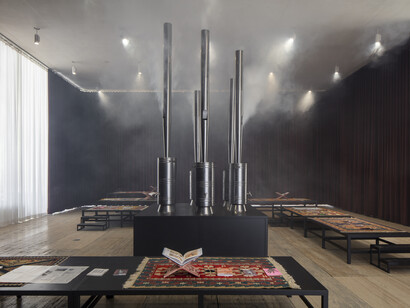
In Samovar swell at Museo Jumex, rahlés hold publications open for reading and wandering through, while visitors sit on a Persian kilim and listen to the intensified sounds of samovars. Rather than proposing a silent or solitary encounter, the installation invites a collective, performative, and dramaturgical mode of reading. For this reason, lecture-performances occupy an expansive role within S&T’s practice. While often structured as historical lectures, they are punctured by moments of satire that unsettle the authority and seriousness typically associated with such formats. S&T describe these events as “tentacular lectures,”3 reaching simultaneously toward ludic, historic, and theatrical representation.
The speaking Samovar
As a metal vessel in which tea is boiled, the samovar carries the weight of vast cultural continuities across Eurasia. Although commonly under stood as a Russian invention, emerging in the mid-eighteenth century, its traditions also resonate within domestic and communal settings across Iran, Turkey, and Kashmir. Designed to serve tea to large groups, the samovar creates a moment of belonging through shared ritual. In Samovar swell, it functions as a means of releasing steam in an increasingly heated world—a gesture of decompression that is not diluted, but rather infused with discourse and conviviality.
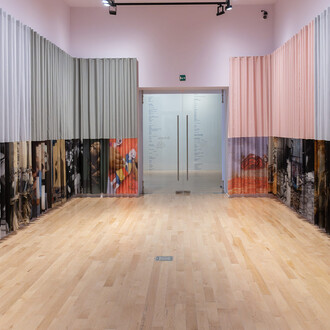
S&T have previously referenced the samovar in their practice. In 2021, they installed an oversized samovar at the Hayward Gallery in London as a symbol through which to address the colonial history of tea within British culture. More recently, in the group exhibition Columna rota at the Museo de la Ciudad de México, the work Creep and steep (2025)—a folding screen featuring three samovars—activates the layered histories of the samovar, foregrounding its material and artisanal affinities with Mexican metalwork.
Rather than representing language, Slavs and Tatars activate it. One might then ask: if a samovar were to speak, what would it say to us? In the present installation at Museo Jumex, a series of six samovars chant at a multivocal pace, releasing steam through their enlarged pipes. All are synchronized with a commissioned sound piece of percolating tea by the Polish composer and sound artist Lubomir Grzelak, also known as Lutto Lento. Acting as a speaking samovar, the installation stages a performative encounter in which a multilingual chorus comes together, bridging not only Eurasian motifs but also Latin American contexts.
Throughout a series of performances presented within the frame work our public program, we rehearse ways of translating ourselves and others. The program unfolds through multiple formats—collective tea sessions, poetry readings, and dramaturgical experiments—listening closely to other collectives and their methods for revealing modes of language, politics, and collectivity.
(Text by Rosela del Bosque)
Notes
1 The Golden Horde was a Mongol khanate that ruled large parts of Eastern Europe and Central Asia
from the thirteenth to the fifteenth centuries, founded by Batu Khan, a grandson of Genghis Khan,
following the Mongol conquests of the region.
2 “Slavs and Tatars,” Work cycle: language arts, accessed December 2025.
3 Mikey Muhanna, host. Slavs and Tatars | Eurasian narratives & the linguistic history of the Muslim world. Afikra. January 10, 2025, published by Afikra,
October 13, 2013. YouTube, 34 miSlavs and Tatars, Samovar swell, exhibition view. Courtesy of Museo Jumexn., 3 sec.