English
 Español
 Français
 Deutsch
 Italiano
 Português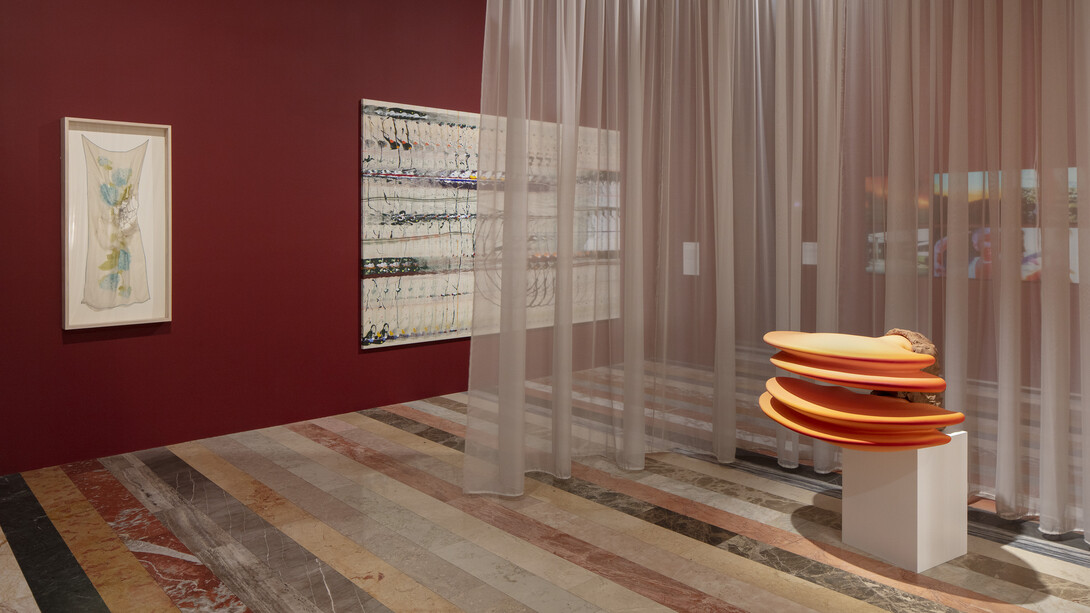
…all my hummingbirds have alibis,
and a hundred profound virtues cover my body.
—Marceline-Marie coming out of the anthropophagus tree.(Max Ernst, A little girl dreams of taking the veil)
In 1930, Max Ernst, a central figure of the Dada movement and poet of the Surrealist imaginary published A little girl dreams of taking the veil, his second illustrated novel.1 In this work, Ernst arranges a reper toire of oneiric scenes via the juxtaposition of clippings from popular novels about criminal adventures and supernatural presences. The result is a repository of Victorian prints transformed into a satirical collage that subvert their original reading in order to tell a story that springs from the depths of the subconscious.
One of the engravings shows the young protagonist, Marceline Marie, caught in the vertigo of a cylindrical structure in ceaseless rotation, surrounded by a flock of birds. With one hand covering her face, she descends into her nightmares while her body remains suspended midair. This rotating device is in fact, an optical mechanism known as a zoetrope, whose stroboscopic effect2—produced by the rhythmic interruption of vision through narrow slits—made it possible for a sequence of still images to be condensed into an illusion of movement. This nineteenth-century technology, a precursor of cinema, inaugurated a field of graphic micro-narratives that enabled Ernst to project the visual language of the subconscious into the interstices of dreams and fantasy.
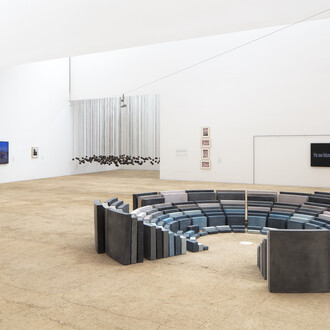
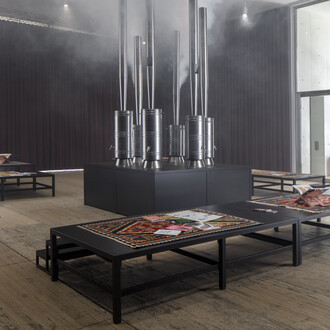
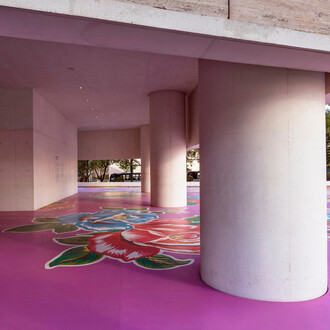
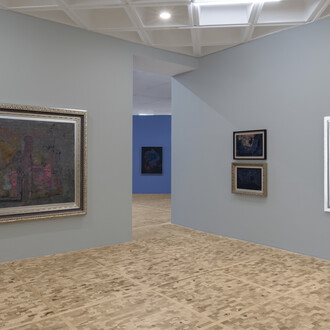
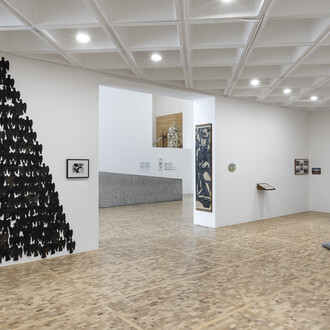
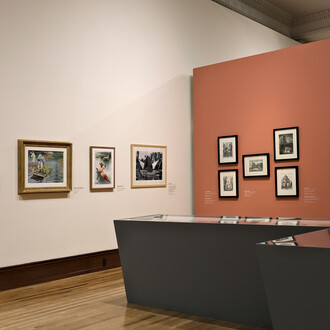
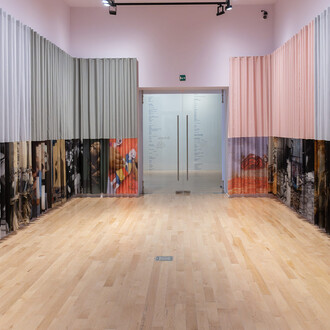
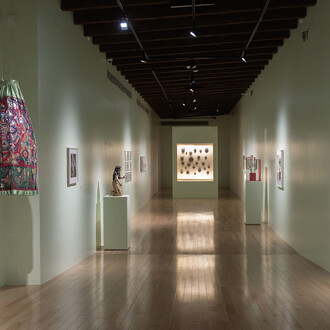
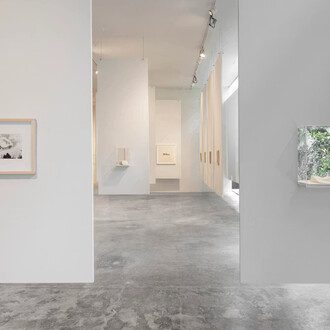
Visiones difusas [Diffuse visions] is a selection of works from the Colección Jumex at the threshold where images of the tangible world are freed from their usual logic, giving way for matter that emerges from the depths of dreams. Drawing on Max Ernst’s fascination with the optical mechanism of the zoetrope and its ability to unfold the static image in time, some of the selected artworks present familiar scenes that border on the edge of the unsettling, while others suggest traces of more-than-human presences. Within in a spiral of signs and apparitions devoid of immediate meaning, the viewer’s gaze drifts toward an atmosphere of estrangement, where the works come together as delirious, hallucinatory visions marked by chromatic saturation, symbols, and hieroglyphs that persist, even with eyes wide shut.
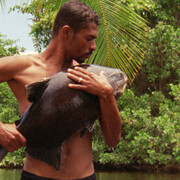
As a provocation to abandon the waking order, the photograph Coudes [Elbows] (1991) by artist Michel François evokes Marceline Marie’s hidden face, although in this portrait the worn surfaces of the elbows function as a facade of a body held captive within its own delicious intimacy. Renouncing physical materiality to venture into unfamiliar territories, the fleshy lobe sculpted by artist Teresa Solar Abboud suggests a descent towards the cavities of what underlies the gaze. Tunnel boring machine (2022) belongs to a series of sculptures that, like components of excavation machinery, enter the rocky folds of the subsoil, that hidden space where mineral presences and other forms of life remain concealed, much like dream matter.
This descent through the tunnel of the subconscious materializes facing the nebula of Real remnants of fictive wars II (2004). Filmed on 35 mm film, this video work by the artist Cyprien Gaillard presents a close-up view of the mouth of a railway tunnel of uncertain destination, that slowly disappears amid a dense cloud of steam. This vapor—actually produced by fire extinguishers—acts as a seductive element that dissolves any reference to reality. Film theorist Christian Metz underscores a subtle yet decisive distinction between filmic and oneiric situations, emphasizing that though “we sometimes speak of the illusion of reality in one or the other,” “true illusion belongs to the dream and it alone. […] The dreamer does not know that he is dreaming; the film spectator knows that he is at the movies.”3
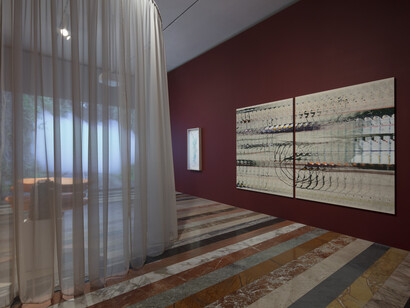
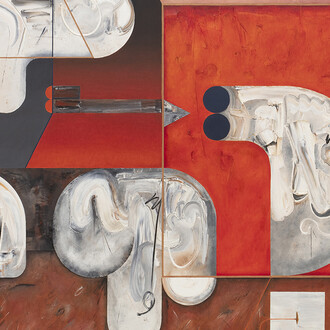
Through this nebula between the real and the fictional, a succes sion of signs unfolds rhythmically in the diptych Ouroboros (Fractal 3) (2023) by Emily Kraus. Guided by the rhythms of natural cycles, the artist employs a self-devised system of rollers set into continuous rotation within her studio to produce this series of paintings in which waves of oil paint are inscribed like hieroglyphs in endless repetition. The canvas, originally sewn as a single piece and subsequently divided into diptychs, functions as a graphic register of vital pulses. This inscription of lines and undulations evokes the cadence of the respiratory cycle, the tracings of an electrocardiogram, or the sensation of falling, again and again, into the vertigo of an endless loop.
The diffuse visions presented throughout the exhibition reaffirm the oneiric as a material of artifice in the hands of contemporary artists who, like the Surrealist Max Ernst, are drawn to the liminal space between sleep and wakefulness. In the essay The optical unconscious, theorist and art critic Rosalind Krauss examines works from different movements and by artists such as Marcel Duchamp, Pablo Picasso, and Eva Hesse, who conceived the field of the image through an opacity guided by unconscious automatisms, sexual impulses, and obsessive neuroses.
The development of technological artifacts like the zoetrope, camera, and cinema throughout the twentieth century played a crucial role in the history of art by expanding the possibilities of the image.
[The] artists of the “optical unconscious” were concerned with the vehicles of mass culture. It seemed to them that what was con firmed there was an order in which the neat separation of the senses —space logically segmented off from time—had been dissolved, deconstructed. That the beat summoned by these devices could not be understood as structurally distinct from “vision” but as operating within it.4
In this optical processing of the world that surrounds us, a transfer of information also takes place, whereby even phonetic language reverts to a primordial tongue in which signs become mere visual flows. If the zoetrope proposed a new way of altering reality through a burst of moving images, the works of Jim Hodges and Petrit Halilaj suggest an observation of reality from an animal alterity.
Jim Hodges turns to the figure of the spider as the protagonist of the narrative in Untitled / (Daydream) (1994), in which a veil of silk in terwoven with metal chains evokes an animal grammar that exceeds the function of shelter or trap. The orbicular geometry of the spider’s web transcends visuality, to safeguard within its threads a suspended, subtle, and luminous form of writing.
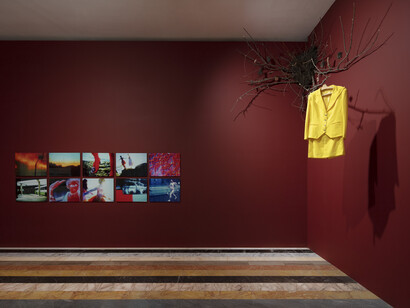
The nest of branches and mud that constitutes Petrit Halilaj’s installation I’m hungry to keep you close. I want to find the words to resist but in the end there is a locked sphere. The funny thing is that you’re not here, nothing is (2014)5 disrupts habitual scale, situating us within a dream landscape on a monumental scale. Halilaj’s sculptures and interventions draw upon personal experiences linked to his condition as a refugee during the political conflict between Albania and Kosovo in the late 1990s. Through a repertoire of fantastical creatures that emerge from his own imaginary, the artist creates an atmosphere of estrangement where ideas of refuge, migration, and freedom meet. In this work, the bird appears as a metaphor for the forced displacements that affect any living being in contexts of profound vulnerability, while the yellow suit suspended among the branches functions as the sole reminiscence of another human presence.
Ernst’s novel deliberately using pre-photographic imagery, organized into chapters that operate as hallucinatory dreams, progressively reveals the tragic events from which Marceline-Marie attempts to free herself, in an effort to break with social norms and overcome her state of neurosis. Similarly, the Swiss artist Pipilotti Rist draws upon psychic drifts to recreate liminal scenarios in which the body is seduced by an atmosphere that is unsettling yet comforting, where the color-saturated pixels both envelop and disorient.
The encounter with Rist’s work often leads to readings that situate her within the realm of pop culture, owing to the musical performativity and aesthetic of her filmic works since the 1980s. According to the artist, however, this ostentatious use of color—said to emanate from the subconscious—is in fact nourished by Dadaist practices and by references to Fluxus figures such as Joan Jonas, Hannah Wilke, and Nam June Paik. In Remake of the weekend/Still stills (1998), the artist reappropriates frag ments from the film Weekend (1967), directed by Jean-Luc Godard which function as visions detached from dreams.
“I’m not more colorful than life is—we are simply used to seeing images that have less color, because we are so fearful that otherwise white skin might appear tinted.”6 This statement encapsulates a per spective from which Rist’s chromatic universe does not exaggerate reality, but rather intervenes in it and molds the sphere of the everyday, destabilizing dominant visual paradigms. This sequence of frames, beyond unsettling us, returns our gaze through the body-camera-lens in that other plane, at times hallucinatory.
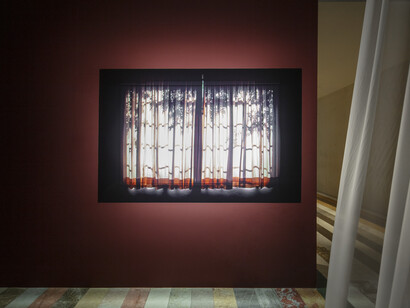
Within this spiral of blurred visions, where the one who observes is at the same time observed, Ventana (2004), a work by the artist Ale de la Puente, emerges. This photograph, illuminated by a lightbox and imbued with a ghostly presence, records the the circadian rhythm and the passage from daylight to night. For the artist, time functions as an abstract idea of indistinct cycles that structure of reality or reverie. Thus, the window manifests as a threshold that receives or bids us farewell, situating us in an intermediate space between inside and outside—a passage that returns us to the everyday or invites us to abandon reality, akin to the vaporous sensation experienced when we wake up from an interrupted dream.
(Text by Adriana Flores Suárez)
Notes
1 Max Ernst, A little girl dreams of taking the veil: an illustrated novel. Translated by Dorothea Tanning (Garden City, NY: Dover Publications, 2017).
2 The stroboscopic effect is the optical effect by which objects appear to move at a slower speed than their actual speed.
3 Christian Metz, El significante imaginario (Barcelona: Editorial Paidós), 2001.
4 Rosalind Krauss, The optical unconscious (Cambridge, Massachusetts Institute of Technology), 1996.
5 In spanish: Tengo hambre de tenerte cerca. Quiero encontrar las palabras para resistir,
pero al final hay una esfera cerrada. Lo curioso es que no estás aquí, nada está.
6 Louisiana Channel, Pipilotti Rist interview: color is dangerous, March 16, 2016.