English
 Español
 Français
 Deutsch
 Italiano
 Português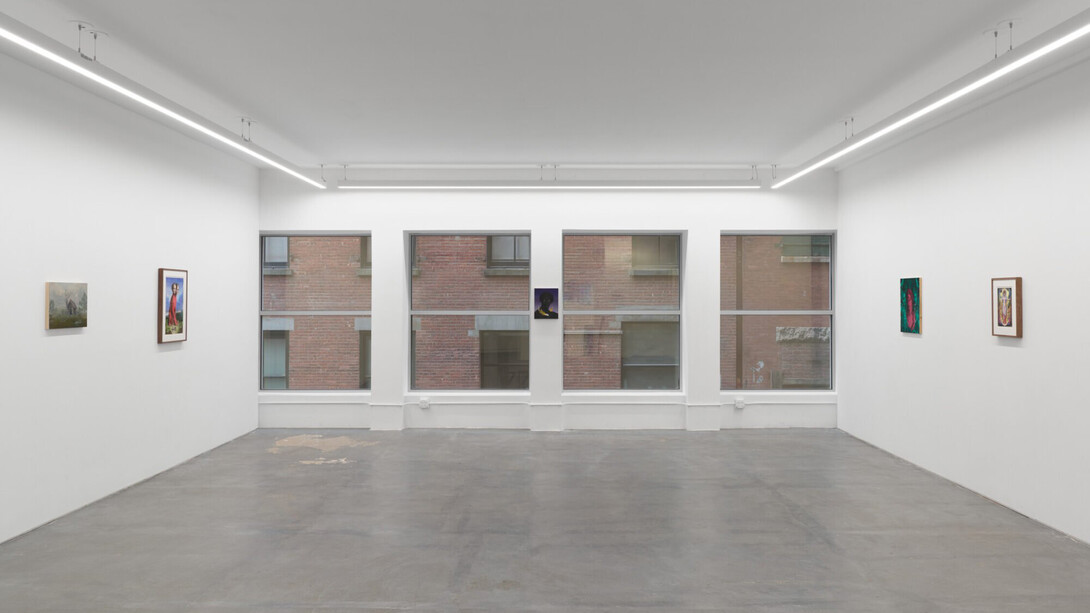
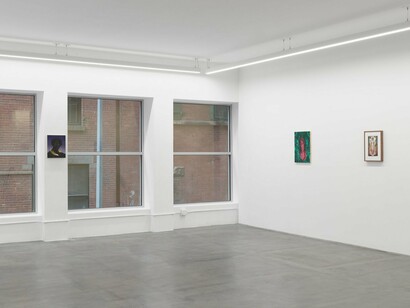
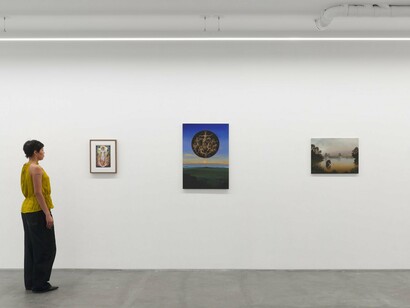
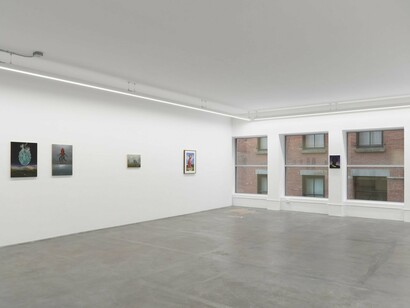
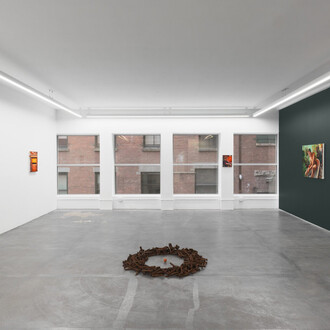
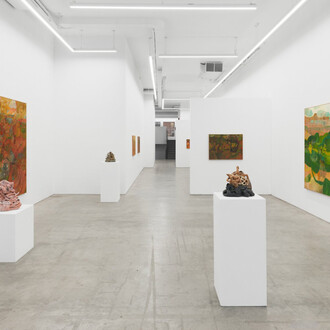
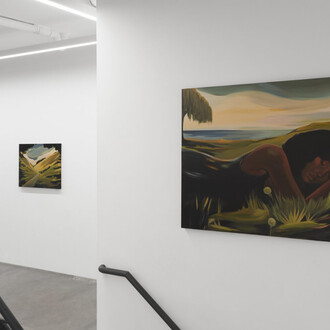
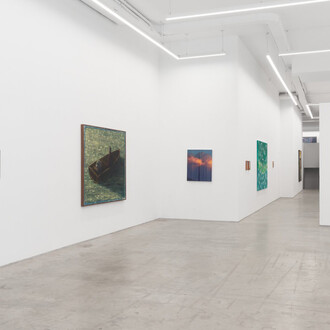
Anat Ebgi is pleased to present Tech Duinn, Ryan Driscoll’s second solo exhibition with the gallery and debut in New York and will include new oil paintings and watercolors. The exhibition is on view at 372 Broadway from May 2 through June 13 with an artist reception on Saturday May 2 from 4-6 pm.
The exhibition takes its title from Tech Duinn, meaning “House of Donn” or “House of the Dark One;” it refers to a dwelling in Irish mythology where the souls of the dead gather before passing onward to the afterlife. Driscoll’s newest works construct a self-contained mythological system that explores the mysteries of death and the realms beyond. Frontal figures of idealized bodies rendered with a disciplined smoothness recalling academic and Renaissance painting recur across the exhibition as presiding sentinel-like forms that watch over this place.
Around them, Driscoll assembles dense constellations of symbols—serpents, flames, hybrid creatures, architectural fragments, and radiant geometries—that operate with the clarity of emblems and ground his visual language. Each painting holds a fixed image, structured through symmetry, repetition, and a tightly managed hierarchy of form and color.
Driscoll’s work makes associative references to classical sculpture, devotional icon painting, Symbolist figuration and Romantic landscapes, absorbing these sources into a consistent pictorial logic. The central figure often asserts authority through scale and placement, while surrounding clusters of faces, attendant bodies, or ornamental systems compress the pictorial field around them.
Across the exhibition, Driscoll maintains a precise control of surface and finish. Figures are frequently rendered in monochrome, evoking marble or cast forms, while select elements—eyes, flames, or internal structures—are heightened through concentrated color, asserting their mythological charge and situating them within an unfamiliar non-reality. Carefully controlled light and the absence of visible brushwork stabilizes the compositions as fully resolved objects.
Driscoll’s cosmology, constructed through fragments of literature, observation of the real world, and invention from his own imagination, fits seamlessly into centuries old traditions of the occult and the mystical. Serpentine forms trace continuous paths through the compositions, linking figures and reinforcing a shared visual vocabulary. His articulation of this world—its characters, causes, and internal relations—suggest an ordered realm governed by a constant and eerie logic.