English
 Español
 Français
 Deutsch
 Italiano
 Português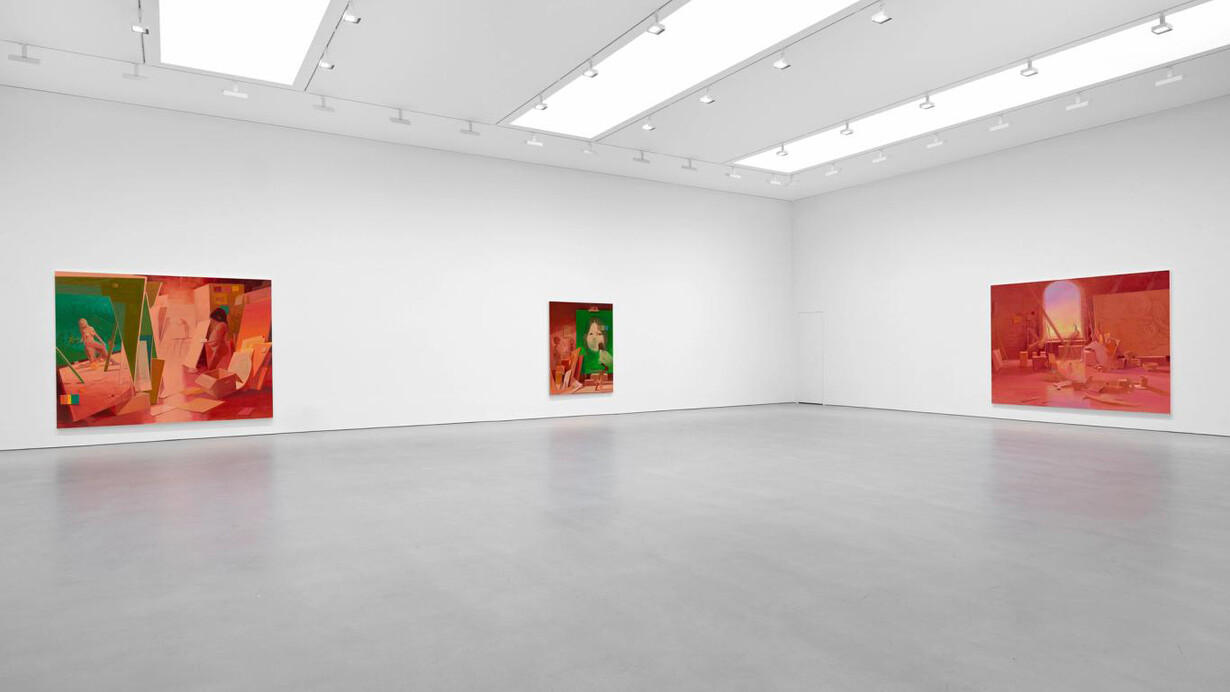
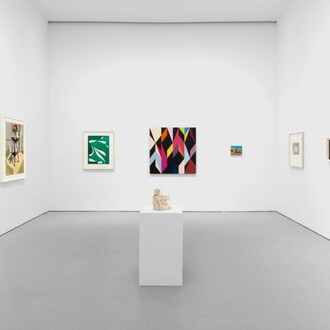
David Zwirner is pleased to present an exhibition of new and recent paintings and works on paper by American artist Lisa Yuskavage, on view at the gallery’s 533 West 19th Street location in New York. This is Yuskavage’s tenth solo exhibition with David Zwirner and marks twenty years since her first show with the gallery in 2006. This exhibition follows her 2025 solo exhibition at David Zwirner Los Angeles and Lisa Yuskavage: drawings—the first comprehensive museum presentation of the artist’s works on paper, recently on view at The Morgan Library & Museum, New York. A new monograph of Yuskavage’s work was just published as part of Phaidon’s Contemporary Artists Series, with texts by Barry Schwabsky, Ariel Levy, and Lena Dunham.
One of the most influential painters of the past three decades, Yuskavage has developed a highly original approach to figuration that continues to expand the possibilities of painting and its role within contemporary art. Her simultaneously assertive and vulnerable, exhibitionist and introspective characters assume dual roles of subject and object, complicating the position of viewership. Deploying color as a character, Yuskavage’s paintings are realms of artifice and imagination in which realistic and abstract elements coexist.
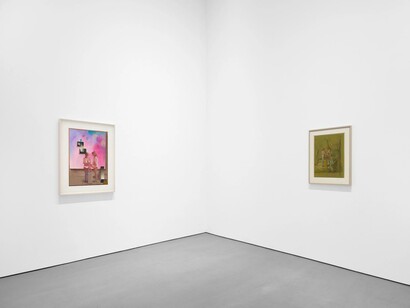
The exhibition marks a significant development in Yuskavage’s practice while synthesizing the themes that have shaped her oeuvre since the beginning. Although many of the paintings and drawings appear to unfold within a studio setting, they are more accurately located in the mind of the artist, becoming imaginative gatherings where time warps and folds back on itself, collapsing spatial and temporal boundaries. As writer and curator Helen Molesworth notes, Yuskavage’s new works reveal “a complex history composed of personal iconography and a range of art-historical allusions—the artist as young girl, the older woman, the painter, the painted—each work functions like a wormhole, moving viewers forward and backward through time. Nothing is exactly what it seems; instead, the paintings sustain a state of constant vacillation. This is something painting as a medium can do, but it is specifically what Yuskavage’s paintings do.”1
Although widely recognized as a figurative painter, Yuskavage has long engaged with the legacy of color field painting—an influence that becomes particularly evident in the present exhibition. In a new development in her practice, she introduces trompe-l'oeil devices to arrive at a comparable emphasis on abstraction, mobilizing illusion precisely to expose the inherent flatness of the works. In this sense, mimesis becomes paradoxically more abstract than abstraction itself, recalling an early modernist moment before abstraction and figuration hardened into opposing categories—when a painted figure could function simultaneously as representation and as purely pictorial event.
While the numerous empty canvases that have populated Yuskavage’s imagined studio interiors over the past several years have seemed to suggest future paintings, their recurrence across this body of work has gradually revealed a deeper significance. As an art student, her color theory classes utilized Color-aid decks to create collage studies, and in these colored squares she recognized a connection to her formative education. A latent narrative of color pedagogy emerges, summoning the presence of Bauhaus figures Josef Albers and his teacher Johannes Itten.
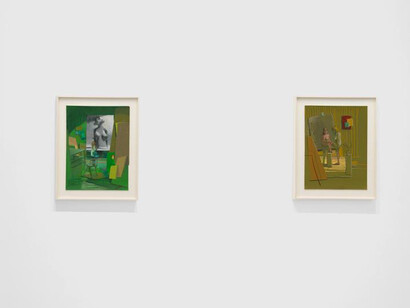
The exhibition introduces a body of collages—a new medium for the artist—using Color-aid paper as a ground. The slightly textured surface of the paper interacts with the mixed media of pastel, egg tempera, gouache, and pasted elements to produce subtle light effects that heighten the spatial illusion. The collages move beyond the re-representation of works from Yuskavage’s oeuvre—some of which have been pasted onto the surfaces in perspective—to reenact the artistic techniques embedded within them. While they effectively disguise their constructed nature, the paintings, by contrast, simulate its appearance.
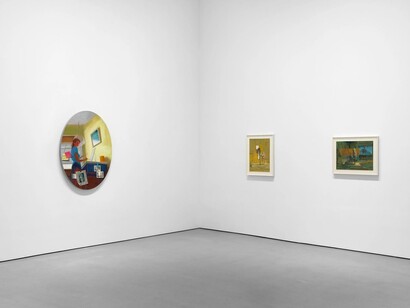
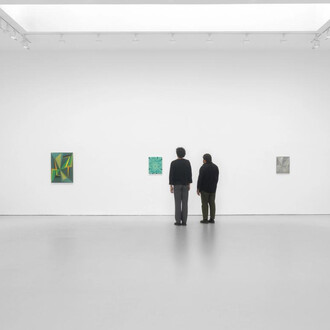
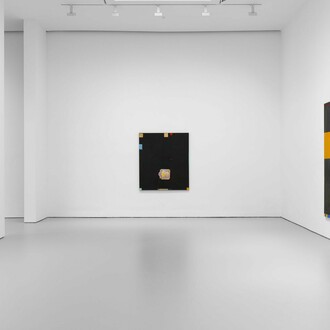
Across these intricate works, scale shifts continuously as characters and images appear in unexpected proportions. This dynamic is echoed within the exhibition itself, where viewers move from expansive canvases to smaller, intimate compositions in a recursive play of enlargement and reduction that produces a surreal, almost fractal form of world-building. Ultimately, the works become both subjects and objects within an ongoing relational exchange—a pictorial universe that continually reflects back upon itself.
Yet above all, these are works that insist on being looked at. They signal a renewed embrace of pleasures historically associated with painting before the modernist project of demystification: color, illusion, sensuality, and imaginative invention. If much of the twentieth century sought to dismantle the magic of the medium, Yuskavage restores it—not nostalgically, but with full awareness of its constructed nature. By repeatedly returning to her own images rather than appropriating those of others, she demonstrates painting’s capacity to transform imagination into visible form, and the enduring, unapologetic joy and potential of the medium itself.
Notes
1 Helen Molesworth in correspondence with the artist, March 2026.