English
 Español
 Français
 Deutsch
 Italiano
 Português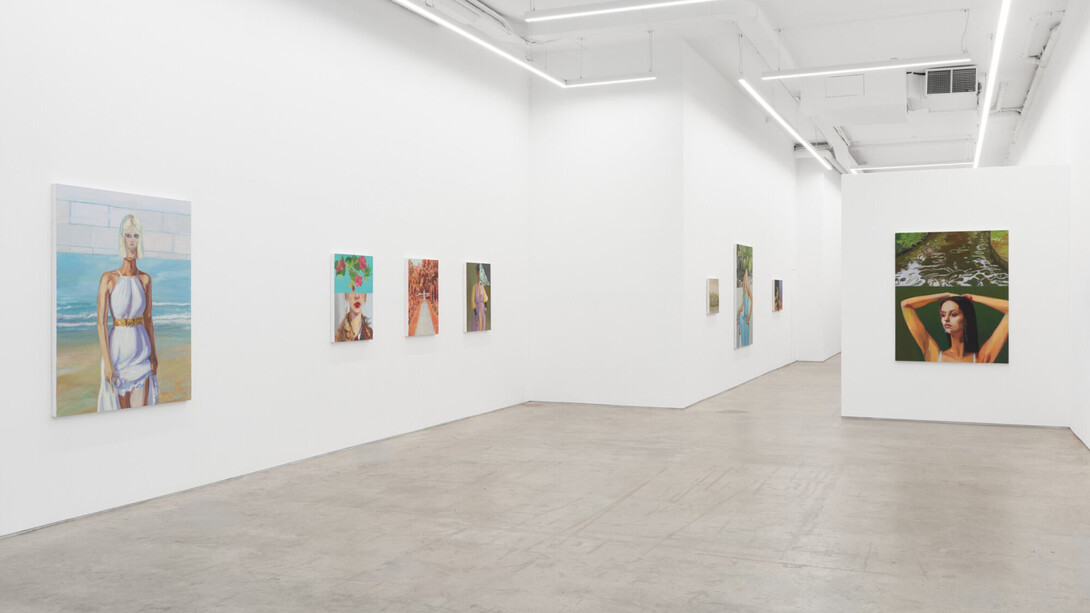
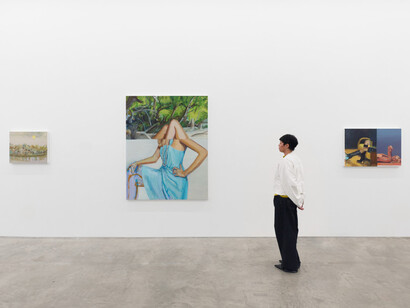
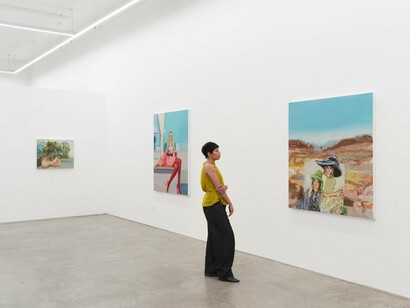
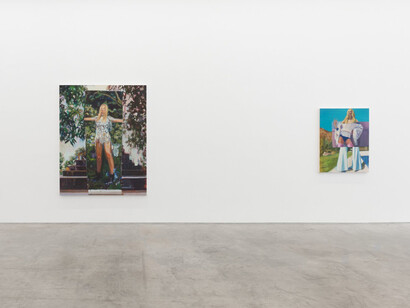
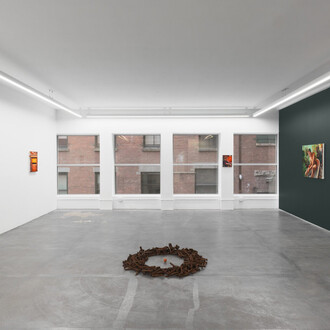
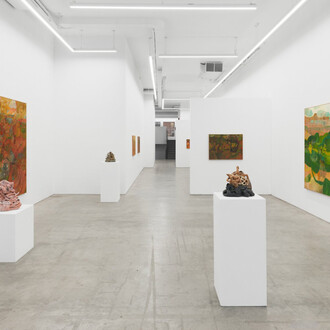
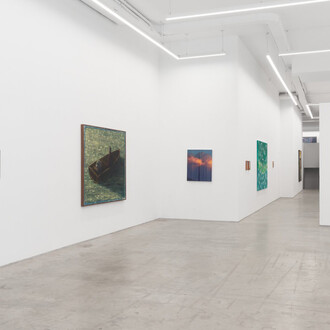
Anat Ebgi is pleased to present Landscape with legs, Janet Werner’s first exhibition with the gallery in New York, on view at 372 Broadway from May 2 through June 13. The exhibition continues Werner’s longstanding investigations in female portraiture that draw from both fashion imagery and art historical references.
On Saturday, May 2, at 4pm the artist will be in conversation with curator and writer Anaïs Castro with a reception to follow.
Werner begins a new painting by collaging two or more images culled from her vast collection of fashion magazines accumulated in her studio over the past 25 years. The juxtapositions create breaks in the image where the joined elements align or misalign; sometimes there is a vertical split, or a horizontal one, while others are altered with folds or tears. These interruptions alter the original sources radically enough for Werner to begin painting from a place of discovery, allowing her to push to new ways to investigate the narrative of the fictional portrait.
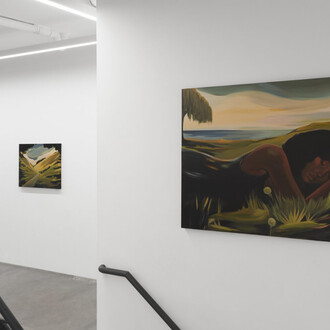
A dynamic force persists between the original images and Werner’s alterations, opening up a set of existential questions. The introduction of landscapes extends these inquiries, representing spaces that remain unknown and ungraspable. Werner stages her figures within landscapes—multiple times removed from reality—drawing on reinterpretations of Edvard Munch, Caspar David Friedrich, and Jean-Antoine Watteau. These environments share a sense of the staged, the choreographed, and the romanticised. Werner’s engagement with artifice uncovers something evasive about human psychology.
This exhibition title, Landscape with legs, follows a convention from art history that describes a picture’s contents in terms of the subject paired with an object (e.g., Woman with a parrot; Boy with a greyhound). Landscape with legs subverts this trope, upending various hierarchies, giving figure and ground equal importance. It conjures an absurd idea of a moveable landscape that could get up and walk away if it wished to.
Though Werner’s subjects circulate within popular media, these women are not necessarily famous, nor are the paintings intended to replicate their likenesses. While they are not invented from pure imagination, the final result is not pre-meditated either; Werner allows herself to deviate dramatically from her references in the process of painting. Werner’s paintings are layered, recording hesitation and revision, pulling figures in and out of legibility through a process of renegotiation, interruption, and accumulation. Passages of her initial drawing and underpainting, various stages of full rendering or unpainted edges remain in the final composition, leaving some air and space to breathe.
Ruffles, lace, silks of haute couture and the wild countryside filled with bramble, grasses, and riverbanks, become passages through which Werner paints toward the human interior. Attention to lips, eyes, hair, and pose may anchor the composition, while a sense of emotional truth emerges through fragile, responsive, painterly decisions. In this exhibition Werner is dealing with continuity in a new way—the exterior world and the inner world of the psyche—are combined in one image. Through undoing, dismantling, and fracturing spatial logic, Werner allows multiple moments and movements to collapse into a single, seamless image. Beginning with the collision of her found images, Werner eliminates the possibility of a singular reading, instead her paintings bare traces of contradiction and shifting subjectivities.