English
 Español
 Français
 Deutsch
 Italiano
 Português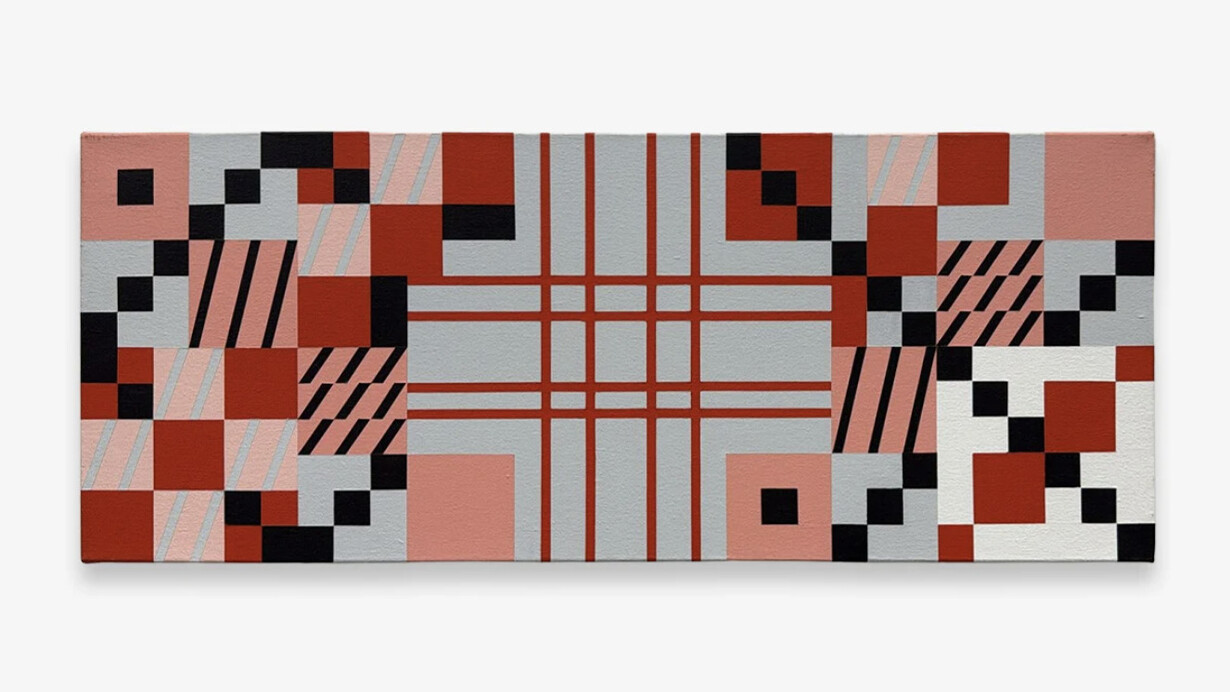
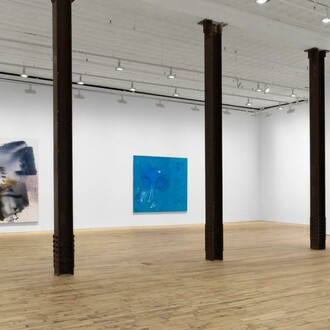
Anat Ebgi is pleased to announce Crisis management, an exhibition of paintings by American artist Gloria Klein. This is Klein’s first solo exhibition with the gallery in New York. On view at 372 Broadway in Tribeca from January 9 through February 28, with an opening reception on Friday, January 9 from 6-8pm.
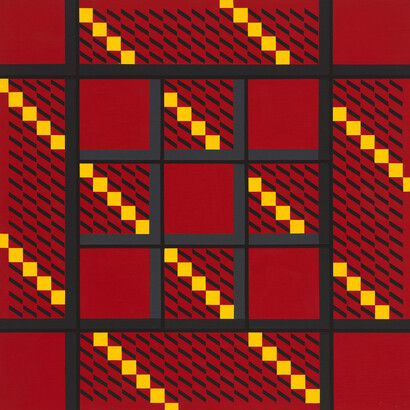
Gloria Klein’s mature works are rooted in repetition and systemic order, developed through an enigmatic and self-determined process in which repeated strokes accumulate into vibrating fields of diagonal hatch marks. She once remarked “I regard each of those hatch marks as participants, as individuals. Together they create lines. The lines then became ‘individuals’ that are part of larger patterns.” Klein’s compositions push against the limits of comfort, forming dense structures that evoke psychological or urban chaos: the jostling of bodies in a crowd, visual overload of signage, or the coded language of digital information.
Born and raised in Brooklyn amid rapid social, cultural, and aesthetic shifts, Klein first studied economics at Brooklyn College, City University of New York. This early training sharpened Klein’s sensitivity to how individual choices accrue into collective behavior, expressed later in her work through the discrete unit of the hatch mark, whose accumulation and interaction produce larger patterns and systemic pictorial effects. She subsequently attended the Brooklyn Museum School of Art and the Art Students League of New York. Building on these foundations, in 1970, with a letter of recommendation from Roy Lichtenstein, Klein enrolled at Hunter College, where she studied with conceptual artists Robert Barry and Robert Swain.
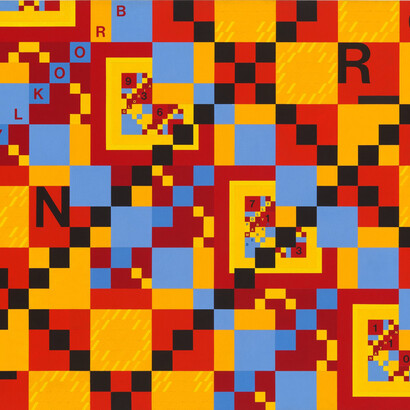
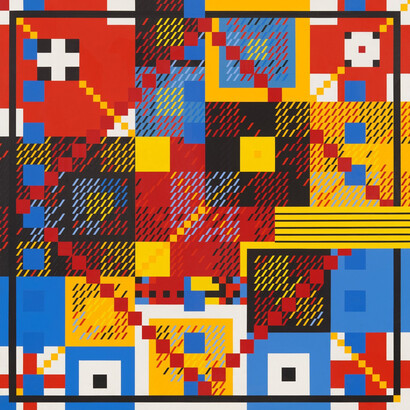
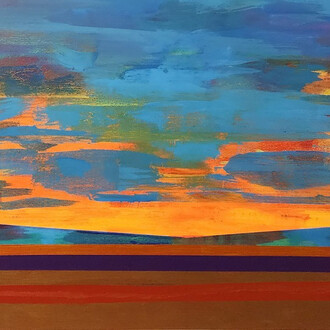
Crisis management presents paintings Klein made in New York during the late 1980s and early 90s, a period in which her syntax expanded into the modular and asymmetrical. While her earliest hatch marks served as a type of fundamental expressive ‘unit,’ this later period of work performs a détournement—transforming the diagonal slash into optical scores of nested squares, pixelated interruptions, and sequential ornament. These works pursue order within shifting fields and interlocking grounds that refer back to modernist grids while subtly undermining their authoritative stability. Her paintings are both arresting and slow burning, grabbing viewers with their complex harmonies and sense of constant movement. Klein imparts her boisterous paintings with emotive and rational perspective, sifting through the complexity of people and society, life’s problems and solutions, movements, feelings, and experiences.
Across the works in this exhibition we see Klein’s layering of systems become increasingly complex. Her patterns and systems also turn prepositional; compositions are superimposed upon, abutted against, and embedded within one another. Klein described her works as “pictures of the structure of reality and the structure of space,” and the works in this exhibition reveal her efforts to extend that ambition. Almost algorithmic, the works read as frequencies, digital signals, or early lines of code, yet they are charged with human irregularity.
Klein’s orientation toward understanding aggregated behavior underlies the mathematical rigor with which she allocated color, density, and interval. Klein felt that her patterns “related to the world around [her]” and articulated that they emerged from observing “systems and sub-systems in our society, and the way individuals behave in large and small groups and on their own.” Animated by analytic clarity, she noted, “I want to make visible what is already there, to bring and illuminate the underlying structure.” Her obsessive pursuit of order exposes the friction between the cool authority of a system and the messy realities of lived experience. Formulas falter and transcendental ascension through rationalism fails the stress testing of her palette and rules-based systems. Multilayering, sequencing, and interlocking thus serve as metaphors for layers of consciousness, perception, social harmony or disharmony, and for the interaction of individuals and groups in society.