English
 Español
 Français
 Deutsch
 Italiano
 Português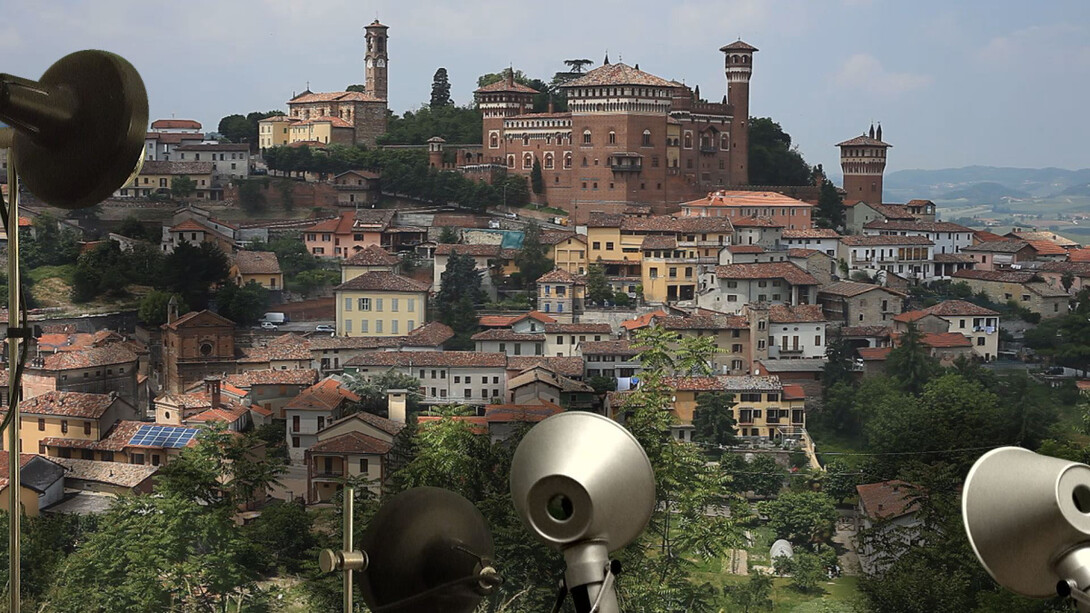
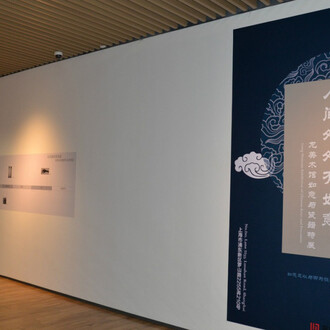
The Power Station of Art (PSA) will present Flatform: concert for films and works, Flatform’s first large-scale debut in China, from May 1 to June 28, 2026. Offering a systematic overview of nearly twenty years of the collective’s artistic practice, the exhibition is organised by the Power Station of Art, with the support of the Italian Cultural Institute in Shanghai (Consulate General of Italy in Shanghai) and the Italian Council (13th Edition) – Directorate-General for Contemporary Creativity of the Italian Ministry of Culture, produced and coordinated by Ramdom (Italy).
The starting point for Flatform is always film, but their physical works – whether pictorial, sculptural, or performative – are material counterparts, which move from the apparent intangibility of moving images to the concrete sphere of matter and space. In this process, many other qualities both emerge and take root. "Films" and "works" in the exhibition title are not simply juxtaposed, rather, they are emblematic of Flatform’s distinctive approach: through the assemblage and transformation of films, installations, and other media, elements that may appear in contradiction are brought into the same circuit, where they blend and pull on one another, as if orchestrated in concert.
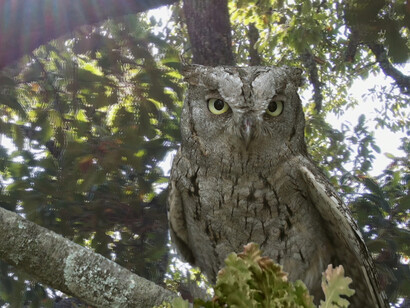
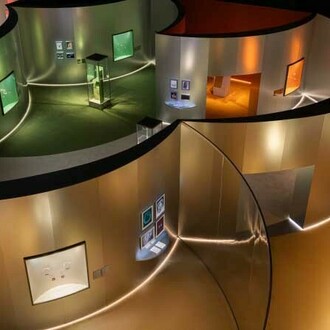
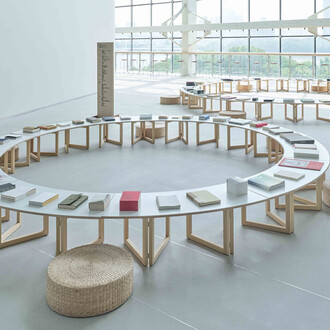
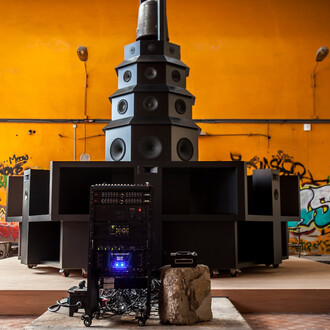
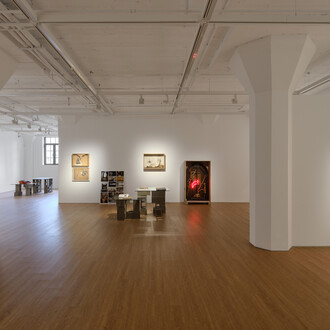
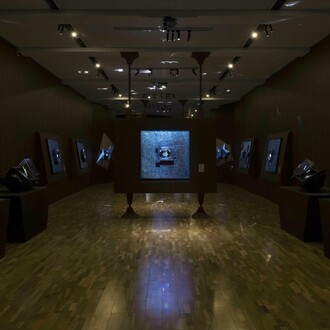
The exhibition consists of more than ten groups of installations, each staging a dialogue between a film and its corresponding work. Among them, in Cannot be Anything against the Wind, presented in an installation conceived for this exhibition at the Power Station of Art, the audio, consisting solely of different types of wind, is spatialized and distributed among four analog recorders that produce an additional wind sound (absent in the film) when the tape is rewound; meanwhile, the corresponding series of drawings, One Second of Wind, unravels the succession of the 25 frames that compose the unit of time of the film itself, revealing the temporal structure inherent to the medium. History of a Tree is a film/portrait of a monumental Valonia oak: its storyboard is engraved on oak parquet, allowing the film’s narrative to take physical form—one that can be walked upon and perceived—while reexamining film as a medium that creates a loop between words, images, and matter. In the installation of Quantum, two facing walls present, on one side, the film, where light is the fundamental element, and on the other, the film’s score, illuminated by lamps synchronized with the variations of light in the moving image.
Conceived as a concerted interaction between different works, the exhibition as a whole functions as a precise apparatus of attention: a space in which films and works mirror and transform one another, and where viewing becomes not merely a visual act but a repeated probing of temporal forms, material memory, and the thresholds of perception.