English
 Español
 Français
 Deutsch
 Italiano
 Português
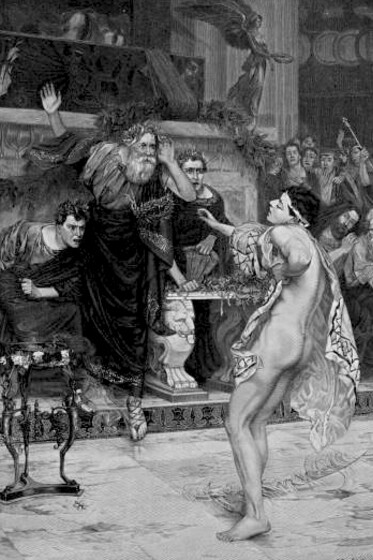
In Glorious Exploits, we see the blurring of class and social boundaries amid the changing circumstances brought about by the Peloponnesian Wars. The Athenians are prisoners left to starve in an old stone quarry with one entrance in and out. It is because they are Athenians that Gelon believes they will know the work of Euripides, his favourite playwright, and in particular the play Medea. This tragedy has particular significance for him as his wife has left him after the death of their son.
Gelon and Lampo are unemployed potters. We learn from Lampo’s conversation with Lyra that his father left when he was young and he was raised by his mother. Due to economic necessity, he did not finish school and cannot read or write. He also still lives with his mother, again suggesting economic necessity born of poverty rather than choice. When he looks for work to obtain money to buy Lyra’s freedom, he takes on manual work, shifting crates in the market. In contrast, Gelon’s status is unclear; we know he is a potter whose wife has left him after the death of their son. He is astute enough to know that they will need a patron to finance the play if they are to procure costumes and scenery. When they discover the Athenian armour, they sell it to a collector, Tuireann, who gives them enough money to buy food and costumes for the play.
When Gelon tasks Lampo with using the money for provisions for the play, Lampo is seduced by the merchants into elevating his own appearance and wanders into the expensive area of the market where the aristos shop. Based on his appearance, he is largely ignored until they realise he has money to spend. He buys a chiton in lightning blue, the bright colour setting him apart from the lower classes. This new clothing causes him to look at other aspects of his appearance, buying new boots and having a haircut. The expense is measured in terms of work, reminding the reader that this is only borrowed wealth, the boots costing more than a year's income and the shave the equivalent of a week's rent. This is reckless extravagance, but it makes him feel better and more important. The aristos are generally portrayed as the riotous sons of prominent individuals, clothed in white fluffy cloaks and silver bracelets, which contrasts with the dirt floor of the tavern. They are also identified by the vivid colour of their cloaks, hence the colour of Lampo’s chiton, suggesting he is trying to emulate their style and status.
When courting Lyra, making a good impression is particularly important. Although Lyra is a slave, she can read both Greek and Persian, as her father was a government employee and he taught her. There is also a reference to a maid singing to her when she was young, which is further evidence of her elevated status before she was captured. This may explain her reluctance towards Lampo’s courtship despite his hard work and commitment to buy her freedom. In contrast, Lampo is raised by his mother when his father abandons them, resulting in him not finishing his schooling and not being able to read. Lampo’s poverty, disability and work elevate him to a position little more than a slave, giving money and consumption a greater significance in his life. Equally, the status of being a director, along with Gelon, gives him a sense of worth outside his profession.
Lampo expresses his reservations about the play’s benefactor, Tuireann, but these are quickly dispelled by the fact that he has money. He introduces Lampo and Gelon to Babylon Black, a wine that has to be procured especially for him, the implication being it is both exclusive and expensive, reinforcing his status as a man of discernment and wealth. He is also a man of the world, offering to take the Athenians back home if Lampo can get them to Hyccara before the ship sails. When he arrives at the ship, Tuirenna offers Lampo a job, which he declines and instead gives him a gift before he leaves. The way Tuireann treats the Athenians, giving them food and clothing, does not suggest that he is a slave trader, merely an eccentric collector and philanthropist.
Lampo develops an attachment to Patches, one of the Athenian slaves, whom he chooses to play Jason due to his green eyes. There is a suggestion that he comes from an Athenian aristocratic background and that his commanding performance stems from the fact that he is used to giving orders. After the play, Lampo is determined to rescue him from the quarry and send him home to Athens on the merchant’s ship. Unlike the other residents of Syracuse, he does not blame the Athenians for the death of his countrymen; he sees them in their poverty and hunger as kindred spirits. Lampo’s determination, ingenuity and desperation are demonstrated in his efforts to rescue Patches, along with his ruthlessness as he demands that the other slaves secure Patches' escape before he will take them with him.
Glorious Exploits charts the changing fortunes of the residents of Athens and Syracuse, showing how even the noble can be brought low by war. Equally, despite his boasting, Lampo never learns to read and write, and the story he is narrating has to be written down by a scribe. Patches returns to Athens and meets Euripedes as an old man, explaining that he performed in one of his plays at Syracuse. The final line proclaims “the world a wounded thing that can only be healed by story.”