English
 Español
 Français
 Deutsch
 Italiano
 Português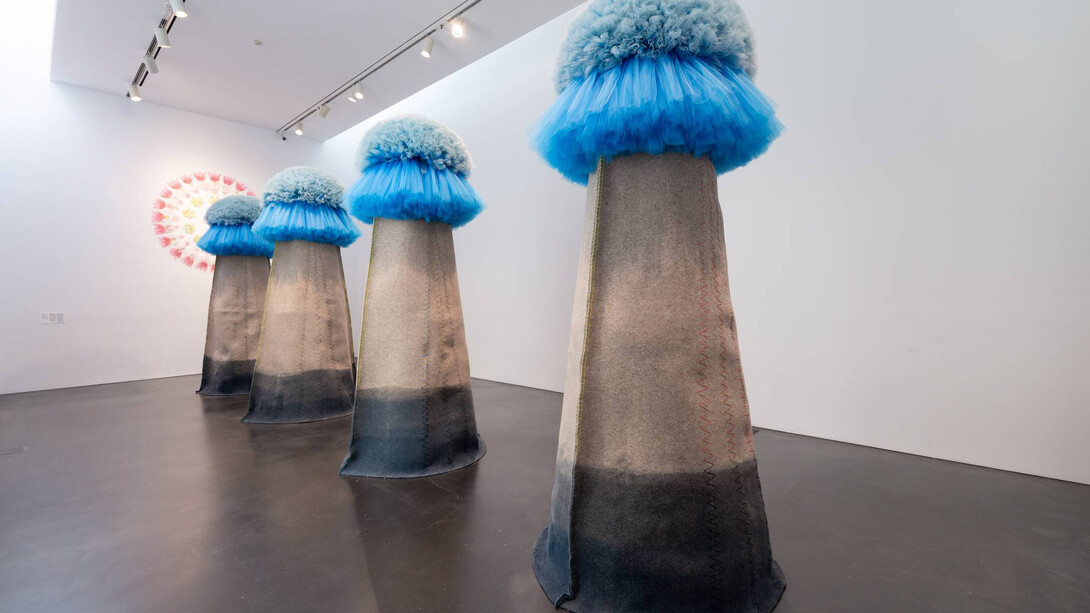
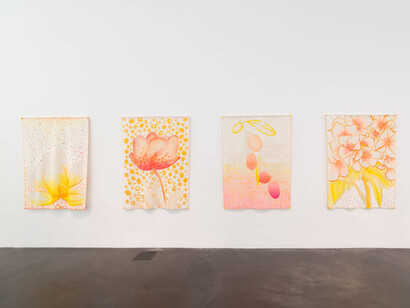
Spanning the museum’s 2nd floor galleries, MCA Denver presents Ana María Hernando: Seguir cantando (Keep singing), which marks the Argentine-born, Colorado-based artist’s largest solo museum exhibition in a decade. Ana María Hernando presents new and recent work rendered in her signature materials: tulle, textiles, paintings, and works on paper to explore how color, song, and poetry are potent emblems of strength, persistence, and rebirth. Hernando is a multidisciplinary artist whose work focuses on the feminine, using empathy to make the invisible visible, and to question our preconceptions of the other and each other, including nature and the earth, their worth, and value.
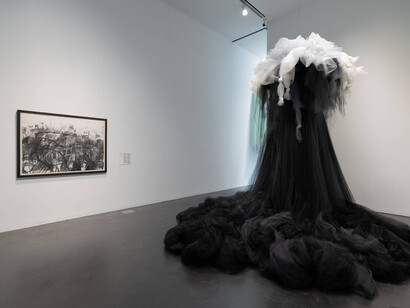
The exhibition explores themes of abundance and emergence as symbols of strength and regeneration. For Hernando, abundance signifies power and collectivity, an unstoppable force. This notion will manifest visually through the materiality of Hernando’s artwork: tulle flowing through and densely filling spaces with a sense of (forward) momentum. Since 2018, the Argentine Denver – based artist has transformed prototypically feminine material, tulle, into large-scale sculptures that appear to emerge from walls, ceilings, windows, or spring vertically from the ground. For Hernando, tulle alludes to a fantasy of complacent feminine fragility, which she rebels against, bringing the material forward in such bounty that softness becomes less a discreet quality and more a function of power, both formally and symbolically.
At MCA Denver, the exhibition will unfold chromatically, beginning with works rendered in black charcoal, gray tulle, and dark paint to white tulle and embroidery, to new works bursting with color. By highlighting tonal shifts from dark to light, Hernando flattens hierarchies of color to give way to an emergent recognition of the subtle details and differences between ourselves and the surrounding world.
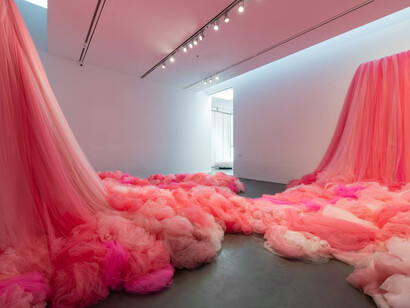
The exhibition centers on a new sculpture titled Seguimos cantando (Waterfalls), sited in MCA Denver’s largest gallery, occupying over 1400 square-feet. Seguimos cantando will consist of two large-scale cascades rendered in a vivid pink tulle. The mountainous forms are supported by a wooden and wire mesh interior structure to lend shape and stability. Measuring approximately 12 feet high and 8 to 10 feet wide each, the forms will emerge directly from the gallery walls, flowing toward each other in a near-convergence on the floor. Visitors will be invited to move through this space, experiencing the immersive, glowing environment activated by the room’s length-spanning skylights. This work is a vivid expression of abundance, generosity, and power. The waterfall — evocative of force and natural miracle — serves here as a symbol of vitality, dignity, and inner potential. The verticality of the installations suggests a refusal to be timid; it is a call to presence, a demonstration of integrity, and an offering of transformative beauty. The work foregrounds the idea of effervescence, movement, and warmth — offering a beacon of joy and vitality to museum audiences.
Another new work, titled Una cama para la luna (A bed for the moon), is a collective offering to nature. This low-hanging circular sculpture will be suspended in front of MCA’s person-height “picture window” that allows viewpoints onto the street, and from the outside into the museum. Hernando was contemplating how the moon provides light to us during the night, and imagines this sculpture as a caring gesture for humans to offer back to the planet. The work will be made collectively, where participants will assist the artist in weaving tulle through the sculpture’s metal framework to fill out its form.
The exhibition’s title, Seguir cantando borrows from the refrain of Como la cigarra (1972) a song by María Elena Walsh, a writer, composer, poet, and musician from Argentina. Walsh wrote the lyrics reflecting on her life and artistic career, likening its ebbs and flows to the lifecycle of the cicada. During Argentina’s military dictatorship (1976 to 1983), however, the song took on new meaning and became a powerful anthem of resistance and strength. In the context of Hernando’s exhibition at MCA, the phrase seguir cantando (keep singing) becomes an inspirational charge to persist through joy amidst adversity.