English
 Español
 Français
 Deutsch
 Italiano
 Português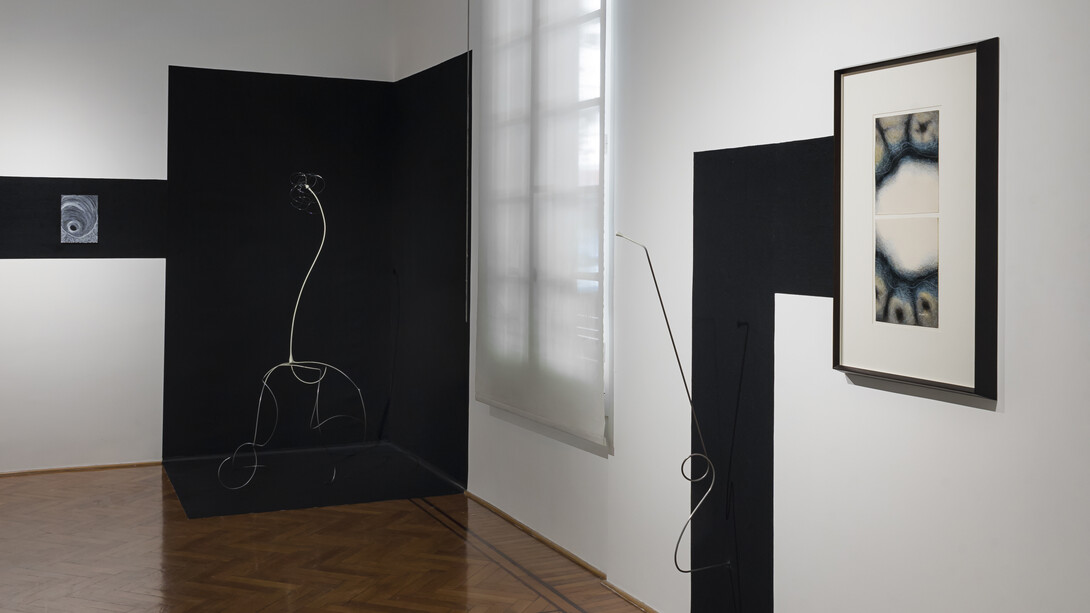
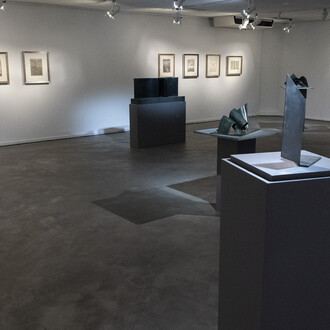
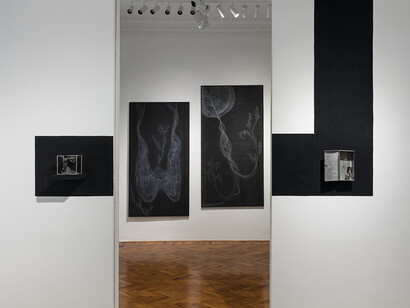
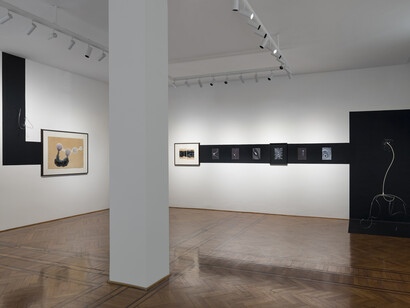
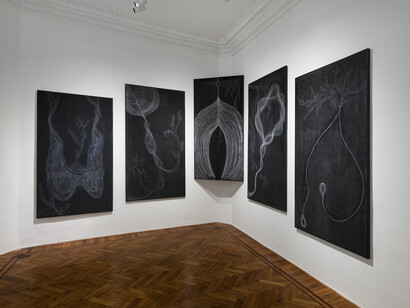
The works of Ginevra Landini (1996) and Emilio Renart (1925–1991) operate within an abstract territory that may generate a certain kind of sensitive information when one embarks on a journey into the mind, along a shared route that expands toward the cosmos. It is a groundless movement toward an unknown formality which, nonetheless and at the same time, may belong to that intrinsic and unobservable sensitivity that constitutes us as human beings. As Landini’s work reminds us, the calcium in our teeth was produced by the same supernova. It is from this fact—among many others—that it becomes possible to move sinuously through the sensations of an active neural network and its expansion into filaments beyond the body itself, using as a vehicle a single line floating in space.
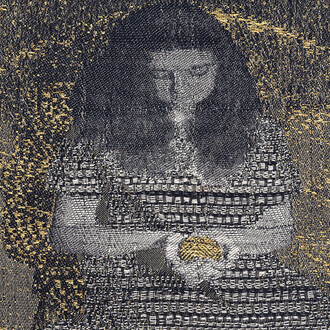
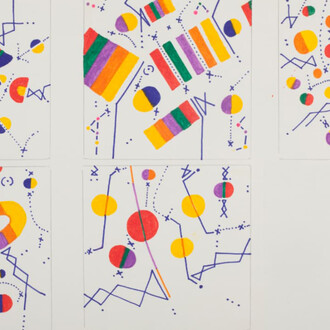
Both artists pursue a sensory semiotics of their own: a kind of writing whose graphemes are cells, hairs and follicles, eggs and holes, neural networks and filaments—forms that organize and narrate, in a language as internal as it is alien, the experiences of the body and consciousness alongside the organic emergence of celestial abstraction. This writing is not translation, but rather a form of sensitive performativity enacted by the hand as interlocutor of the mind. They do not produce closed abstractions, but open systems. Forms connect scales: the microcellular with the abyssal, the anatomical with the geological, hair with calcium, thought with matter. Life appears as a network of relations that traverses organs and organisms, energies and territories.
In Renart’s investigations, lines unfold as a persistent exploration of being and human consciousness. His cellular organisms and linear topographies expand the body from its cellular interior toward the epidermis, and from there to the social realm and the galaxy itself. Consciousness is conceived as the connective mechanism of a living system that manifests across multiple dimensions. In Landini’s works, materiality takes on a more prominent role, from which connections emerge as sensitive cartographies: roots, branches, echoes, and halos register liminal zones between perception and immersion. Psychological states, dreams, nervous sensations, and thoughts take shape as matter in fugitive motion—as an organization of feeling prior to any classification. The minimal and the subtle—sometimes fragile, almost always lyrical—function as vectors of expansion with infinite possibilities. As in a capillary network, the micro feeds the macro and transforms it. In this movement, a sensitive field opens up in which body, matter, and cosmos are once again conceived as parts of a single living system.
Ultimately, human consciousness and the unconscious unfold in these works as part of a broader system. Emotions circulate systemically, as if they were part of a neural network, a bloodstream, or an orbit in perpetual motion. The interior does not settle into fixed subjectivities, but instead shifts in order to avoid reducing emotions to personal narratives and predictable categories—something like a continuous, and perhaps unresolved, search for what is intimately collective.
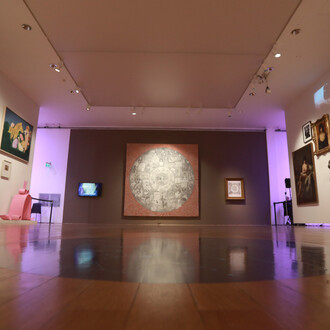
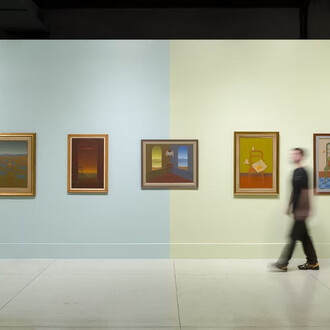
![Various artists, La memoria de la colección. El Moderno en el parque [The collection remembers: the Museo Moderno at Parque de la Memoria], exhibition view. Courtesy of Museo de Arte Moderno de Buenos Aires](/attachments/d292b175cb675e87e5e0bc4f1db740c9e6fcfbe7/store/fill/330/330/5bd19cc5226872f7bb4139c896d817d255dad63113d554be1b333dde96bb/Various-artists-La-memoria-de-la-coleccion-El-Moderno-en-el-parque-The-collection-remembers-the.jpg)