English
 Español
 Français
 Deutsch
 Italiano
 Português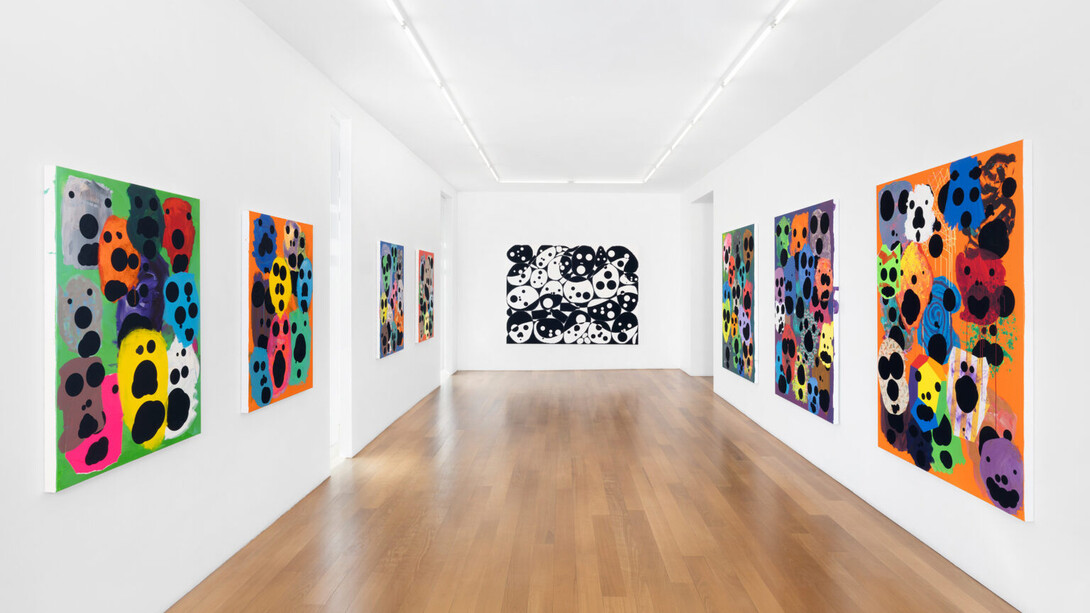
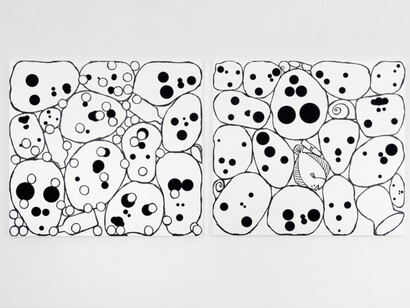
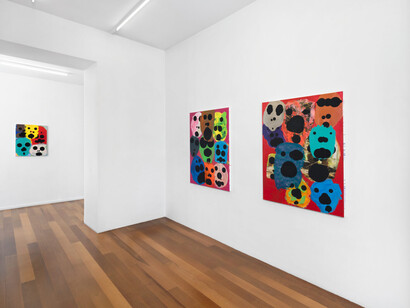
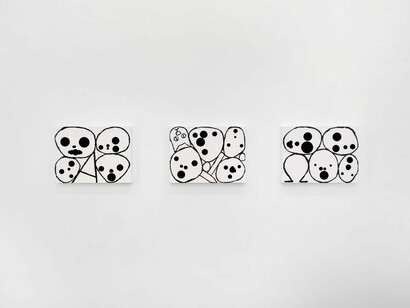
Xippas Geneva presents Avec omega, pomme, haricot, cornichon, rien, bouteille, Mitja Tušek’s first solo exhibition at the gallery in Geneva. The exhibition brings together two recent groups of paintings that extend key questions running through the artist’s work since the 1980s: the materiality of painting, the instability of the image, and the fragility of identity.
The first group presents clusters of faces emerging from a dense pictorial field. Each canvas reveals a small society of figures that overlap, conceal and merge with one another. The portraits arise from a surface of smeared, poured or knife-spread paint, where the figure appears only to waver again, caught within a material that seems both to reveal and to engulf it. Each face is constructed from nine black circles of varying size, often overlapping, which form the elements of the face. This structure echoes Dante’s Divine comedy, where both Paradise and Hell are organised into nine spheres.
In Dante, these orbs are inhabited by saints and sinners; in Tušek’s paintings, each face appears to contain its own mixture of vices and virtues. While each figure possesses its own complexion, all share the same space, that of the canvas, and the same structural logic, that of the circle. This coexistence can be related to the concept of biocenosis formulated by the biologist Karl Möbius. In his studies of oyster beds in the nineteenth century, Möbius showed that one must consider not an isolated species but the entire community of organisms sharing and interacting within a given environment. The faces painted by Tušek thus form a kind of pictorial ecosystem, a network of individual presences coexisting within the same visual field and structured by their relationships.