English
 Español
 Français
 Deutsch
 Italiano
 Português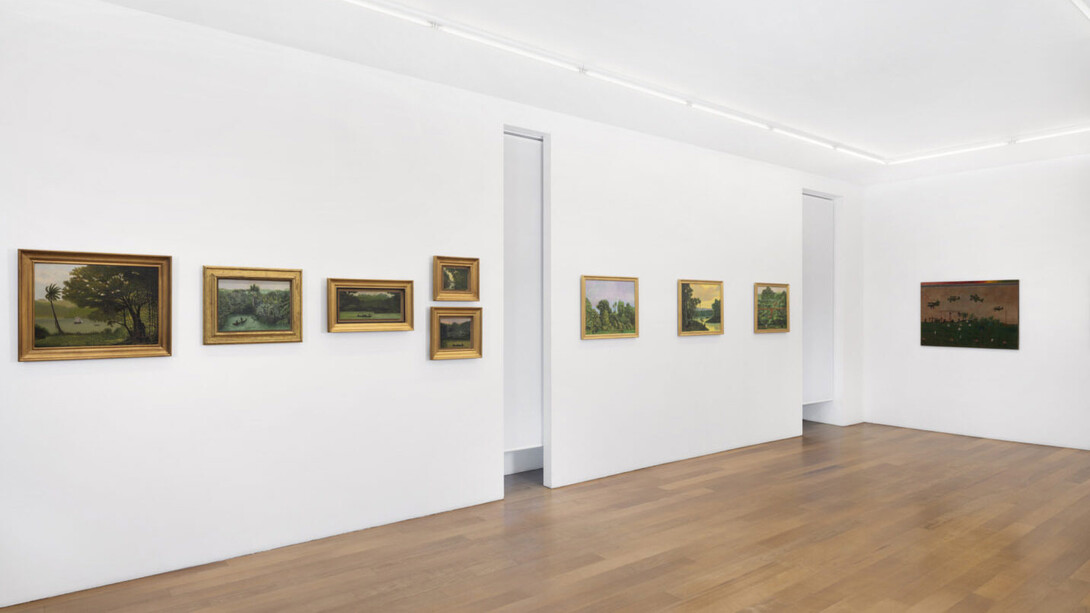
The Xippas Gallery is pleased to present an exhibition dedicated to Uruguayan artist José Gamarra. Whispers in the forest offers an anthological journey spanning fifty years of creation through an exceptional selection of paintings and drawings.
We must return to the forest where the source of our words lies, the reliquary of signs and forms that haunt us — not knowing whether it threatens us or is favorable to us.
(Édouard Glissant)
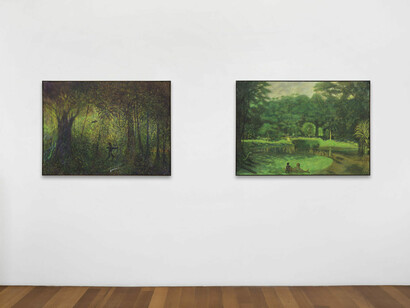
In José Gamarra’s 2024 painting La vigie (the watcher), we see a canoe peacefully crossing a river. Four figures are inside. At the center, Jesus of Nazareth is flanked by a dog and escorted by a demon, both watched over by a Spanish conquistador armed with an arquebus.
Everything described appears consistent with the narrative of colonial Baroque art created in the Americas, but the scene is completed by one final figure who not only adds an incongruous and fantastical dimension to the work, but also anchors it in the contemporary context it projects.
This final figure, the one steering the boat, is Superman.
The famous American superhero is cast as an emblem of North American culture and politics across the American continent (and the Western world).
Likewise, in the detailed jungle setting surrounding the scene described above, an Indigenous person can be seen observing the scene.
The title of the work clearly frames its interpretation: Jesus Christ and the Devil, the Conquistador and Superman all traveling together, “in the same boat,” guided by the power of American culture.
The only witness to the event is this anonymous figure watching over them, along with the vast, lush natural world that seems to resist quietly.
Likewise, in the work Amigos, created in 2021, we see within a sumptuous depiction of the jungle three figures: an animal, a human, and a mythological being, along with two creatures observing them.
In both works, the jungle serves as the setting and the space where a story unfolds. In the first, it is both witness to and victim of an imperialist policy; in the second, it is the only possible space where real and imaginary beings can coexist “the law of the jungle” and The jungle book.
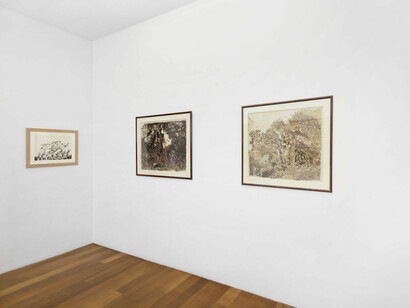
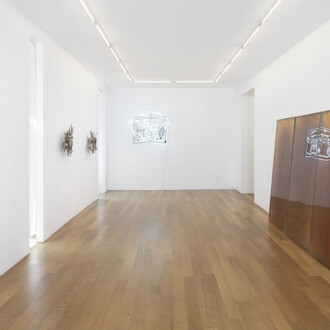
The anthological exhibition Whispers in the forest, presented at Xippas Geneva, retraces fifty years of work by this singular artist through an exceptional selection of paintings and drawings.
José Gamarra was born in Uruguay in 1934. After living for a few years in Rio de Janeiro and participating in the Venice Biennale (1964), he settled in the Paris region in the mid-1960s.
The first series of works created in France reflects certain aesthetic directions of Narrative Figuration (Adami, Arroyo, Arnal, Castro, Cueco, Días, Fromanger, Rancillac, Recalcati, Télémaque). Gamarra was involved for some time in the back-and-forth of this heterogeneous figurative group, associated with media imagery, comic books, and the entertainment industry, which in a way embodied the highly politicized atmosphere prevailing in Paris during the 1960s.
During the 1970s, the depiction of nature and particularly the tropical jungle gradually gained prominence in the artist’s pictorial compositions. At the beginning of the following decade, the representation of the jungle became more formally sophisticated and occupied almost the entire space of Gamarra’s paintings.
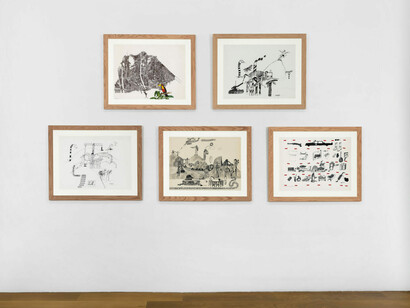
José Gamarra’s artistic project, centered on painting but also involving drawing and graphic production developed since the late 1960s, introduced the depiction of the forest or jungle as a possible scenario for human development. For the artist, the jungle, the forest, the selva is the theater of all conflicts and all agreements, a fundamental space of human action, the primordial setting of myth and fable, the impenetrable mystery of the unknown.
In this infinite and mysterious setting, the artist presents unusual stories where diverse characters from different cultures and historical moments coexist and interact: The Pope and Superman, the Spanish conquistadors of America and mythological animals, or the Yanomami and American sailors. The jungle landscape witnesses and suffers all these conflicts and stands as an ontological space of resistance and resilience perhaps the last possible one.
As with all great creators, Gamarra’s artistic project is not only contemporary by its relevance and creative originality but also because it acts in the present by projecting images that reveal fundamental questions and issues. Nature, culture, society, and politics; the geography from which life comes; the vital space of entropy and the hearth of negentropy this fragile yet resilient space may be the last frontier nature offers to humanity and its culture.
The last frontier.
(Text by Manuel Neves)