English
 Español
 Français
 Deutsch
 Italiano
 Português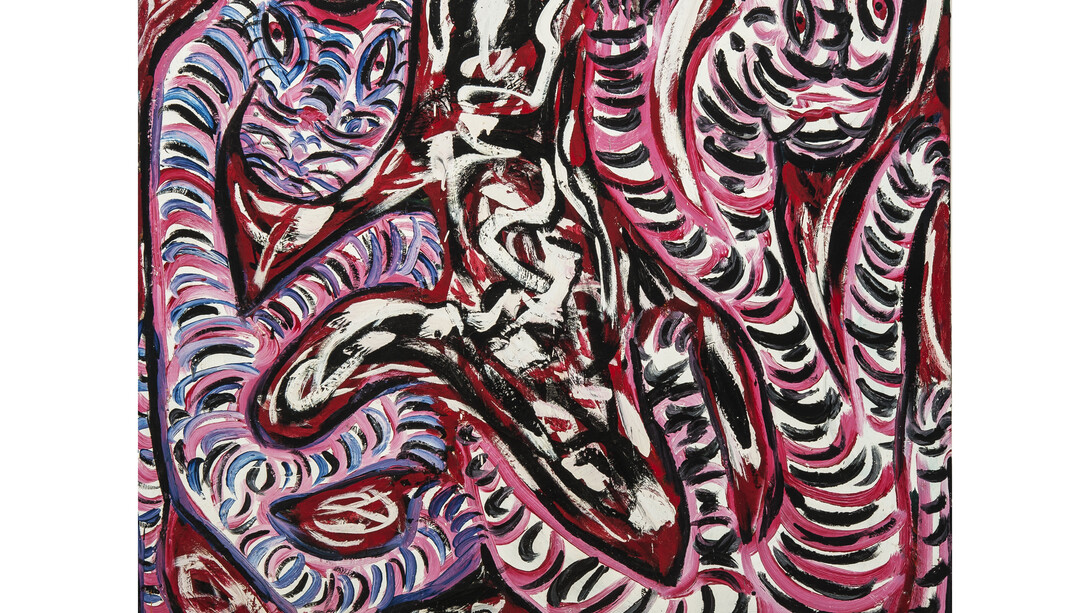
333 Montezuma Arts is pleased to announce a new exhibition, “The Deeper The Southern Roots, Thornton Dial & Lonnie Holley”, curated by Tom Tavelli. The exhibition opens with a reception from 5-7pm on Friday June 27th. The exhibition dates are June 27th – December 31, 2014…
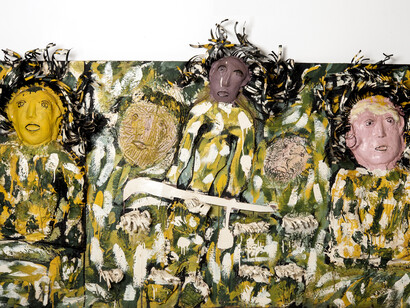
There is a compelling case to consider Thornton Dial the most important African-American artist working today. The exhibition at 333 Montezuma Arts features rarely seen early work by Mr. Dial and the extraordinary energy and archetypical power that bursts from that work just adds more weight to the scale in favor of this assessment.
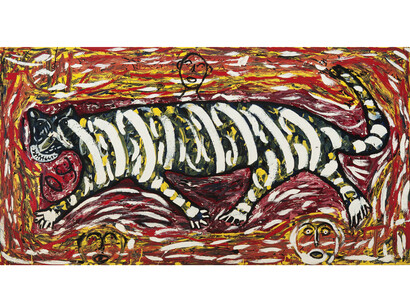
Born in 1923, in Alabama’s Jim Crow South, it has been a long hardscrabble road to travel for a Southern black man with a third grade education to reach rave reviews in the Wall Street Journal, Time Magazine, The New Yorker and numerous museum exhibitions including three solo exhibitions: 1993 “The Image of the Tiger” The New Museum New York simultaneous with The Folk Art Museum, New York, the 2005 Museum of Fine Arts Houston, “Thornton Dial in the 21st Century” and a solo exhibition initiated by the Indianapolis Museum of Art, “Hard Truths, The Art of Thornton Dial” 2011-2013, that traveled to the High Museum in Atlanta, The Mint Museum of Art in Charlotte, and the New Orleans Museum of Art.
It should not be surprising that the same people living on the same ground that seeded gospel, blues, soul, rock and roll, and jazz also had an independent visual art tradition. Thornton Dial as a boy watched his older second cousin take found or discarded materials to make objects of decoration for the house and yard. He and his friends made toys from the same materials. Southern Black woman passed down a quilting tradition that extended back through slavery to African textile traditions. Black men in the South added their voice to build this visual tradition. The art from this tradition was labeled Southern vernacular, folk or outsider art.
In Thornton Dial that “vernacular” tradition met a highly intelligent, virtuoso art talent who was a skilled metal worker from years of work at the Pullman factory in Birmingham Alabama. There was also another fortuitous meeting. Lonnie Holley introduced Thornton Dial to collector, art dealer, curator, scholar and impresario William Arnett. Arnett was the first to recognize the scope and importance of this Southern visual tradition. William Arnett has collected, studied, and gathered a critical mass of work to make this Southern Vernacular Art recognizable as an important independent tradition. He provided the scholarship, documentation and financial support to enable the best of these artists to come to the attention of the larger museum and academic world.
The terms “vernacular” art and “outsider” art have a pejorative slant but these terms do describe some key points. The term “vernacular” does capture the fact that this tradition emerged spontaneously from black American roots deep in the rural South. There was no central organization or college curriculum. It was a grass roots phenomenon. “Outsider” correctly describes that this was an independent tradition outside the American and European art system.
When Karen Wilkin art critic for the Wall Street Journal picked, “Hard Truths The Art of Thornton Dial” as one of the five best art exhibitions of 2011, she placed Thornton Dial with de Kooning, Degas, Picasso, Matisse and Kandinsky. What this acknowledges is that an independent art tradition centered on Birmingham Alabama, unconnected to the Paris and New York centered European tradition, produced an artist comparable to the best of the European Modernists. This is what makes Thornton Dial so important. To further make that case consider what independent means. Mr. Dial was uneducated beyond the third grade. He was isolated in the Jim Crow South. He never saw a Picasso, Matisse, Van Gogh or Munch, or a Schwitters or a Duchamp yet his work stands with the best of the European tradition and has many formal similarities. When his work is compared to Anselm Kiefer, Louise Bourgeois or Jackson Pollack it must be remembered that he traveled through a route different and independent of the route that flowed from the early European modernists influenced by African art in Paris. He comes from an art tradition embedded in the African American roots deep in the Southern soil. He is one of the purest voices of the African-American experience and one of the most powerful because his African influence is “in the blood”.
Thornton Dial is both a pinnacle and a bridge of this Southern Vernacular tradition to the larger world. As a pinnacle of that Black Southern tradition Mr. Dial is its Muddy Waters, with a deep and true voice. As a bridge Mr. Dial’s virtuoso talent bridges the gap and takes that tradition into the international art world. He is its John Coltrane. The work of Lonnie Holley exhibited at 333 Montezuma Arts exemplifies how another virtuoso art talent from the Birmingham school has crossed the bridge. Most of the work exhibited at 333 was done in residency at the Robert Rauschenberg Foundation in Florida. As with Thornton Dial, opportunity and support have allowed Lonnie’s natural talent to blossom.
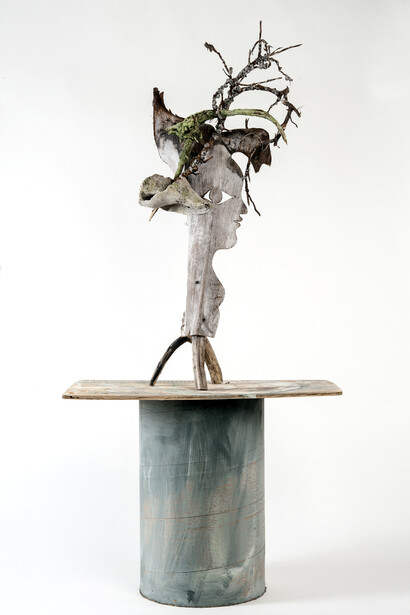
With the Rauschenberg residency Lonnie Holley had time to wander along the beach picking up materials that washed in from the sea. “Untitled” 2014, is a sophisticated, elegant sculpture that would stand gracefully beside a Picasso. It is made from driftwood, a seashell, a wooden spool and a found piece of plywood. To describe it one could reference “Picasso” or describe it as a spirit out of an American Mid- Summers Night Dream but that would not be correct. Holley is not referencing Picasso or Shakespeare; he is directly referencing an African sculptural tradition that existed long before Picasso was influenced by it. It is not an intellectual reference it comes from another deeper place.
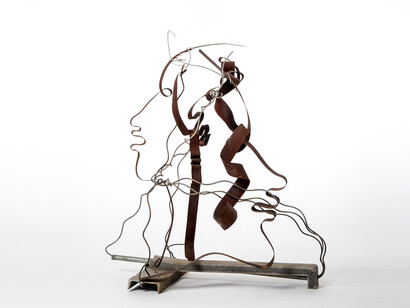
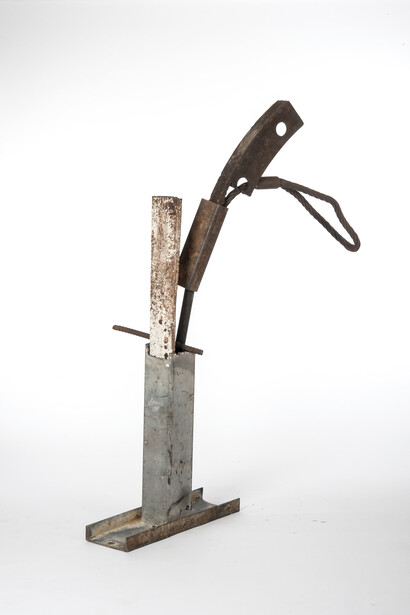
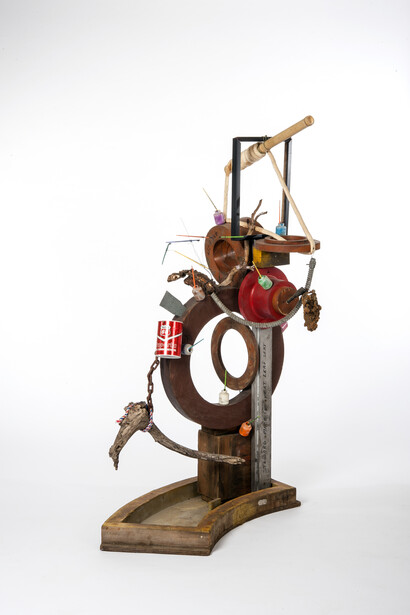
Holley has a gift for assemblage. He can take almost any material and/or found object and transform it into sculpture. 333 is exhibiting a Holley mobile as beautifully balanced as a Calder made from found industrial aluminum objects, driftwood and a shell. Again there is the African tradition in it. I would call it a contemporary hoodoo. Given the time and access to different materials at the Rauschenberg Foundation Holley took several of his on going motifs to different and extraordinary places. Taking strips and scraps of found aluminum usually used in heating ductwork Holley created several sculptures that combine the high modernism found in work by architects like Santiago Calatrava, Zaha Hadid and Frank Gehry with a Duchamp readymade. Holley takes an aluminum vent and incorporates it unaltered into a bent and folded single piece of aluminum to make a contemporary sculpture. In another piece Holley weaves in space rusted wire and found aluminum scrapes to make a work more sophisticated and more graceful than any of Frank Stella’s recent work. It all looks so effortless, so perfectly engineered, so visually intelligent it is easy to forget and difficult to imagine how hard the road has been for Lonnie Holley to reach the Rauschenberg Foundation.
Thornton Dial at 85 and Lonnie Holley at 64 have crossed the bridge and there like may not come again. The visual tradition that they come from has traveled from the deep black roots in the Southern soil through Jim Crow through the Civil Rights movement to a new world where they are beginning to receive their due as artists. The residue of Jim Crow may linger but the isolation of Jim Crow no longer exists. The times are a changing … someone should write the Museum of Modern Art and let them know.
333 Montezuma Arts
333 Montezuma Ave.
Santa Fe (NM) 87501 United States
Tel. +1 (505) 9889564
info@333montezumaarts.com
www.333montezumaarts.com
Opening hours
Tuesday - Saturday
From 10am to 5pm
Related images
- Thornton Dial, “Things Don’t Always Weigh the Same in the Cotton Fields” 1988, Mixed Media, 4’h x 8’w x 9”d
- Lonnie Holley, “Him Her and Them” 2005, Mixed Media, 50”h x 42”w x 30”d
- Thornton Dial, “Scrambling for Life” 1989, Oil on Canvas on Wood, Board, 48” x 90”
- Lonnie Holley, “Lifting Me Up” 2014, Mixed Media, 69.5”h x 51”w x 18”d
- Lonnie Holley, “Root Mama” 2014, Mixed Media, 56.5”h x 26.5”w x 16.5”d
- Lonnie Holley, “Beyond Elementary”, 2003, Mixed Media, 66”h x 38”w x 27”d