English
 Español
 Français
 Deutsch
 Italiano
 Português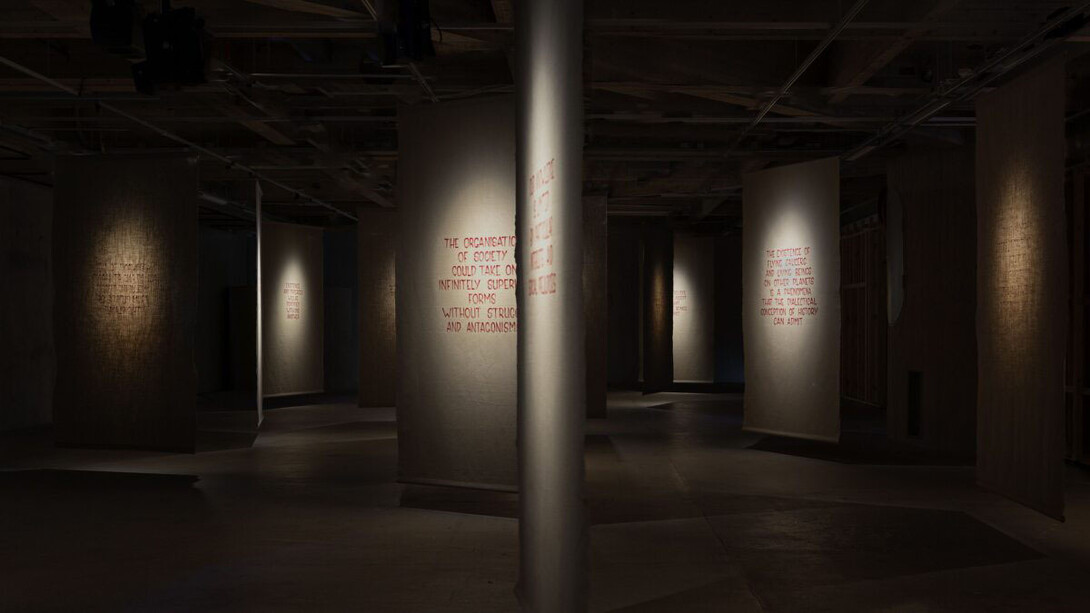
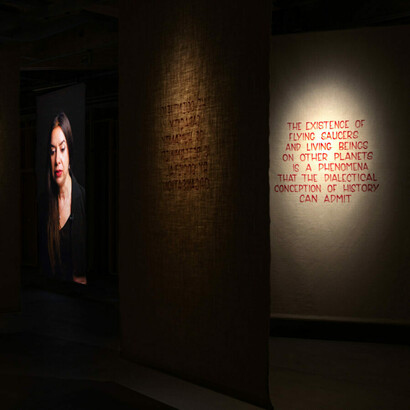
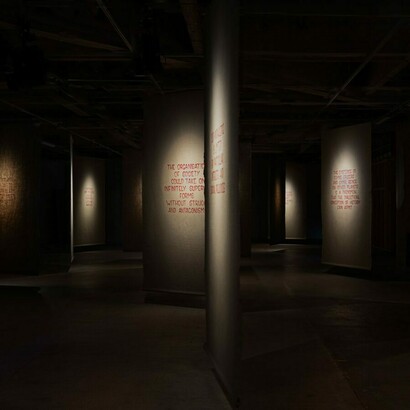
Artist and filmmaker Axel Straschnoy’s (b. 1978) new work collides political utopia with scientific theories of space exploration. The work is a multi-part installation spanning the entire exhibition and an artistic research project that examines a marginal political movement known as Posadism. The movement was founded in the late 1950s by Argentine Trotskyist activist J. Posadas. Among his most radical claims, he asserted that advanced communist civilisations exist in outer space and that contact with them would enable a new kind of society on Earth, free from poverty, hunger and war.
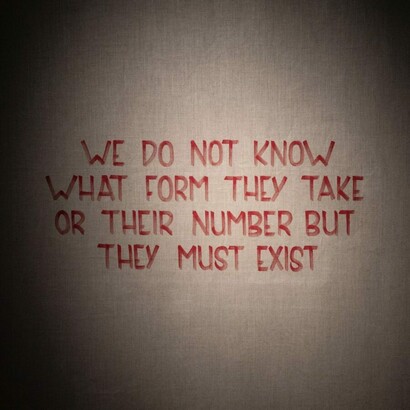
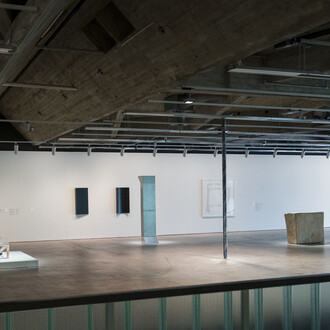
Straschnoy revisits Posadas’ ideas in a time marked by deepening political, military and ecological crises. The exhibition space is punctuated by excerpts from a speech by Posadas published in 1968, in which he sets out his vision of communist extraterrestrial beings. The hand-painted quotations evoke both protest banners and oversized book pages while underlining the power of the printed word as a tool of political movements. The videos in the installation bring voices from space research, political history and ufology into a multifaceted dialogue.
Born in Buenos Aires and based in Helsinki, Straschnoy has, throughout his career, employed a wide range of methods to explore practices within science and art. His long-term, multipart projects challenge viewers to look at familiar phenomena from new perspectives. Here, Straschnoy reflects on the limits of both political imagination and science. He invites us to reach not only for the stars but also for futures grounded in equality, abundance and freedom.
The exhibition is part of the prize awarded to the artist in 2025 by the Fine Arts Academy of Finland. It has been produced by EMMA in collaboration with the Fine Arts Academy of Finland and the City of Espoo. The prize includes an exhibition at EMMA and a publication produced by the museum, to be released in June. The previous winners featured in prize exhibitions at EMMA include Aaron Heino, Tuomas A. Laitinen, Outi Pieski, Katarina Reuter and Camilla Vuorenmaa.