English
 Español
 Français
 Deutsch
 Italiano
 Português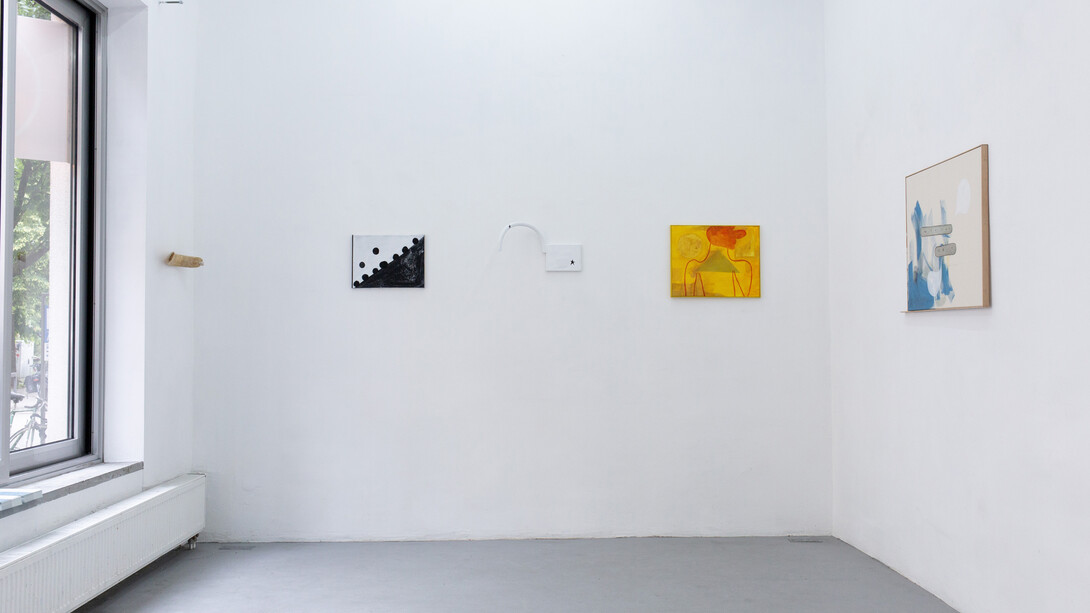
Blowing raspberries begins with the mouth as both bodily organ and site of expression. The phrase describes the childish act of forcing air through the lips to produce a comic, dismissive sound — something between noise, gesture, and a brief refusal to behave. As a title, it introduces Tom Król’s exhibition through a threshold between the visual and the audible, suggesting a form of expression that remains tied to breath, sensation, and the body. In Król’s work, this becomes a way of reconsidering painting itself: not as a silent image fixed on the wall, but as a medium that appears less certain than usual about staying in its place.
The comic force of the raspberry lies in the way it communicates through excess rather than precision. It is a sound produced by a face briefly giving up on language. It cannot be imagined without vibrating lips and expelled breath, which means the title is not simply read but almost involuntarily rehearsed. Before the viewer has fully encountered the work, the body has already become involved in it. Król uses that small slippage between image and physical response to test how far painting can move beyond the purely optical while continuing, somewhat stubbornly, to remain painting.
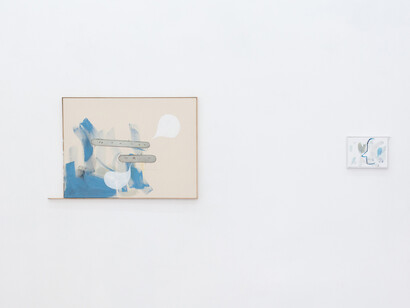
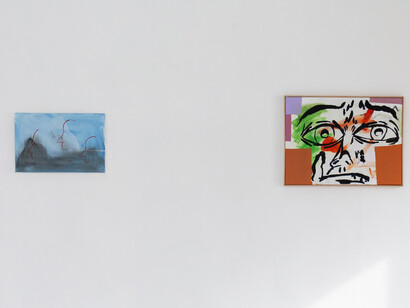
Throughout the exhibition, sound appears not as something audible but as something visually implied. Curved forms resemble pulses of air, repeated motifs establish rhythm, and expanding shapes suggest the outward force of breath. Rather than depicting sound, Król constructs paintings that seem to have only just decided not to make any. Small comic noises — pops, whistles, puffs — linger at the edge of the image, giving the works the faintly implausible quality of objects that know they are expected to remain silent.
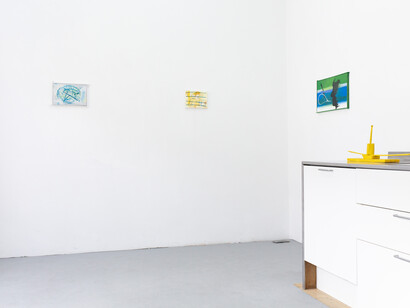
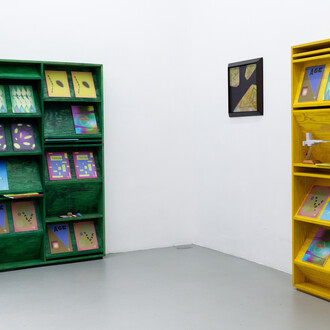
As a result, stillness becomes less stable than it first appears. Although materially fixed, many of the works seem caught in the act of deciding whether to remain still. Bent wooden elements appear ready to recoil, circular forms imply rotation, and rounded shapes hover as though they have paused there out of courtesy. The viewer is left completing these movements mentally, supplying the sounds the paintings decline to provide. Król turns painting into a form of suspended action, holding the image at the point where movement has been delayed rather than resolved.
Horizontality reinforces this condition. The eye moves laterally across the surface rather than toward a single focal point, producing a slower and more temporal mode of looking. Visual energy travels across the work like a sound wave moving through air. This shifts painting away from the idea of the contained image and toward something more spatial and bodily — a surface encountered over time rather than absorbed all at once. The work unfolds gradually, as though painting itself had developed a dry sense of timing.
The projecting wooden frames make this even more explicit. Extending beyond the canvas in propeller-like forms, they interrupt the traditional flatness of painting and suggest rotation despite remaining completely still. Frame and image no longer perform separate roles. Instead, Król allows the support to become part of the composition, as if the frame had become mildly dissatisfied with remaining a background detail. These extensions push the work toward sculpture, not by abandoning painting, but by exposing how provisional its boundaries may have been all along.
Recurring motifs such as spirals, arcs, bubbles, and bursts deepen this visual acoustics. Some resemble pockets of air, while others recall the graphic shorthand of cartoons used to indicate impact, dizziness, or minor catastrophe. These references never become illustrative, yet they introduce a visual language in which humour and form remain inseparable. The works often feel like animation paused at an awkward moment — too composed to collapse, but too animated to settle completely into stillness.
Taken together, Blowing raspberries shows how Król approaches painting as something more unruly than an image. His works ask how a painting can imply sound without becoming audible, or movement without physically moving. What emerges is a practice in which painting retains its stillness while quietly suggesting that it was never entirely convinced by stillness in the first place.
(Text by Michiel Ceulers, 2026)