English
 Español
 Français
 Deutsch
 Italiano
 Português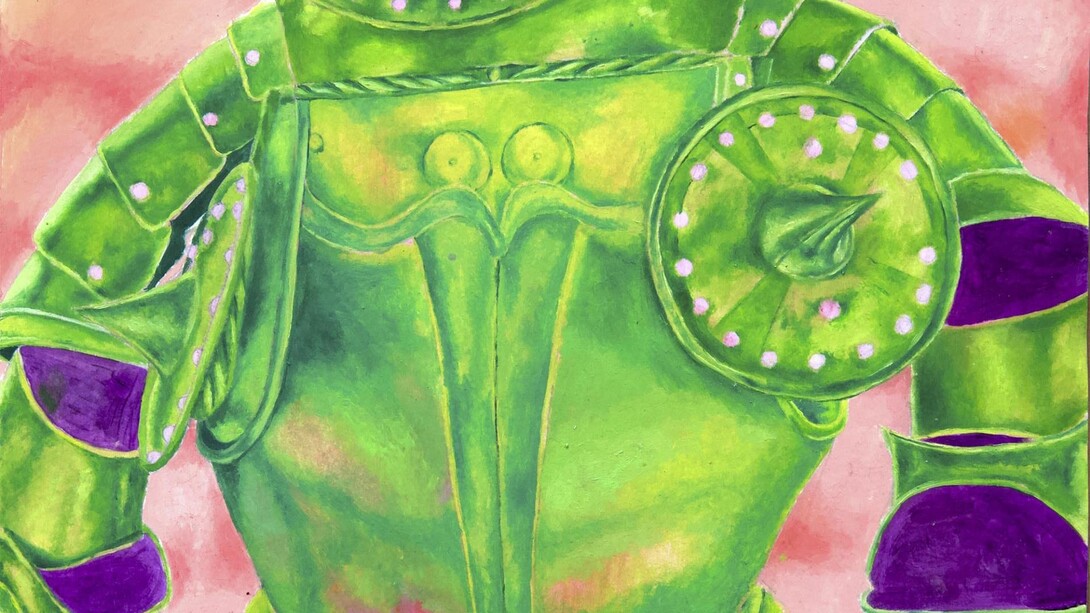
Close yet distant, similar yet diverse, the works of the six artists featured in the eighth edition of YoungVolcano represent an energetic and multifaceted cross-section of current trends in the visual arts. If one were to identify a common theme, a leitmotif uniting these various productions, the word intimacy would be the most fitting. Whether corporeal, spatial, psychological, or affective, the artists in this exhibition reveal a deep and personal dimension—a subjective vision of the world that invites us to rethink the coordinates through which we interpret our existence.
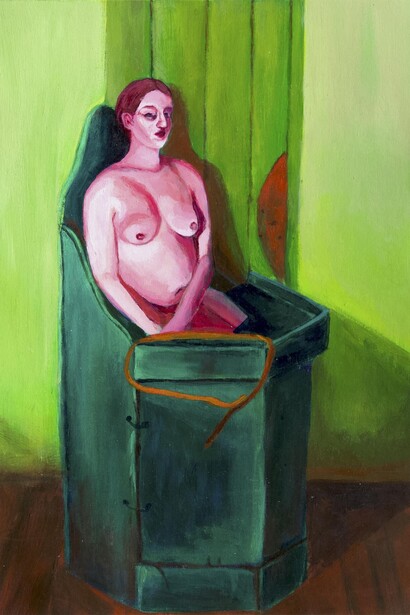
The curious and provocative gaze of Agnese Bruno opens the doors to an explicit and unsettling (unheimlich) universe inhabited by presences that resemble hallucinations. Her characters are sharp figures with non-conforming identities: human bodies stripped of modesty and paradoxical animal forms that, at times, intertwine to generate continuous fields of tension and transformation. In many works, the figures undergo a powerful process of alteration, where acid and saturated hues intensify the visual tension of the surface, constructing an unstable rhythm that accentuates the perception of an ambivalent corporeality. The viewing experience is thus pulled between aversion and fascination, generating a subtle yet persistent voyeuristic tension. The spectator finds themselves immersed in a territory devoid of reassuring coordinates, startled by an hybridism that creates new conditions of possibility. In this ambiguous and disorienting space, what appears alien becomes an opportunity to redefine the visible. Bruno’s research is driven by a spontaneous sensibility that centers on the experience of the body. Exposed, deformed, and recomposed, the body is stripped of traditional codes and returned as a site of identity, self-determination, and affirmation, opening new ways to imagine femininity, subjectivity, and sexuality.
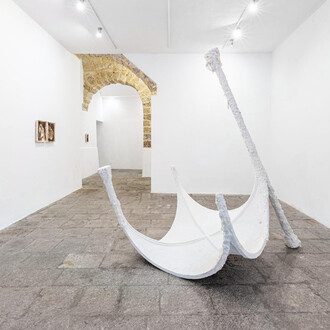
Conceiving her totemic figures as reifications of the status quo, Serena Etiopia performs an extreme act of insubordination aimed at shattering their oppressive control and demolishing their order: the idol is attacked and cast down. In this iconoclastic gesture, Eros and Thanatos overlap, making the boundaries that separate them increasingly blurred and undefined. Much like Vaughan, the character in Crash, Etiopia views the collision as a paradoxical event linked to both destruction and the fertility and release of sexual energy1. This libido manifests in excrescences—defined by the sculptor as "blisters" or "humoral sacs"—that develop and spill out from the totem, forcefully enveloping its body to the point of modifying and fragmenting its original structure. A sexuality made explicit in the very elements of the work: the totem as phallic, the "blisters" as uterine. In line with certain eccentric abstraction2, the artist subverts the rigidity of minimalist language— already significant in her use of plaster, the quintessential academic material—by reintroducing an emotional and corporeal component into sculpture. Etiopia’s research thus finds its field of action in a risk zone where fetishism, trauma, death, and addiction coexist and merge with life, hope, and rebirth.
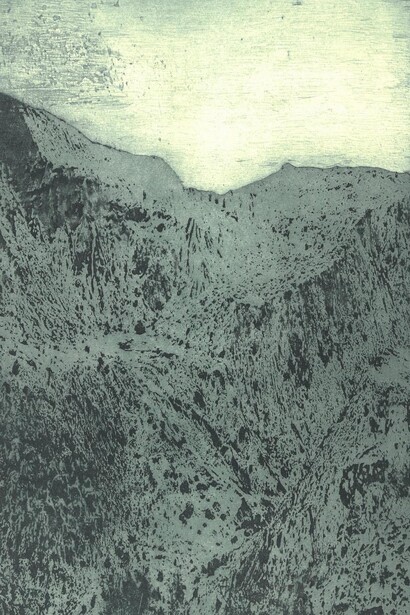
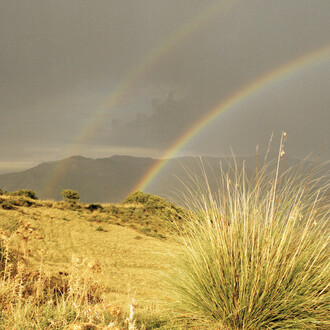
The works of Stefano Minutella reflect the complex relationship between the artist and his native land. Raised among the evocative Madonie mountains, he is so fascinated by them that he has made them the pivot of his entire research. The very orography of the mountains, deeply investigated by Minutella, is first photographed and subsequently graphically reworked and etched onto the matrix, giving life to landscapes that sometimes border on abstraction. The dense web of marks obtained through double-strike printing creates an intertwining—visual, psychological, and spiritual—that traps the viewer's eye, forcing it to follow its paths. Furthermore, the skillful use of a restricted color palette—usually Payne's gray and Indian yellow, to which the artist occasionally adds other colors to modify the tone—contributes to accentuating a dimension poised between ecstasy and perturbation, mystery and ineffability. In line with the "poetics of the mountains" briefly enunciated by Eco3, Minutella’s landscapes present themselves as an ode to silence and the sacredness of the Madonie peaks, reminding us that «the greatest objects of Nature are [...] the most pleasing to behold [...] there is something august and majestic in their appearance, something that inspires the mind with great thoughts and passions»4.
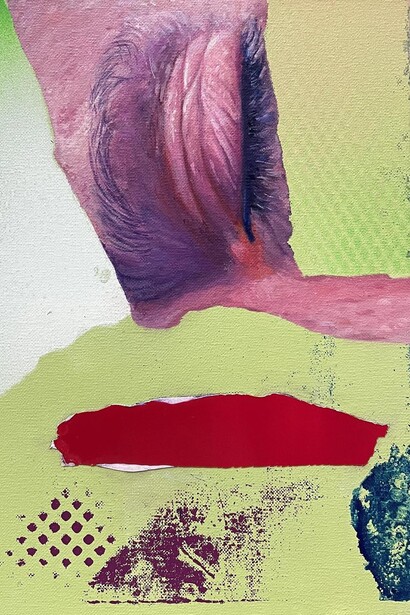
Ennio Parasiliti Caprino’s investigation takes its cue from the Jungian concept of synchronicity, «the temporal coincidence of two or more events not linked by a causal relationship, which have the same or a similar meaningful content»5. From this perspective, painting becomes a means to externalize a mental path, a field of forces where individual fragments and traces of a collective imagination concentrate and merge. Through the juxtaposition of mutually alien elements, accentuated by the use of different pictorial registers, the artist stages the functioning of thought— understood as a process in which meaning forms and disintegrates simultaneously. What initially appears clear, as it flows through the phases of reasoning, becomes contaminated and merges with the residues of other thoughts, with unsettling mnemonic images and reminiscences of an undefined past. Yet, upon closer inspection, within this construction of an "other" world—made of impalpable things so foreign they cannot be named—traces of reality emerge on the pictorial surface. Eyes, fruits, flowers, and botanical elements anchor us and, by reassuring us, allow us to abandon ourselves to the unknown. As the artist states: «the observer is pushed to question themselves, to lose themselves among the forms, recognizing the unknowable, exactly as happens in everyday life and thoughts».
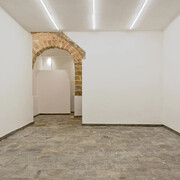
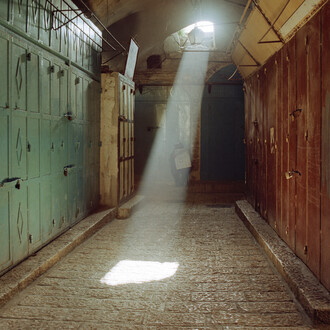
The work of Angela Pillitteri investigates thresholds: those transitory, liminal places imbued with topological dichotomies: interior/exterior; continuous/discontinuous; open/closed. It is from this perspective that the artist understands condominium spaces: circumscribed environments that separate the public space of the street from the private domestic one, yet are neither one nor the other. They are intermediate points where the subjectivity of the person crossing them is not yet fully defined, as they transform their status by marking a change in role or behavior. The artist's photographs thus explore the condominium space as a social device in which spaces and subjects define each other. Paradoxically, Pillitteri’s shots are devoid of human presence. There are only plants and furnishings: the sole guardians of dwelling, material signs of the relationship. The artist’s reflective approach to photography finds a correspondence in her sculptural language. The installation is articulated within the exhibition space, remodulating the perception of the space itself and the idea of dwelling. By suggesting temporary presences, it recalls the logic of ephemeral architectures: structures designed to live for a limited time and then disappear, which in this context operate as sensory devices that destabilize the original function of the threshold.
Ada Rizzo’s kaleidoscopic figurative universe feeds on a vast repertoire of motifs—medieval books, armor, swords, vases, and furnishings—drawn from the past, which emerge as relics of a time suspended between history and imagination. In this narrative space, the epic dimension of struggle and war intertwines with the more intimate and corporeal dimension of existence. Nervewracking and renewing the tradition of drôleries, hybrid creatures, ambiguous symbols, and real, naked, fragmented, and often hairy bodies emerge at the center of the scene. As in a grotesque bestiary, Rizzo’s work collects elements that recount human instincts, passions, and contradictions: it is the everyday, transformed into the carnivalesque, shown without censorship; it is the human being who—in the era of technology and anthropocentrism—reclaims a primordial aspect now abandoned and lost. From watercolors to oil production, the artist renounces any claim to a threedimensional rendering of her subjects, revealing instead an interest in the luministic possibilities of color—simultaneously acid and delicate, sometimes with a high degree of saturation. Through an agile, fluid, and confident stroke, the artist gives rise to a code that speaks of the tragicomic aspect of life, an immediate language that attempts to place the viewer in direct contact with her vision of the world.
(Text by Martina Sanzeri and Marcello Nocera)
Notes
1 See the film Crash by David Cronenberg, 1996; inspired by the namesake novel published by
James Graham Ballard in 1973.
2 Reference to the exhibition Eccentric abstraction, curated by Lucy Lippard and held at Marylin
Fischbach’s Gallery in New York in 1966.
3 See Umberto Eco (ed.), On beauty: history of a western ideal, MacLehose Press, 2004.
4 Thomas Burnet, Telluris theoria sacra, IX, 1681.
5 Antonio Vitolo, Avvertenza, in Carl Gustav Jung, Synchronicity: an acausal connecting
principle, Princeton University Press.