English
 Español
 Français
 Deutsch
 Italiano
 Português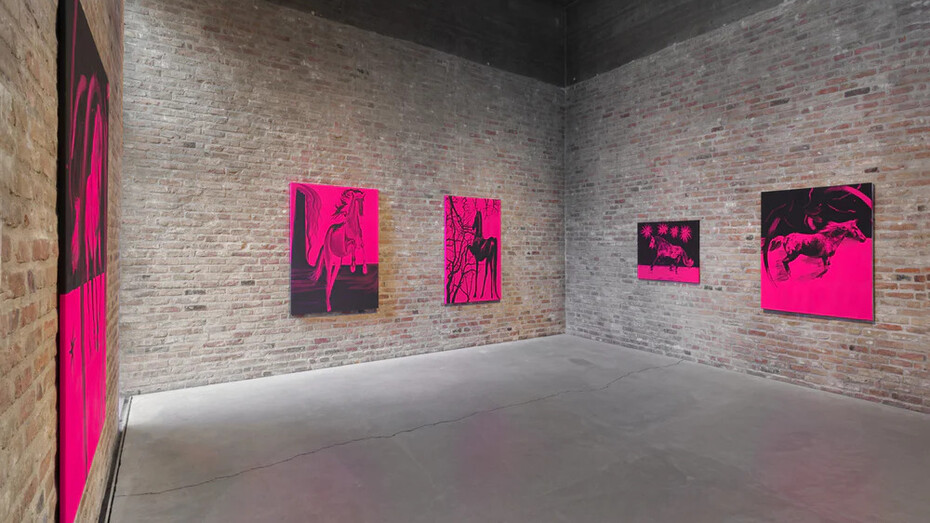
König Galerie is pleased to present Blue is a gaze, a solo exhibition by Sihan Chen, on view in the Chapel of St. Agnes. This marks the artist’s first exhibition with the gallery.
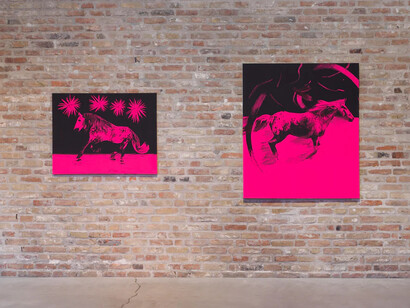
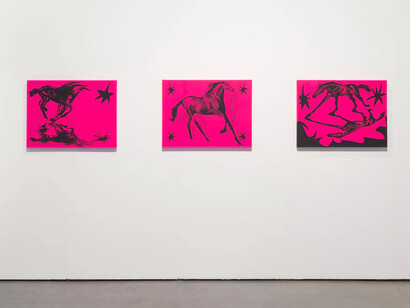
Point by point, precisely placed, the figure of a horse takes shape on fluorescent pink cardboard. Surrounded by black, star-like forms, these finely executed drawings were the first works by Sihan Chen that I was able to see.
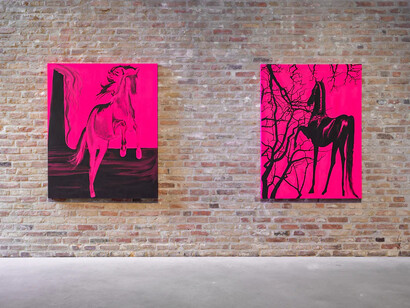
The voluntary restriction to two colors—black and a luminous pink as the background—with the horse as the central motif, combined with other elements drawn from nature such as stars and trees, struck me as a radically self-imposed task. The restraint in the choice of subject and the determined reduction to a high-contrast combination of two colors in no way signify a limitation of her artistic expression. On the contrary.
In her painterly works, the horse as a figure is mirrored, fragmented, appears static or in motion, or casts a shadow. It appears within a landscape, rendered in positive or negative, developed in highly varied individual depictions—sometimes painted realistically, sometimes graphically concise and strikingly reduced. The other components surrounding the horse figure also shift—from landscape descriptions of water, trees, and branches to abstracted striped forms and free lines, most often combined with stars in a wide variety of shapes and numbers.
Although all the images emerge from this same reduced framework, they are nevertheless highly personal, constantly reimagined, and always different from the work that preceded them. Through her serial practice, she develops an open system shaped by differences within repetition. The images reflect the artist’s personal situation and life story and take on the character of a diary.
Recording her daily mood and condition—whether in texts, drawings, or paintings—is an important endeavor and part of her daily practice. Her interest in film and screenwriting remains, but her artistic method is currently focused on painting and drawing. Painting enables her to directly record her personal state at a specific moment in time. In this form of deeply personal perception and documentation of a day, she connects with conceptually oriented artists of a very different generation, such as Hanne Darboven or On Kawara.
(Text by Johannes Wohnseifer)
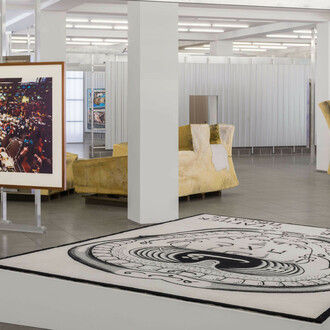
![Various artists, [ materialistin ], exhibition view. Courtesy of Hamburger Bahnhof](/attachments/fd8f4fd76b73be0a02d398535c29d017e1309b65/store/fill/330/330/3f54331fd7869a13166dfe67a9e91306c6e180b2e29b9fd308d958b87ad2/Various-artists-materialistin-exhibition-view-Courtesy-of-Hamburger-Bahnhof.jpg)