English
 Español
 Français
 Deutsch
 Italiano
 Português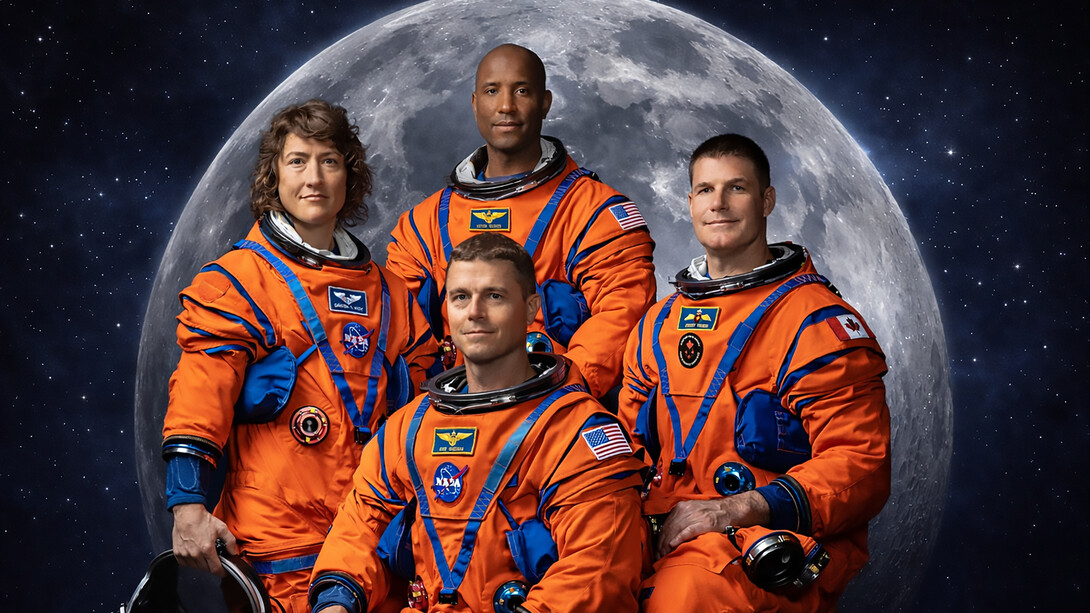
There are moments when the future tastes like nostalgia and others when the past comes knocking with unexpected force, asking to be resumed, completed, perhaps even corrected. The special cover of Time dedicated to the Artemis II mission, aptly titled “Back to the Moon,” seems to belong to both categories. It is not merely an editorial or celebratory gesture; it is a symbolic act, a visual and cultural bridge between two eras that have remained disconnected for far too long.
Since the last human mission to the Moon—Apollo 17 in 1972—the silence of deep space has remained intact, almost suspended. For over fifty years, the Moon has stayed there, motionless and distant, more a memory than a destination. Now, with Artemis II, four astronauts are about to break that silence once again, resuming a journey that once seemed definitively concluded. The decision to visually echo the era of Apollo 8 is no coincidence: back then, the goal was to prove that reaching the Moon was possible; today, perhaps, it is to prove that we have not forgotten how.
The mission, which will not include a lunar landing, will follow a free-return trajectory around the Moon, bringing the crew safely back to Earth after approximately ten days. And yet, its significance does not lie in its destination but in the act of returning itself. It will be the first human flight beyond Earth orbit since the 1970s, carrying astronauts farther than any human has traveled before—thousands of kilometers beyond the far side of the Moon. In essence, it represents the reopening of a long-interrupted route, a quiet declaration that this chapter of history is not closed, merely left unfinished.
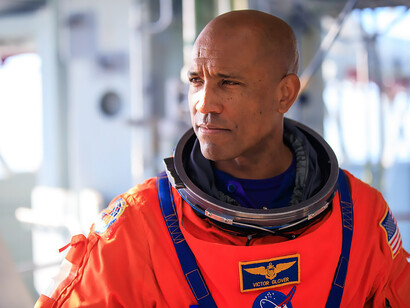
The faces chosen to embody this new beginning—Reid Wiseman, Victor Glover, Christina Koch, and Jeremy Hansen—tell a story of profound transformation. They are not just astronauts, but symbols of a cultural and political evolution. With them, the Moon ceases to be the exclusive domain of a narrow, male, American elite and becomes—at least in intention—a shared frontier. Koch will be the first woman to travel toward the Moon, Glover the first African American astronaut on such a mission, and Hansen the first non-American to venture so far into deep space. It is a quiet yet radical shift, reflecting the transformation of space itself: from an arena of superpower competition to a platform for international collaboration.
There is also an almost vertiginous detail that deepens the meaning of it all: none of the crew members were alive when humans first walked on the Moon. And yet, they will be the ones to take us back. This creates a fascinating, almost paradoxical temporal fracture. Artemis II is not merely a technological mission—it is a generational one. These astronauts are not simply following in the footsteps of Neil Armstrong or Frank Borman; they are inheriting a story that has always existed for them as narrative, myth, and secondhand memory. In this sense, their journey is not only physical but symbolic: a passing of the torch between those who lived the space race and those who inherited its meaning.
The Time cover, then, does more than report an imminent event—it constructs a narrative. In the 1960s, space was a showcase of the Cold War, a stage on which political and ideological battles were fought. Today, the Artemis program presents itself as something different: a global project involving multiple nations, aiming not only to return to the Moon but to stay there, building a sustained presence and laying the groundwork for even more ambitious missions, such as those to Mars. It marks a clear paradigm shift: from conquest to permanence, from planting flags to building infrastructure.

The February 2026 Time cover, illustrated by Jason Seiler, alongside the 1969 Time cover featuring Apollo 8 astronauts Bill Anders, Frank Borman, and Jim Lovell, who were named Men of the Year.
And yet, precisely for this reason, the cover also carries a more ambiguous meaning. Like all grand narratives, it simplifies, selects, and constructs an image. “Back to the Moon” is at once a promise and a slogan, a project and a declaration of intent. Covers like those of Time have always sought to freeze history as it unfolds, but in this case, they seem to do something more: they anticipate the meaning of events, framing them before they even occur.
The return to the Moon, therefore, is not merely a matter of technology or exploration. It is a question of memory, identity, and storytelling. It is an attempt to resume an interrupted conversation—and perhaps to rewrite it. The question that lingers behind the polished and carefully constructed image is simple, yet unsettling: this time, will we truly return to stay, or are we once again staging the irresistible allure of a return that risks being more symbolic than real?
The path ahead, however, is far from straightforward. Although the Apollo missions opened the way, a physical return to the Moon will not be a “walk in the park.” The approach chosen is complex and demands technical capabilities that, even today, are still in the process of being developed, tested, and validated—before being entrusted, along with advanced artificial intelligence systems, with the lives of the first astronauts who will set foot on the lunar surface again.
NASA’s ultimate goal is to land astronauts on the Moon before the end of 2028. Achieving this objective requires the maturation of several key technologies, many of which represent a significant departure from the Apollo-era architecture. Central to this effort are the two commercial lunar landers selected under the Artemis Human Landing System program: Starship, developed by SpaceX, and Blue Moon, developed by Blue Origin. Both systems remain under active development, and both embody radically new approaches to lunar exploration.
Unlike the Apollo Lunar Module, these landers are designed to be reusable, scalable, and integrated into a broader cislunar infrastructure. Starship, in particular, represents a paradigm shift: a fully reusable, super-heavy spacecraft capable not only of landing on the Moon but also of supporting long-duration missions and potentially serving as a cornerstone for future Mars exploration. Yet, this ambition comes with immense technical challenges, from orbital refueling—still unproven at the required scale—to the complexities of landing such a massive vehicle on the lunar surface.
Blue Moon, on the other hand, follows a more modular and arguably conservative design philosophy, emphasizing reliability and incremental development. It is conceived as part of a broader ecosystem that includes orbital platforms such as the planned Lunar Gateway, a space station that will orbit the Moon and serve as a staging point for missions to the surface and beyond.
Whether one or both of these landers will ultimately be used remains an open question. NASA has indicated a willingness to proceed with whichever system is ready in time for the mission. This pragmatic approach reflects both the urgency and the uncertainty inherent in the program.
The current roadmap envisions Artemis III as the mission that will attempt the first crewed lunar landing of the new era, potentially as early as 2027, although delays remain likely given the complexity of the technologies involved. During this mission, astronauts traveling aboard the Orion capsule will perform rendezvous and docking maneuvers in lunar orbit with the selected lander—operations that, while routine in Earth orbit, become significantly more challenging at such distances.
Artemis IV, planned for the following year, is expected to build upon this initial landing, marking the beginning of a more sustained human presence on and around the Moon. It is at this stage that the broader vision of Artemis—one that includes infrastructure, continuity, and long-term exploration—will begin to take shape.
Yet, beyond the technical milestones and mission timelines, a deeper question persists. The return to the Moon is often framed as a stepping stone toward Mars, a necessary rehearsal for the challenges of interplanetary travel. But it is also, inevitably, a return to a place already visited, already walked upon, already claimed—at least symbolically. This duality lies at the heart of the Artemis program: it is at once a leap forward and a step back, an act of innovation and one of remembrance.
In this sense, the phrase “Back to the Moon” acquires a layered meaning. It is not just about going back to a celestial body; it is about returning to an idea, to a vision of the future that once seemed inevitable and then, for decades, was set aside. The Moon becomes a mirror, reflecting both what we were and what we aspire to become.
Whether this time the journey will lead to permanence or remain another powerful, fleeting symbol is a question that only the coming decade can answer. But one thing is certain: history is no longer standing still. It is moving again—quietly, deliberately—toward the same horizon that once defined an era and may now define the next.