English
 Español
 Français
 Deutsch
 Italiano
 Português
Fresh water is often taken for granted in many parts of the world: a tap that runs, a shower that flows, a glass filled. Yet for hundreds of millions, and many more in the decades ahead, water scarcity is increasingly the norm rather than the exception. According to expert assessments, the world may face up to a 40% shortfall in fresh water supply by 2030 unless new solutions are scaled.
In this context, one of the most hopeful—and also challenging—answers lies at the edge of the seas. Desalination, the process of removing salt and other impurities from seawater or brackish water, promises to turn abundant saltwater resources into lifelines of fresh water. But as we’ll see, it is neither simple nor without consequences. The technology, engineering, and economics of desalination are evolving fast, especially as sustainability becomes a priority.
Why desalinate? The urgency of water stress
Look at coastal or arid regions—from the Mediterranean to the Middle East to Southern Africa—and one theme repeats: rainfall is falling, aquifers are dwindling, and demand is rising. According to reporting from Deutsche Welle (DW), current global desalination capacity is about 56 billion litres per day, yet that corresponds to only about 7 litres per person on Earth. In extremely water-stressed regions, desalination is already a lifeline: for example, in Qatar and Bahrain, the share of drinking water coming from desalination reaches 76% and 56%, respectively.
In Europe, while the challenge may not be as acute as in some parts of the Middle East, the Mediterranean basin, parts of Spain and Italy, and island regions are still facing serious shortages and drought risks. Desalination offers a way to decouple the water supply from rainfall. The point is not that desalination will replace all freshwater—even the seas aren’t infinite in terms of extraction and disposal—but that it becomes a strategic component of secure water systems.
The World Economic Forum notes that the resource risk of water is among the top long-term global risks, and desalination features among the engineering responses.
How desalination works: key methods at a glance
There’s more than one way to turn salt water into drinkable water. Broadly, the main methods are:
Reverse osmosis (RO)
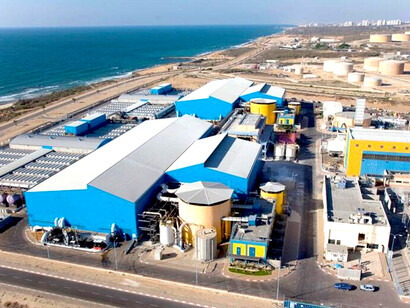
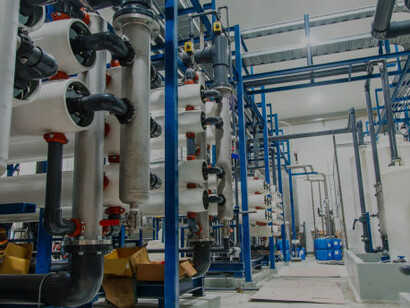
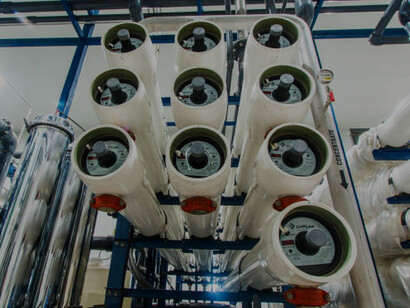
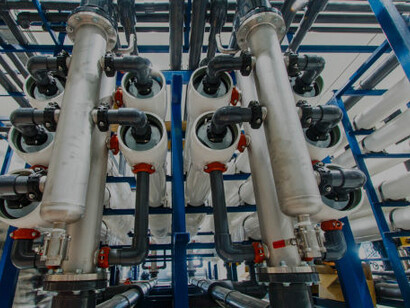
This is the most widespread technology today. Seawater (or brackish water) is pumped under high pressure through a semipermeable membrane that blocks salts and impurities while allowing water molecules to pass. Over the past decades, energy efficiency has improved significantly: according to DW, the energy required for RO dropped by nearly 90% between 1970 and 2020. In practice, even the best plants still require around 3 kWh per cubic metre of water, compared to 0.6 kWh/m³ for typical surface water treatment.
Thermal desalination
This older method uses heat—either from steam, hot brine, or multi-effect distillation/multi-stage flash processes—to evaporate water and condense it, leaving salts behind. It’s been widely used in some regions (especially the Gulf), but it is very energy-intensive and generates heated brine.
Emerging technologies: forward osmosis (FO), membrane distillation (MD), hybrid systems
Researchers are now exploring newer approaches to reduce energy consumption or make use of low-grade heat or waste heat. For example:
Membrane Distillation (MD) uses a hydrophobic membrane and a small temperature difference (often below 80°C) to allow water vapour to pass while salts are rejected.
Forward Osmosis (FO) uses osmotic pressure from a draw solution to draw fresh water across a membrane, potentially with lower energy input.
Other experimental membranes: for example, nanoporous carbon composite membranes or graphene-based membranes promise high throughput and near-complete salt rejection in laboratory models.
Each of these methods has advantages and trade-offs, and part of the innovation challenge lies in making them commercial, scalable, and affordable.
Innovation in action: energy, sustainability, and materials
One of the biggest hurdles for desalination remains energy consumption—and the associated environmental footprint. But innovation is moving quickly in this space.
Renewable energy-powered desalination
Combining desalination with renewable power is gaining traction. For example, a study from Portugal found that solar-powered desalination systems could reduce unit water production cost by around 33% compared to grid-electric versions. The Water Scarcity Atlas notes that seawater reverse osmosis plants powered by renewables can soon compete in cost with fossil‐fuelled plants.
In Europe, small islands and remote communities are already testing off-grid solar or wave-powered desalination systems. For instance, tide- and wave-powered units developed by some pioneers show that 90% less land may be required compared with conventional plants.
Innovative membrane materials
Traditional RO membranes are increasingly efficient, but researchers are exploring next-gen materials—carbon composites and graphene channels—that promise higher flux (more water per unit membrane), better salt rejection, and lower energy input.
Brine management and circular approaches
One of the most critical environmental issues is the brine discharge—the leftover highly concentrated salt solution. This brine, if dumped into the sea without careful management, can raise salinity, lower oxygen levels, and harm marine ecosystems. A recent review noted significant ecological risks, including thermal pollution from heated discharges, species disruption, and biodiversity loss. Innovations aim to reduce brine volume (higher recovery rates), treat or mine brine for minerals, or avoid discharge entirely (zero-liquid-discharge systems). Such approaches are essential for desalination to be truly sustainable.
Europe’s role and emerging projects
Although many large-scale desalination plants are in the Middle East, Europe’s innovation ecosystem plays a critical role both as a user (especially in island and coastal zones) and as a technology developer.
In the Algarve region of Portugal and the Madeira archipelago, solar-powered desalination pilots have shown economic viability and environmental value.
The EU and European water-research networks are supporting projects that integrate desalination with renewable energy, advanced membranes, and brine recovery techniques, helping coastal communities maintain water supply under climate stress.
In Spain, for example, authorities in Barcelona announced a floating desalination unit to help with drought mitigation for the city, showing how technology is being deployed in Europe.
Trade-offs and ethical dimensions
As promising as desalination is, it is not a silver bullet—and it comes with trade-offs that must be managed.
Energy and carbon footprint
Even RO systems today consume several kWh per cubic metre; if the electricity comes from fossil fuels, desalination can become a significant source of greenhouse gas emissions. Some estimates suggest emissions from desalination could reach 0.4 billion tonnes of CO₂ per year by 2050.
Environmental impact of brine
As mentioned, discharge of brine without dilution or mitigation can harm marine life, alter salinity gradients, and reduce oxygen availability. Even in Europe, careful siting, discharge design, and ecological monitoring are essential.
Cost and access
Desalination remains relatively expensive compared to conventional water treatment. According to DW, while production costs have dropped to around 0.50 USD per m³ in some regions, the business remains mostly within upper-middle- and high-income countries. For low-income or inland regions, desalination may not yet be viable without subsidies or innovative financing.
Social & institutional considerations
Large desalination plants require infrastructure, maintenance, energy supply, and regulatory oversight. Community engagement is important, especially in coastal zones where ecosystems or fishing livelihoods may be affected. Also, the ethics of diverting ocean water, habitat impact, and brine disposal must be addressed.
The human story: turning salty seas into daily life
It’s easy to talk in cubic metres and kilowatt-hours, but let’s bring this home.
Imagine a small Mediterranean island. Rainfall has dropped, reservoirs are emptying, and tourism keeps the economy alive. A floating desalination unit is installed offshore. Solar-powered and compact, it draws seawater, uses advanced membranes to purify it, and pipes fresh water ashore. Local farmers now have reliable irrigation, households no longer ration their use, and the risk of potable water shortages during high season is averted. That’s the kind of transformation possible when engineering meets everyday life.
Or consider a coastal Spanish city during a drought. Authorities deploy emergency desalination capacity to avoid water restrictions. This preserves community well-being, supports local industry, and buys time while longer-term water-reuse or conservation projects ramp up.
Behind the machines are engineers designing membranes, scientists modelling brine flows, technicians monitoring plant health, local officials grappling with cost and public trust, and citizens adapting. The human dimension—water as life, technology as enabler—makes this topic deeply relevant for everyone.
Looking ahead: what’s next for desalination?
The horizon of desalination technology is evolving rapidly. Here are a few trends and future directions to watch:
Hybrid systems: combining desalination with water reuse, stormwater capture, and local recycling so that desalination is one part of a broader water-smart strategy.
Zero-liquid-discharge (ZLD) plants: plants that aim to leave no brine waste, instead recovering salts or minerals from the concentrate.
Low-energy, low-carbon desalination: using solar thermal, waste heat, wave power, or novel membranes that reduce electricity needs significantly. For example, FO and MD systems hope to exploit low-grade heat.
Decentralised and modular plants: smaller, modular units could serve remote or island communities with less infrastructure, lower cost, and faster deployment.
Material innovation: graphene or nanoporous carbon membranes, advanced fouling-resistant surfaces, and longer‐lived membranes that reduce maintenance and energy.
Brine valorisation: turning the concentrate (brine) into useful outputs—minerals, salts, even energy—from what was once waste.
Integrated water-energy systems: desalination integrated with smart grids, renewables, and energy storage to optimise both power and water production.
Conclusion: a lifeline with responsibility
Desalination offers one of the most promising technological pathways to secure fresh water in a warming, drying world. By turning the vast saltwater seas into usable water, we can open new horizons for communities, agriculture, industry, and ecosystems. Yet it must be done with care: balancing energy use, ecological impact, cost, and social equity.
In Europe and beyond, the future of desalination lies not just in purifying water but in purifying our relationship with water—how we source it, consume it, conserve it, and share it. When engineers, policymakers, communities, and nature align, saltwater can indeed become a lifeline rather than a limitation.
Because at its heart, desalination isn’t just about molecules and membranes—it’s about people, places, and possibilities.