English
 Español
 Français
 Deutsch
 Italiano
 Português
My Pinterest feed is full of images capturing sappy little sayings of encouragement. Sentences scrawled on a piece of scrap paper, written eloquently with a blue-inked ballpoint pen. They are framed in the shot lackadaisically, as if to signal that the image wasn’t captured with too much effort when it was framed.
It feels as if it is screaming at me, “Look at how polished these inspirational sayings are! Are you convinced yet? Don’t you want to give it a shot?”
So naturally, I pin the image to my board titled “words” and move on with my day. Maybe I will open my polished collection of inspirational passages later if I need an extra mental boost, but odds are I won’t. Probably not for several months.
Depending on the day, seeing these little scribbles makes me feel insanely frustrated. The idea of someone writing it down, just to fabricate motivation, is infuriating. Was it even meant to show up in my feed? Is it being intentionally conveyed?
Being ready is a myth. You start. You suck. You figure it out. You get better.
As I continued to scroll, I came across several more quotations in the same handwriting, using the same pen color and the same artful stroke. It made me wonder if it was a publicity stunt, an account just for making silly sayings that get trapped within Pinterest feeds.
Frankly, it made me feel slightly stupid that I let myself think about it. If I read a passage or a quotation similar to this one in a novel or blog post, it would not frustrate me as much. I know that authors writing phrases with the same connotation as the one above are doing it authentically. For publication, for personal reflection. However, when regurgitated on social media anonymously, it seems fabricated. Uploaded, repinned, and reposted. In this case, aestheticism is branded as motivation, an addition to your latest board and a supplement to the visual pleasure you get from scrolling on your curated feed, adding a touch of inspiration that approaches scrollers seeking it.
The aesthetic pull
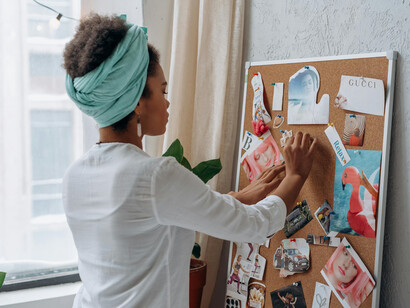
I guess I am also a victim of the aesthetic pull. I have been ever since I was a teenager. I enjoy collaging and daydreaming, putting together images I like as if they were puzzle pieces, eagerly watching the bigger picture come to life. The satisfaction of combining and clicking different ideas into place makes me feel like I have control. I enjoy looking at a piece of art on my screen that looks cohesive and can be made mine.
Mindless scrolling on any platform is used as an escape. Pinterest was originally intended to be a platform for creativity and a catalyst for visual discovery, meant to spark interest and expand ideas. Yet as Pinterest gained popularity in the eruption of influencer culture, society slowly reinvented the word by turning it into an adjective. Calling something "Pinterest" now means that an image is extremely satisfying to the eye and has minimal imperfections. Since then, I have struggled to separate that definition from anything I see on social media and how I interpret it.
Curation and portrayals of perfection became tools of comparison. Images of friends laughing and eating dinner, a couple dancing in the kitchen, a woman sitting in the sunlight reading a book, with her legs daintily draped over the arm of her chair. Carefully framed moments feel too deliberate. If I label someone else’s life as too curated, then I don’t necessarily have to measure my own life against it.
Is it helping me or hooking me?
This image found me in a moment where I didn’t need to necessarily be forced to believe it. Rather, it gave me a gentle push in the direction of redirection that I needed to find. A change of mindset. What surprised me most wasn’t that I believed it, but that I wanted to.
Social media has many good things to offer. When I lack inspiration to write, I seek a list of prompts that can spark my imagination and encourage me to dig deeper. If I want to refresh my outward appearance, I daydream about finding a new top similar to the one pictured on a style-curation collage that caught my eye.
Journal prompts, inspirational quotations, and fashion inspiration don’t require me to transform immediately in that very moment, but they give me the honest, inward recognition I needed from a space that I did not have control over. Yes, you can collect tokens of inspiration and pile them into your basket, but they only make a difference once you begin to practice them.
Branding motivation
I experience this battle with skepticism because of the influence that creator culture has on redefining motivation as a brand. I guess influencers are good at their jobs. Consider me influenced.
A cultural fad of sharing fitness motivation, daily routines, and lifestyles has taken over digital spaces. As the years go on and social media’s presence plays a larger role in our lives, the lines blur between optimism and performance, authenticity and fabrication.
It is hard to zoom out when viewing a reel of someone who sets up their camera every day to show their 5 a.m. wake-up and 10-kilometer run, all for the sake of motivating others to take control of their life. The repetition reinforces productivity as an aesthetic, and the lines are again blurred between genuine inspiration and performative output. Routines and quotations are packaged as universally attainable. They are edited and framed to look effortless and doable.
This reminds me of the opposition I felt to the very quotation I saw on Pinterest. It caused me to pause and question how it could apply to my life, but in actuality, pieces of motivation found on social media just exhibit more consciously that there is truly no “right” way to live.
Harnessing digital influence
We all have mantras that we tell ourselves in moments of stress or uncertainty. If you just had a phrase that came to mind, where did you first hear it? Was it from a parent or sibling? Your therapist? Does it matter where the origin of something lies that gives us a boost, even if it came to you from an anonymous source on social media?
Like most pieces of advice we hear from the people in our lives, it is what you make of it. It is up to you to internalize their words and see where they can fit rhythmically into your life.
It shouldn’t be shameful to find inspiration in a silly quotation that came across your Pinterest feed, either. Even as we doubt their authenticity, we can still take bits and pieces from the millisecond of attention that we pay them.
Being ready is a myth. You start. You suck. You figure it out. You get better.
If you read this phrase again, without the meticulously presented visual, it carries a fresh interpretation.
So, do you think it is true?