English
 Español
 Français
 Deutsch
 Italiano
 Português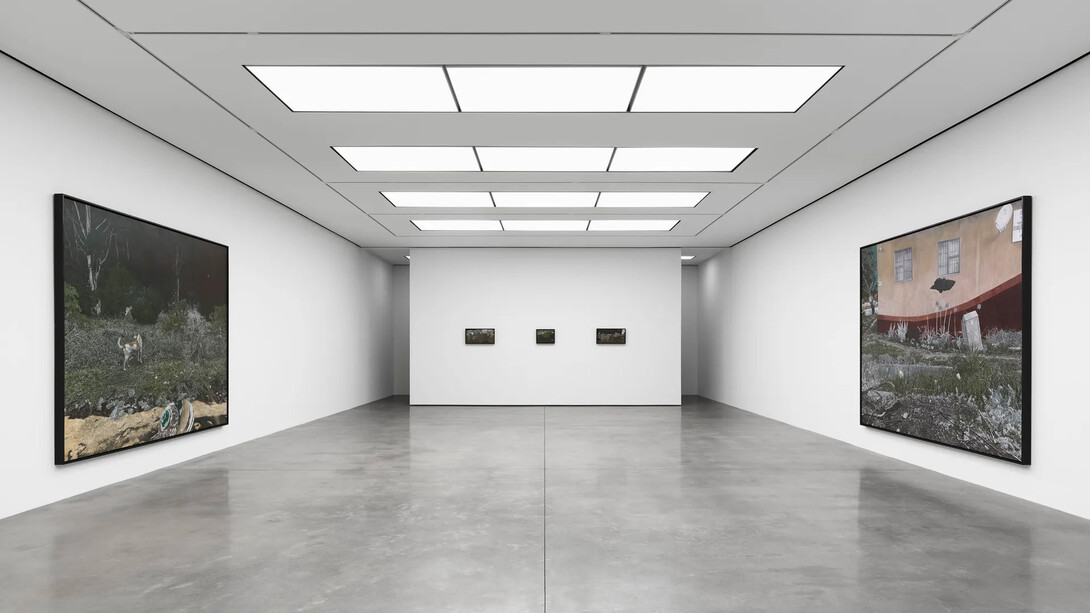
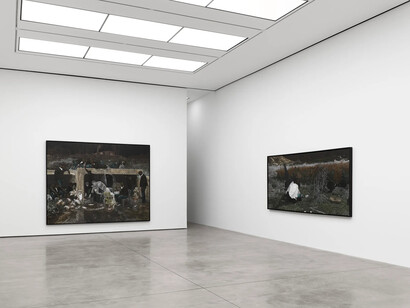
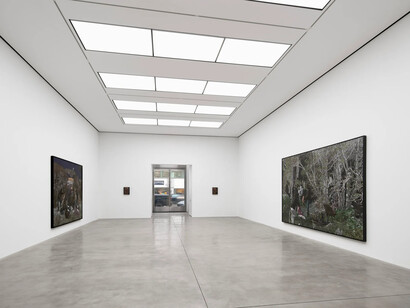
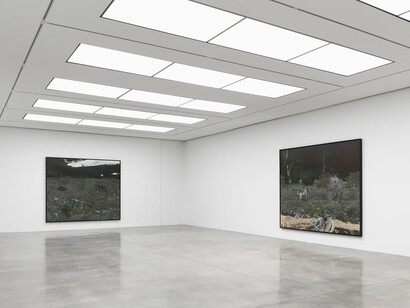
South African artist Cinga Samson’s exhibition of new paintings is titled Ukuphuthelwa, an isiXhosa word in the artist’s native language that translates as ‘unable to sleep’. Unlike the English word ‘insomnia’, the isiXhosa term carries no negative connotation and accordingly, for Samson, sleeplessness is not a condition to be cured but a state of spiritual alertness, a sensitivity that deepens in the dark. Rendered in the artist’s signature occluded palette of near-blacks, carbon and deep Prussian blues, Samson’s scenes depict men-like figures, dogs in overgrown fields and portraits of plant life native to South Africa. Encouraging slow, contemplative looking, a sense of existential gravity pervades Samson’s new series of oil paintings, attempting to depict a vast reality that is continuously in motion. As the artist has it, his quandary pertains to the existential question of how to create a ‘true and honest painting’.
With Ukuphuthelwa, Samson considers his role as an artist in relation to his inability to represent the whole truth of reality, and the fact that he can merely make symbols. Between the static, painted sign and the fluid experience it gestures towards, he contends that there exists a gulf that no image can close. Though the technical mastery and convincing realism of these paintings appear to invite interpretation, the artist asserts that his work confronts the very dilemma of representation: that the image can only ever be a relative symbol of what it reflects, never its equivalent. Acknowledging the open-ended nature of symbols and their subjective interpretation, Samson takes the figure of the dog as an example. The viewer may, for instance, look at Intsingiselo II (2026) and perceive the loyalty conventionally associated with dogs, while an amaXhosa understanding might highlight the dog as signifying the guiding, protective principles of ancestors. Comprising painstaking detail and deft brushwork, Samson’s paintings do not disguise the limits of representation but, rather, aspire to harness his skills towards that which exceeds the representable. Above all, the artist’s work seeks out the authority of the unnameable and the territory of the sublime, one in which the divine is not found elsewhere but present in the vernacular of all things.
Samson’s larger compositions carry a palpable sense of reverence and ceremony. In Umlindo (Watcher) (2026), figures are gathered in a forest clearing with wildflower bouquets and lengths of fabric, a scene that carries the visual grammar of ritual without specifying its addressee or terms. For Samson however, ‘the ritual itself is not the important thing – it’s an opening to what exists beyond’, and the paintings use the aesthetics of ritual to speak to a collective need for orientation, as well as the capacity of ritual to mediate an encounter with a vast unknown. That the works are titled with enigmatic words and phrases in isiXhosa, such as Imfihlo (Secret) and Intsingiselo (Meaning) (both 2026), infer the same problem the paintings contend with – the instability of interpretation as it pertains to the knowable and unknowable. Each word carries a weight in isiXhosa that its English translation approaches but can never fully reach; here, just as between the painted sign and living referent, meaning slips between the interstice of two languages.
The objects, people and settings that recur in these paintings and across Samson’s oeuvre are identifiable and quotidian, yet Samson corrals in each an unexplained mystery. In Tshee (2026), a vast field stretches out, the silhouetted trees meeting a murky sky, though the void of the night is interrupted by a moonwashed cloud, its brilliant white destabilising the eerie, cold atmosphere suffused with majesty. ‘The sky can be so friendly, but sometimes so heavy, dark, so scary. It’s the same energy, but it exists in different forms’, Samson notes, conjuring an oscillation between the approachable and the overwhelming that recalls the affective register of the sublime. Sithini ngelilitye (2026), distils the same sensation: a rocky crag emerges from arid undergrowth, its surface rendered in forensic detail against a sky of barely-there wash, charging the scene with the same quality of mute enormity.
Marshalling light ‘like a magic trick’, Samson imparts a unique kind of rhythm to his paintings – a flickering that emerges and disperses across the picture plane, granting varying degrees of visibility to the dark, nighttime scenes. Producing an unsteadiness that is at once optical and psychical, the artist leaves large sections of the painting’s under-drawing visible to lend moments of transparency to the work. In Isiganeko (2026), for example, thin layers of glaze are applied and wiped back in his typical style, a means of building colour that lends the figures a brooding chromatic density, whilst elsewhere, in the undergrowth and the bird caught mid-flight, the under-drawing is left entirely exposed. In all Samson’s figures, the pupils of the eyes are left unpainted and allow ‘light’ to further circulate, a decision that renders them porous, so they are ‘completely one with the whole painting’. Without pupils, these figures are not personified identities, but ‘human’ forms enmeshed with the painting’s landscape and atmosphere, no element ever possessing full mastery over the other.
In places where the ‘trick’ of painting reveals itself, it is as if Samson’s works were stepping back from the pretence or promise of representation. What Ukuphuthelwa reaches towards is not individual transcendence in subordination, but rather the mystery that can be unearthed in ordinary forms, whose immanent magic is available to those who are sensitive to it. This is the condition that ‘Ukuphuthelwa’ ultimately describes: not an absence or deficit, but a hypersensitivity that affords everything in existence the same potential for eliciting wonder or fear. Samson’s pupilless figures do not ‘look’ outward because the figures’ knowing comes from within the world they inhabit, a shared knowledge that exists between the bowing foliage, the vigilant dog, the bird in flight and the foreboding of the night sky enshrouding them all. In Samson’s hands, each optical device and representational motif prises apart what it cannot contain, in service of painting ‘a thing that links us to God – by God, I mean everything’.