English
 Español
 Français
 Deutsch
 Italiano
 Português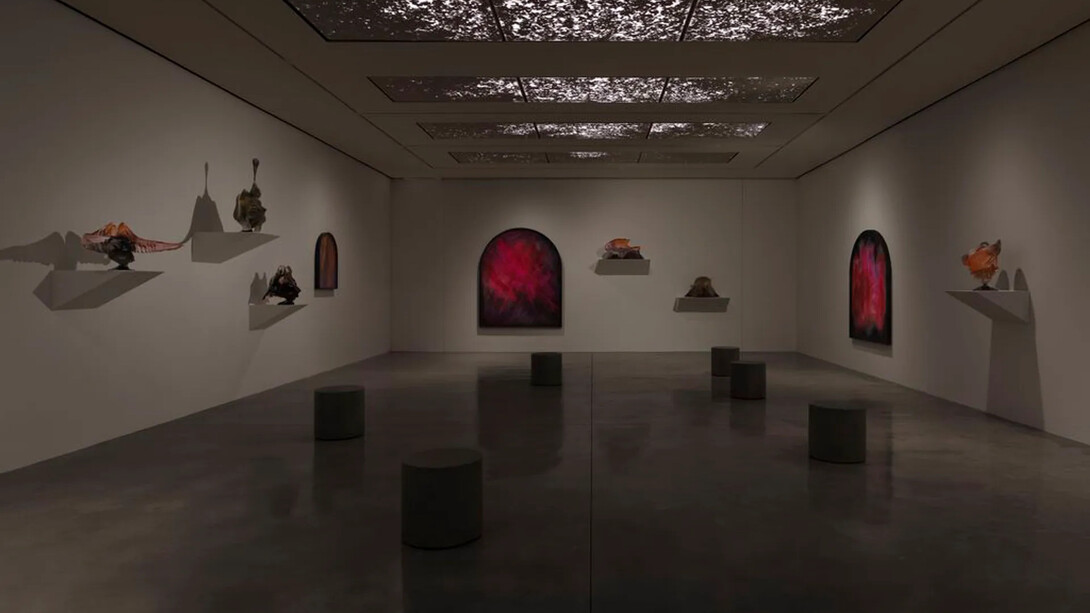
It is not really about creating sculptures, it’s about creating life. These works have something that feels almost liquid. They’re alive, dead or somewhere in-between, but they all have a soul.
(Marguerite Humeau)
Sparked by her visit to a cave in West Papua and the lifeforms she encountered there, Marguerite Humeau has created a new body of work that draws upon her research into the intricate ecosystems of caves and their inhabitants. Taking the cave’s darkness as a metaphor for transition, flux and uncertainty, the artist was also inspired by John Koenig’s The dictionary of obscure sorrows, a semantic experiment that attempts to define complex emotions not yet available to the English language. For Humeau, the labyrinthine cave came to parallel a ‘simulation of uncertainty with a clear exit’ architecturally but, equally, fostered an understanding that darkness and indeterminacy are conditions capable of instantiating ‘new forms of cooperation – from voids to be conquered to teachers of collective survival’.
The exhibition title ‘scintille’ derives from the Latin scintilla – meaning a spark or small flash of fire – which has also come to signify a faint trace or residual hint at the edges of perception or sensation. In Humeau’s new work, this idea is at once physical and ephemeral; further to the glowing eyes of bats and the bright mineral deposits native to the cave, ‘scintille’ evokes the glimmers of understanding that give early shape or name to the unknown. Within the primordial dark of the cave, boundaries between lifeforms appear to dissolve: ‘Everything is part of the same flowing exchange of matter and energy,’ Humeau observes, ‘where life proceeds at its own pace.’ Reflecting this radical dissolution of individual and entity she experienced in the West Papua cave, ‘scintille’ presents an immersive, ‘emotional landscape populated with sculptural relationships’, wherein artworks behave as active agents rather than merely discrete objects.
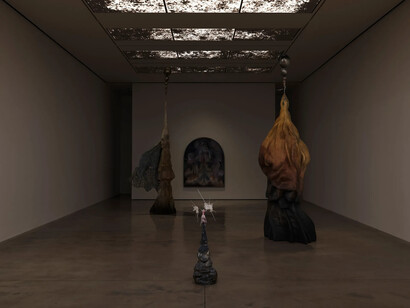
On entry into the cavernous, first-floor gallery, two colossal ‘guardians’ loom at four metres tall in dappled light. Recalling the crystalline structures of stalagmites, the sculptures were formed through repeated layering, pigmenting and lacquering, and their surfaces reveal strata of colour and texture that suggest the gradual accumulation of sediment over time. The strange, almost alien Softament (The guardian of mineral memory) (2025) appears to emerge from the ground, twisting upwards into sinuous swells and folds; at its tip, delicate glass orbs gather like so many water droplets carrying the minerals that render ever-growing stalagmite forms. Taking cues from Koenig’s Dictionary, the artist has titled the work after one of her own neologisms, Softament, a word devised to invoke ‘the accumulation of tiny, repeated acts of faith that eventually create monuments. A change that comes from persistence, that is not grand, but is geological, slow, patient, almost invisible.’ The neologism of its counterpart, Stillenary (The guardian of the emergence) (2025), meanwhile, refers to ‘the paradox of creating movement through perfect stillness.’
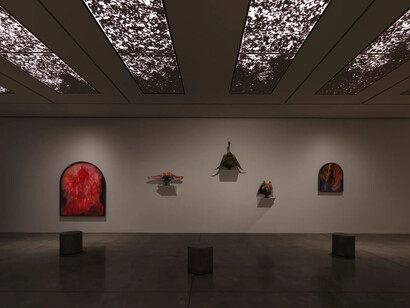
The upstairs gallery Humeau has dedicated to the key animal protagonist of the cave: the bat. During her extensive research into the creature’s behaviour and social organisation, the artist was astounded to discover familiar acts of care – living in dense groups, bat colonies thrive through the assignment of individual roles related to reproduction, food and maintenance of the roost. These dynamics inform Humeau’s cast-glass sculptures, many of which show bats fusing with one another or the cave walls, their bodies becoming indistinguishable from the environment that sustains them. Each sculpture is titled with the role a bat may play within the group, foregrounding the creatures’ reliance on collective responsibility. The provider beyond bloodlines (2025), for example, provides milk to a gaggle of hungry pups, who nestle deep into her wings. Elsewhere, a small bat perched on the nose of The retriever of the fallen pup (2025) visualises a specific, protective impulse: ‘the inability to watch anything small fall without launching yourself into the void after it’. Together, these sculptures stage scenes of interconnection that exceed the boundaried individual, to instead speak of co-dependencies – of ecological, social and emotional entanglements.
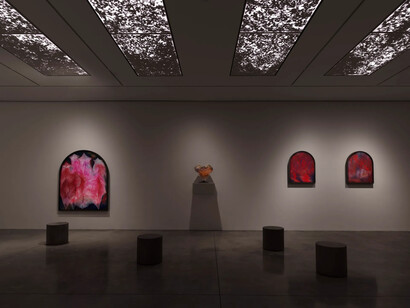
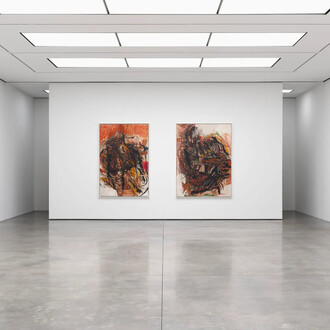
Interspersed among Humeau’s sculptures are 12 works on paper in pigment and charcoal. Rendered on supports that echo the shape of arched cave mouths, they function as portals into other chambers and arteries of the cave. These drawings mirror the accretive process by which the guardian sculptures are made; they are built up through layers until, finally, lucent, billowing forms emerge, as if ‘from clouds of dust’. Conceived by Humeau to embody ‘a newly emerging emotion’, each drawing takes one of the artist’s coined words and definitions as its title. In Vasculeth (2025), vein-like linework blooms across the surface, lending image to ‘the quiet conviction that slow circulation creates growth, water moving through stone like a hidden lifeblood, a becoming...’. A similar tracery appears in Noctilumen (2025), itself a manifest scintilla picked out in neon pink against a void-like ground: ‘the radiance of thin roots lit by microbial films, fragile strands glowing in absolute dark, a refusal to disappear, a brightness that exists only because darkness sharpens it.’
In times as uncertain as ours, Humeau proposes the cave as both a site of exchange and a venue of encounter, one in which the individual is recontextualised within a wider logic of co-existence. ‘It is not really about creating sculptures’, Humeau explains, ‘it’s about creating life. These works have something that feels almost liquid. They’re alive, dead or somewhere in-between, but they all have a soul.’ In composing an ‘emotional landscape’ that engages a new poetics of perceiving, inhabiting and enduring uncertainty, ‘scintille’ calls upon non-human guides to orient us in our navigation of the future. Here, amorphous darkness and the unknown are not emissaries of fear but rather invitations to speculate upon alternative ways to care for each other and cultivate shared resilience. As Humeau insists, ‘the ultimate care is the merging of the self with the environment, so that you’re not an entity anymore, you’re a part of the whole.’