English
 Español
 Français
 Deutsch
 Italiano
 Português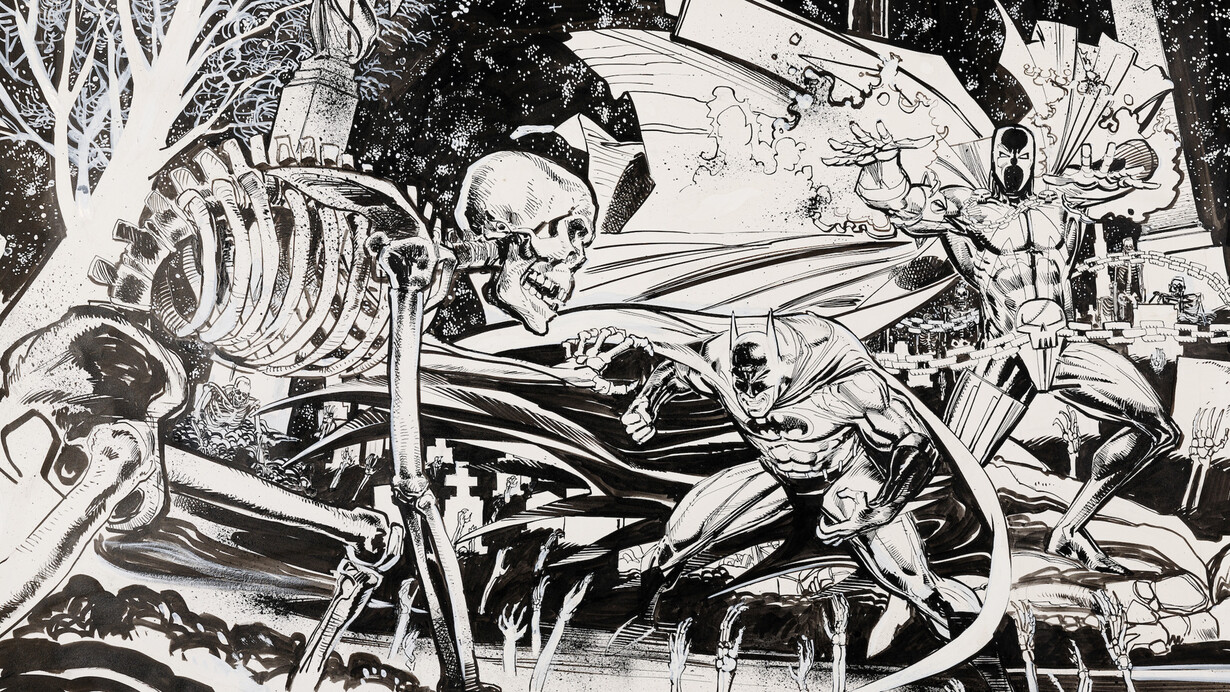
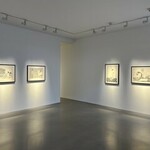
Philippe Labaune Gallery is pleased to present Klaus Janson, one of the most influential figures in American comic art and a defining force in the medium for more than five decades. Through his deep engagement with penciling, inking, coloring, and writing, Janson has developed a comprehensive understanding of visual storytelling, from conception to execution, and from the mind of the creator to the eyes of the audience. Moving fluidly among these disciplines, he observes, “Everything on a page is connected to everything else. No decisions are arbitrary. Everything is conscious and deliberate.”
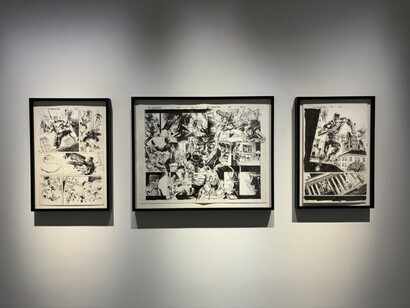
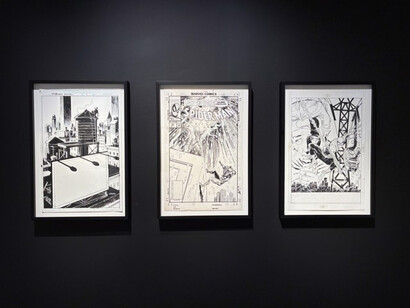
Though his career encompasses a wide range of responsibilities, it was through inking that Janson first established both his livelihood and his artistic identity. The role of the inker is central to how a comic reads and feels; it is the ink line, not the pencils, that is ultimately reproduced. The goals of inking overlap directly with those of penciling, clarity, depth, rhythm, drama, and continuity are interwoven between the two disciplines. As Janson explains, “The reader should never have to decide what the story is. That’s the job of the storyteller. ” Each line, shadow, and compositional decision, when deliberate and thoughtful, guides the reader’s eye across the page and toward the focal point of each panel. Together, penciling and inking work toward a unified purpose: to produce an understandable, emotionally resonant, and compelling narrative.
Working with both traditional and digital tools, what distinguishes Janson’s practice is not only technical mastery, but an exceptional ability to collaborate with artists of widely varying stylistic approaches, including Frank Miller, John Romita Jr., John and Sal Buscema, Dick Giordano, Bill Sienkiewicz, Gil Kane, and Gene Colan, among others. Janson approaches each collaboration by carefully studying the pencils before applying ink. “I try to figure out what the intent of the penciler is, what he wants, and then I try to figure out what they actually need to get there. ” This capacity to intervene without overpowering, to clarify while preserving the individuality of the original drawing, defines his approach and underscores his sensitivity as a Collaborator.
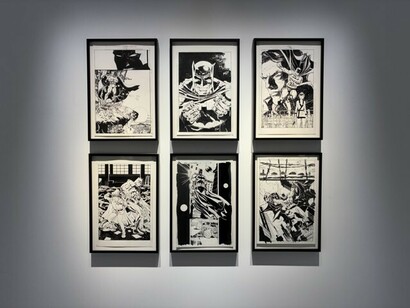
In addition to his work as an inker, Janson has penciled stories written by some of the most significant voices in contemporary comics. Collaborations with writers such as Alan Moore, Grant Morrison, Greg Rucka, Denny O’Neil, Matt Kindt, and Brian Michael Bendis have resulted in projects that continue to occupy shelf space in comic book shops decades after their publication. His partnership with Frank Miller on Daredevil remains one of the most consequential collaborations in comics history. Their process was rooted in sustained dialogue and marked by mutual trust and confidence. “One thing that’s missing in comics today is the ability to sit and talk face to face, learning from each other,” Janson reflects. “Frank and I would often discuss and review what we were doing on our work together.” That exchange, technical, conversational, and iterative, helped define the visual language of a generation.
Central to Janson’s philosophy is the belief that stories must carry emotional weight. Influenced by impressionism and expressionism, he seeks to embed feeling into every element of a page. “I try to reveal some information in a visual way that is not in the text. The stories that interest me all share a common theme: family, relationships, and choices.” This approach gives his work its distinctive resonance, imbuing objects, environments, and figures with meaning that suggests psychological and emotional depth beyond the written narrative.
Equally significant is Janson’s role as an educator. Through decades of teaching and mentorship, he has shaped generations of storytellers, emphasizing not only the technical foundations of the medium, but also the personal discipline and qualities required to sustain a life of creativity. “I didn’t realize until I stood in front of a classroom how much I didn’t know. There’s no doubt that teaching made me a better artist.”
Through this survey, Klaus Janson emerges as a singular figure whose adaptability, sensitivity, and understanding have permanently expanded what comics can achieve. His ability to work across the varied responsibilities of penciling, inking, coloring, writing, and teaching demonstrates the depth and range of his contributions to the medium and underscores why this exhibition is so significant. This survey holds particular meaning for Janson, who regards it not as a retrospective gesture, but as a moment of acknowledgment of sustained effort and persistence. “I don’t approach this casually,” he reflects. “Having an exhibit is acknowledging that effort, and I appreciate that very much.” The exhibition celebrates a life in comics, offering a rare and considered perspective on the medium, and honoring an artist whose work has defined the visual and emotional language of American comics for generations.